

Today’s offering is from Beatrix Kondo. Kondo is a Brazilian journalist and cultural critic with over 20 years of covering pop culture and sociocultural analysis for international outlets. She focuses on feminist readings of genre fiction, trauma-coded narratives, and how beauty, danger, and survival keep rewriting each other in contemporary media. Visit her at beatrixkondo.com.
The Goodreads comments section for Margaret Atwood’s “My Evil Mother” reads like a collective cry of frustration: but was she actually a witch?
Readers finish the story and immediately redirect their attention to the metaphysics—were the broken ankles and inexplicable promotions real? Was the tea anything other than just tea? The question “was she really a witch?” arrives with such insistence that it manages to exit the text entirely, bypassing everything Atwood spent 32 pages constructing with considerable precision.
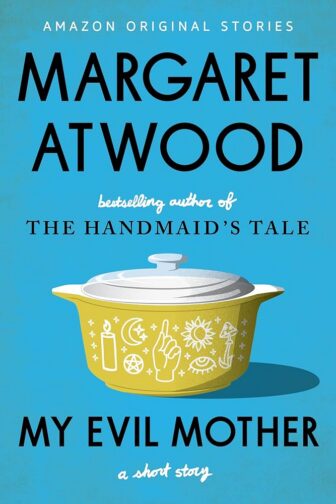
Cover to Margaret Atwood’s “My Evil Mother” [Amazon]
The story, originally published as an Amazon Original in 2022 and later collected in Old Babes in the Wood (2023), follows a narrator from her 1950s childhood through adult motherhood, tracing her relationship with a mother who operates outside every legible script for femininity in postwar America. No husband. No conventional employment. Desperate women arriving at the kitchen table seeking remedies no official system provides. Blue dishes to deflect malicious attention from food. Hair burned from the brush so no one can use it against you.
“Respect Is Better Than Like”
The mother articulates her philosophy plainly and early: “They may not like me, but they respect me. Respect is better than like.” For a woman navigating the 1950s—what historian Elaine Tyler May famously termed the era of “domestic containment,” when suburban conformity functioned as a Cold War political instrument and unwed mothers without legible income were categorically aberrant—choosing to be feared rather than accepted carried a weight the story never lets you forget. The neighbors deliver their verdict in whispers: “No man in the house, so what can you expect?” Masculine absence, in that grammar, explains everything deemed wrong with that woman, that child, that household.
What the mother constructs around herself has a longer historical genealogy than the story’s contemporary setting might suggest. Across early modern Britain and Europe, cunning women—known variously as wise women, healers, pellars, and bean feasa in Ireland—occupied precisely this role: providers of services that physicians, priests, and husbands refused or were unequipped to offer. The practices that inspired accusations of witchcraft were often simply the accumulated pharmacological and psychological expertise of women who had been tending to the health of families and communities for decades, knowledge transmitted through generations precisely because no official institution would legitimize it. The mother in Atwood’s story fits this lineage with unsettling exactness:
“Sometimes women in distress—they were always women—would come over to our house, and she would make them a cup of something that might have been tea, sit them at the kitchen table, and listen, scanning their faces, nodding silently.”
Money changes hands. The daughter suspects this constitutes income alongside whatever other mysterious means sustain them. The mother provides what patriarchal structures withhold: attention, herbal remedies, protective rituals, intervention through channels that the powerful are content to dismiss as superstition. Whether she draws on genuine magic or exceptional human perception, the women who seek her leave helped. The mechanism is secondary to the result—which is, of course, the only thing that ever mattered to them.
The Daughter Who Inherits What She Rejects
The narrator spends considerable energy attempting to compensate for her mother’s strangeness, performing normalcy with the desperation of someone who understands exactly how marked she already is. She wants boyfriends, legibility, distance from the maternal weirdness that made her childhood an exercise in managed embarrassment. What she discovers, years later, is that the inheritance had already taken hold regardless:
“It seemed I wasn’t very good at warm, close relationships at that time. My boyfriends didn’t last, even when they weren’t nixed by my mother. I’d developed a habit of discarding them before they could do the same to me.”
The witchcraft was transmitted as emotional architecture. She received armor rather than tenderness, suspicion rather than sentimentality, the instinct to strike before being struck. She spent decades reading this as damage before circumstances forced her to recognize it as education—the specific curriculum of a woman who already knew what the world would require of her daughter and taught accordingly.
This is where “My Evil Mother” does something genuinely uncomfortable. The maternal behavior that reads as invasive, frightening, and impossible to square with conventional frameworks of good mothering operated from a logic the daughter could only access through her own accumulated experience of a world that turned out to be exactly as hostile as her mother had warned. The strange protections make sense once you understand what they were protecting against.
The 1950s Made Her Monstrous

Tupperware advertisement featuring a Joe Steinmetz photograph, ca. 1958 [Florida Memory Project, public domain]
Context, here, carries the weight of argument. The mother operates during what Betty Friedan would diagnose, just a few years later in The Feminine Mystique (1963), as a mass cultural project of feminine containment—the postwar insistence that women who had worked, organized, and maintained households alone during wartime should now retreat gratefully into suburban domesticity and define themselves exclusively through husbands and children. The mother refuses every dimension of this project. She remains unmarried, economically autonomous through means that resist classification, feared rather than loved, mysterious rather than transparent.
Her “evil” emerges entirely from this refusal. She becomes a witch not through supernatural endowment but through the deliberate construction of an identity outside patriarchal legibility—and in doing so, she makes herself a target and a resource simultaneously, the woman the neighbors whisper about and the woman other women seek out when the official world has nothing left to offer them.
“Never Let Anyone See You Cry”
Atwood constructs the ending with a restraint that is itself a kind of argument. The adult daughter finds herself using her mother’s techniques with her own children—not all of them, not identically, but the transmission has occurred despite decades spent fleeing from it. The voice that surfaces years later, embedded so deeply it arrives as instinct:
“Never let anyone see you cry.”
This is the inheritance. Armor, suspicion, the strategic management of vulnerability in a world that treats women’s distress as invitation. The daughter receives it, resists it, and eventually deploys it forward—lived experience confirmed what her mother already knew, and that confirmation left no room for refusal.
Atwood refuses romanticism throughout. The mother remains genuinely complicated: invasive, occasionally alarming, capable of arriving at a maternity ward with orange ointment for stretch marks and plans to cook the placenta. She functions as neither misunderstood heroine nor cautionary tale, which is precisely what gives the story its staying power. She was a woman surviving alone during an era that punished such survival with social ostracism, raising her daughter without an approved script, using whatever she possessed to protect what mattered.
The witchcraft is that: an assemblage of knowledge, practice, and ritual that women transmit to other women when the structures around them offer only contempt and vulnerability. It can involve herbs, intuition, and the careful cultivation of a reputation dangerous enough to afford some protection. It can involve knowing when to disappear, when to strike, when to make yourself legible as a threat rather than a target.
The Witch Who Changes Form
Contemporary reclamations of “witch” as feminist identity tend toward celebration, which Atwood declines. What she offers instead is something harder and more useful: recognition that these practices functioned as survival apparatus for populations the official world systematically refused to protect, and that the knowledge embedded in them carries real stakes regardless of its metaphysical status.
The title performs its own argument. “My Evil Mother” activates every cultural anxiety about wicked witches and monstrous maternity, then quietly dismantles the framework that produced those anxieties. The evil mother, it turns out, was simply the mother who refused to be controlled—and who taught her daughter to do the same, through methods that resembled cruelty until you understood the world’s cruelty first.
“The percentage of husbands in our neighborhood who developed coughs or broke their ankles, or who, on the other hand, were promoted at their offices, was probably no higher than elsewhere, but my mother had a way of hinting at her own influence on these events.”
Whether she cursed the algebra teacher or merely cultivated a reputation that made him believe himself cursed produces identical protective results. Whether the tea was tea or something else provided the women at her kitchen table with care they could find nowhere else. The ambiguity is load-bearing: Atwood uses it to insist that the question of metaphysical validity is the least interesting thing you could ask about a woman who built power from the materials the world left available to her.
The witch refuses to die. She changes form, generation to generation, adapting to new contexts while preserving what matters. The daughter is there at the end, speaking with her mother again in cycles, using inherited techniques, transmitting protection forward into the next generation.
This mother made herself dangerous for a reason. Eventually, we understand why.
The Wild Hunt is not responsible for links to external content.
To join a conversation on this post:
Visit our The Wild Hunt subreddit! Point your favorite browser to https://www.reddit.com/r/The_Wild_Hunt_News/, then click “JOIN”. Make sure to click the bell, too, to be notified of new articles posted to our subreddit.