

Warning: this review contains extensive spoilers.
“You’re called Una, the most ancient plant. You defy three, you defy 30, you defy venom, you defy air illness, you defy the horror that stalks the land.”
I realize that it is an odd to start a movie review, but a few weeks back, I happened to be invited to a private old-school Swedish Death Metal concert. Because I live in the shticks and don’t have a car at the moment, I had no choice but bus myself to the city and find a way to kill time until the gig started. This is when I stepped in the local cinema, where, to my surprise, Hamnet, Chloe Zhao’s latest feature, was to be screened.
Up until then, I had only situated the movie in two ways: 1) it seemed to have been very popular among the critics and developed a significant popular following; and 2) the movie incorporates sections from Joseph Hopkins’s Nine Herbs Charm translation. Even though moody (even “cottage-core” coded) period dramas are not normally my jam, for that second reason alone I thought it would be worth giving Hamnet a shot.
How did the movie fare, then? Much, much better than I would ever have expected, and for quite a few reasons, all of them evident from the very first scene of the movie, a scene so well-crafted that I have to discuss it at once.
The film opens on a huge green tree, standing tall and thick on a background of a deep blue sky. The camera tilts downwards, revealing a lush forest. At the base of the tree, the moviegoer’s eye is immediately caught by a deep, jet-black cavernous depression emerging from below the tree’s roots. At the edge of this daunting chasm, tucked within what looks almost like a cocoon, or rather a nest of brown roots, lies bundle of sorts. This almost amorphous pile soon begins to writhe, revealing itself to be the female form of Agnes Hathaway (Jessie Buckley).
Upon waking up, the dark-haired, crimson-clad woman, still laying in the leaves and the dirt, lets her gaze rise towards the heavens and the lustrous canopy. On a branch, not far away, she notices a proud, stout bird of prey and heads towards it at once. A faint smile upon her lips appear as she produces a thick leather glove, dons it, and waits for the bird to swoop down and land on it before feeding him some unidentified meaty morsels.
“She is definitely a witch,” I thought, not even five minutes into the film.
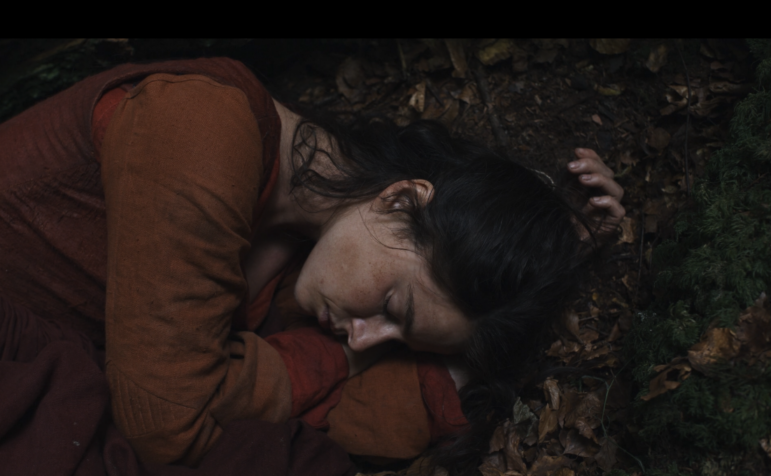
Agnes asleep in her sylvan kingdom (Screen caption. © Focus Features / Universal Pictures)
Agnes, who never as much as wears a single ribbon in her hair, lest a hat, or even a bonnet, is probably the most perfectly, if subtly, witch-coded character I have seen of late. This introduction leaves pretty much nothing be desired. Communing with the forest? Check. (Almost) emerging from chthonic depths? Check. Telepathically communicating with animals? Check.
Bewitching an innocent young lad? As you will see below, check.
In the following scene, Agnes is seen heading back to her home, a rather stately farm surrounded by flowerbeds. There, she meets William Shakespeare (Paul Mescal), her stepbrothers’ new Latin tutor, with whom, despite the family issues it is certain to produce, she quickly falls in love.
The bard, who is very much depicted as some sort of down on his luck vacuous slacker, is here made to represent the audience encountering this mysterious woman for the first time. Like the moviegoer, William Shakespeare immediately senses something different, an exhilarating je ne sais quoi in this free-spirited woman. Indeed, there is no way to overstate how Agnes appears so unlike almost anyone else in this gray and shabby, yet highly aesthetically pleasing, Elizabethan England.
This captivating focus continues in the following scenes: Agnes is shown gathering herbs, making salve out of them and, on several occasions, reciting the Nine herb charms. We also soon learn about her now deceased mother, as she puts it, a “forest-witch” who, one day just emerged from the forest to seduce, mate with, and marry a local farmer. In one of the movie’s earliest flashback scenes, we even see this witch-mother teach Agnes about herb lore. Later, when Shakespeare, the son of a glover, offers her a new falconry mitt he crafted himself, we also learn that it was Agnes’ mother who taught her daughter to communicate with her feathery friends.
“Agnes, wait. I know who you are.”
“Who am I?”
“Well, I… I don’t know you, but I’ve heard things…”
“I’m the daughter of a forest witch?”
“Yes. People say that, but I-I don’t care…”
“I am my mother’s daughter. I’ve learnt many things from her.”
The build-up of Agnes’ witchiness is one of the main threads of the first half of Hamnet, culminating, in my opinion, on two occasions. First, when she gives birth to her second child, and the women assisting her believe it to be dead and heaven-bound, she defiantly declares, “I made a vow the night my mother died. I will go to your church, but I shan’t say a word there.” Then, a couple of scenes later, when she has become the happy mother of three beautiful children, she then leads her family in the highly ritualistic burial of her beloved falcon.
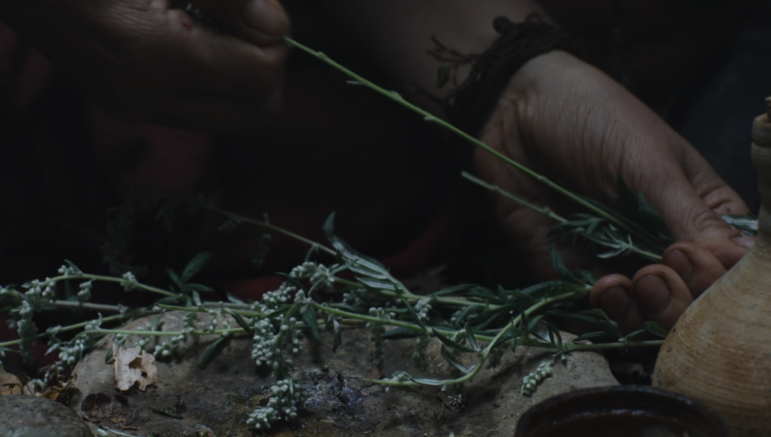
Preparing the Nine herbs charm (Screen caption. © Focus Features / Universal Pictures)
While my gut feeling proved correct, Agnes’ witchiness is far from being her sole defining characteristic. Another aspect of her character the movie leans on throughout its runtime is the interpersonal relationships she develops and cultivates. The first one that is shown on film, and arguably the other main narrative pull of Hamnet, is, of course, her relationship with William Shakespeare.
Tellingly enough, it is with him that Agnes exchanges her first words in the movie (notwithstanding a short one way exchange with her hawk familiar). By the time the pair meet again, the bard, despite having no magical claims of his own, manages to woo her through his lyrical retelling of the pre-Christian Greek tale of Orpheus and Eurydice.
All throughout Hamnet, the love story between William and Agnes manages to retain this earnest, warm, almost courtly dimension and never devolves into baser territory. Admittedly, I feared early in the movie, that this relationship would be shown as nothing but the tale of a dejected, mostly penny-less artist supported by his ever-suffering wife, but it thankfully did not turn out like that. Even during the most uncomfortable moments, Agnes’ agency and perspective remain central in the telling of what fundamentally remains her love and family life. In her depiction of Agnes, Jessie Buckley artfully avoids turning her character into a cliché or the mere recipient of easy to digest tropes.
“We are handfasted, Mother.”
“We will never allow it!”
“There is no sin in it.”
“I’m afraid you will need our consent, and we will…”
“There is no sin in it!”
“…we will never give it, ever!”
“All right! What?”
“You’ve been bewitched.”
“No.”
“I’d rather you went to sea than marry this wench.”
As her and her family’s story goes on, Agnes remains still very much a witch, however. When giving birth to her first child, she does so, you guessed it, in the woods, right by that cavernous hope under the noble old tree shown at the beginning of the movie. When, due to treacherous floods, she is unable to return to what can best described as her den, and has to give birth to her two other children in the Shakespeare’s family’s house. As the scene progresses, Agnes nearly loses her mind, and despite both of her babes surviving the ordeal, her confidence in her abilities, including her magical gifts are shaken to the core.
One such abilities that hasn’t been discussed so far yet remains central in both the heroine’s character and storyline is the gift of second sight. Shortly after tending William’s wounds with her nine herb salve, earlier in the movie, she displays this gift by revealing that she sees within him colorful scenes and vast landscapes.
Obviously, the fascination goes at least a little bit both way in this relationship. Agnes’ power, however, plays a much larger role in her relationship with her kids. Shortly after the birth of her first child, she reveals to William the foreknowledge that two children will surround her on her deathbed. Yet, when she later gives birth for the second time, it is to two babies, one of which, a girl, barely makes it.
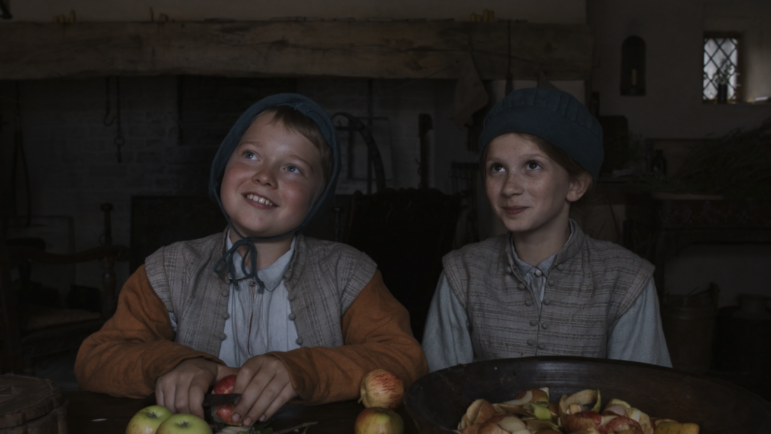
Hamnet and Judith (Screen caption. © Focus Features / Universal Pictures)
Following scenes of domestic bliss introduce the children, Susanna (Bodhi Rae Breathnach), and the twin siblings Judith (Olivia Lynes) and Hamnet (Jacobi Jupe) who all radiate life, love and happiness, a happiness that will sadly soon come to an abrupt end. Beyond the bitter separation with William, seeking glory, coin, and fulfillment in a depressingly dreary London, the ever present deathbed prophecy brings a sense of tension all throughout the otherwise beautiful scenes of a tightly-knit family.
This kind of symbolic sword of Damocles comes crashing down on Agnes’s world when, following an outburst of plague in the capital (an event brilliantly and wordlessly depicted from the point of view of a dazed William), Judith, the child she almost lost once before, falls ill. As her fate seems sealed, her twin brother joins her in her sickbed, in an attempt to take her place and fool Death.
Hamnet’s wish is granted in the following scene. Comes the morning, Judith has recovered, but her brother has lost consciousness. In what is undeniably the rawest and most dreadful part of the movie, we, the audience, stand by Agnes who, totally helpless, does not even have the time to produce a salve for her ailing son, who dies in her arms mere minutes later.
“Your mother’s trying to… keep a grip on her child. It won’t work. What is given may be taken away at any time. We must never let our guard down. Never take for granted… that our children’s hearts beat, that they draw breath, that they walk and speak and… smile, argue, play. Never forget for a moment that they may be gone.”
For all her mystical knowledge, connection with nature, and second sight, Agnes could not save her child. Shattered, she is barely able to welcome back William, who breaks down crying upon discovering that his only son died. With illusions of domestic bliss shattered, the family is pulled further apart, even as her husband reaches financial and critical success. All seem pointless, aimless. How could Agnes ever find any contentment in life after all that happened? Was she wrong to believe in her husband’s dreams? In the powers of magic? Is there anything left to live for but waiting for death?
At this point in the film, some three quarters of the way in, it would be natural for the audience to join the heroine in expecting little but a muted, sorrowful afterwords to what very much looked like it could only have been the emotionally devastating apex of the film.
And yet, not all hope is yet lost.
Agnes and her brother Bartholomew (Joe Alwyn) receive word about the premiere of William’s latest play, a play bearing a name so close to that of their recently departed child that Agnes decides to travel to London to witness it herself.
What unfolds then proves to be nothing short of magical.
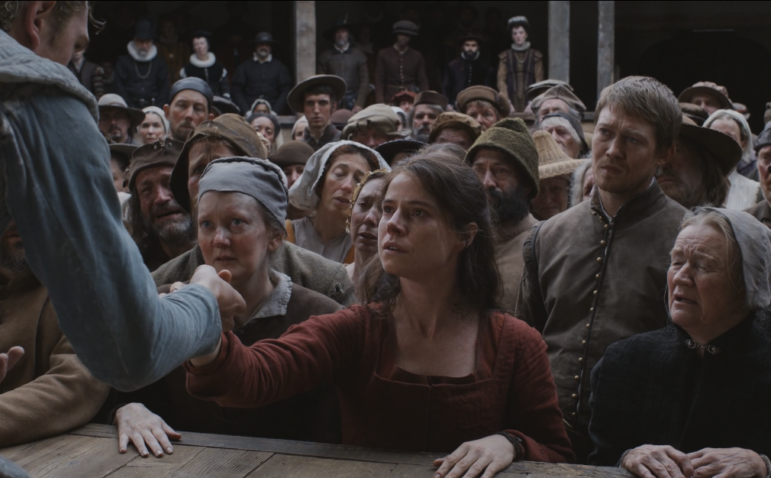
Agnes extends her arm towards Hamlet (Screen caption. © Focus Features / Universal Pictures)
William might not have been born with the same gifts as Agnes, but through the power of his art, he presents Agnes, and the audience with an eerie, ritualistic display of almost mythical proportions. While the masked musicians on the edge of the scene conjure uncanny melodies, William himself, in the guise of the spectral king, voices his grief in a way he never could put in words in the world below the stage.
Soon after, Hamlet himself appears. Played by a monumental Noah Jupe (the real life older brother of Hamnet’s child actor, a casting decision so becoming and successful it beggars belief), Hamlet takes on the role of Agnes’ missing son in a dramatic crescendo of emotional outpouring which nearly eclipse the recent tragedy she and the audience just went through. So powerful is Hamlet’s performance that, upon performing his death in the final moments of the play, Agnes almost unconsciously, extends her gentle hand to the actor, in a gesture replicated by the entire audience of the theater.
As he falls to his death, uttering the immortal line “The rest is silence,” Agnes, overwhelmed, glimpses for a fleeting moment her son, departing the stage, and this world, scared, but resolute. Agnes finally begins to smile, and even laugh. The ritual that her husband initiated was successful, this intricate spell of his was all that was needed for her to finally let the grief depart from her soul. As the credits roll, the audience is left with a feeling blending melancholy and hope. Even in this bleak, cruel world, magic awaits, oft-times in the most unlikely of places, and if one pours one’s soul to it, each and every one, not just silvan children of forest witches, can find a way to work it.
“What are you writing?”
“Nothing of note.”
“It’s never nothing.”
The Wild Hunt is not responsible for links to external content.
To join a conversation on this post:
Visit our The Wild Hunt subreddit! Point your favorite browser to https://www.reddit.com/r/The_Wild_Hunt_News/, then click “JOIN”. Make sure to click the bell, too, to be notified of new articles posted to our subreddit.