

Back in the early 1990s, when I was studying literature and art history in Rome, I read The Leopard, the lone novel by Giuseppe Tomasi di Lampedusa.
The novel spans the years from 1860 to 1910 and centers on Fabrizio Corbèra, Prince of Salerno, as he watches his world fade and crumble.
The old ways of the Sicilian nobility and the peasants over whom they rule are falling apart in the face of the Risorgimento (“Resurgence”), the social movement that ultimately leads to the unification of the independent Italian states into the Kingdom of Italy.
It wasn’t so much the internal conflicts in historical Italian politics that made an impression on me. Indeed, the book was criticized upon publication as being both too conservative and too liberal.
I felt no sympathy for the decay and destruction of aristocratic rule. I had just finished my teenage years, filled as they were with Motörhead’s “Eat the Rich” and assorted polemics by the Exploited, Subhumans, Dead Kennedys, et al.
Instead, what struck me at the time and stuck with me in the decades since was the overarching feeling of lament at the passing of time and the passing away of a way of life.
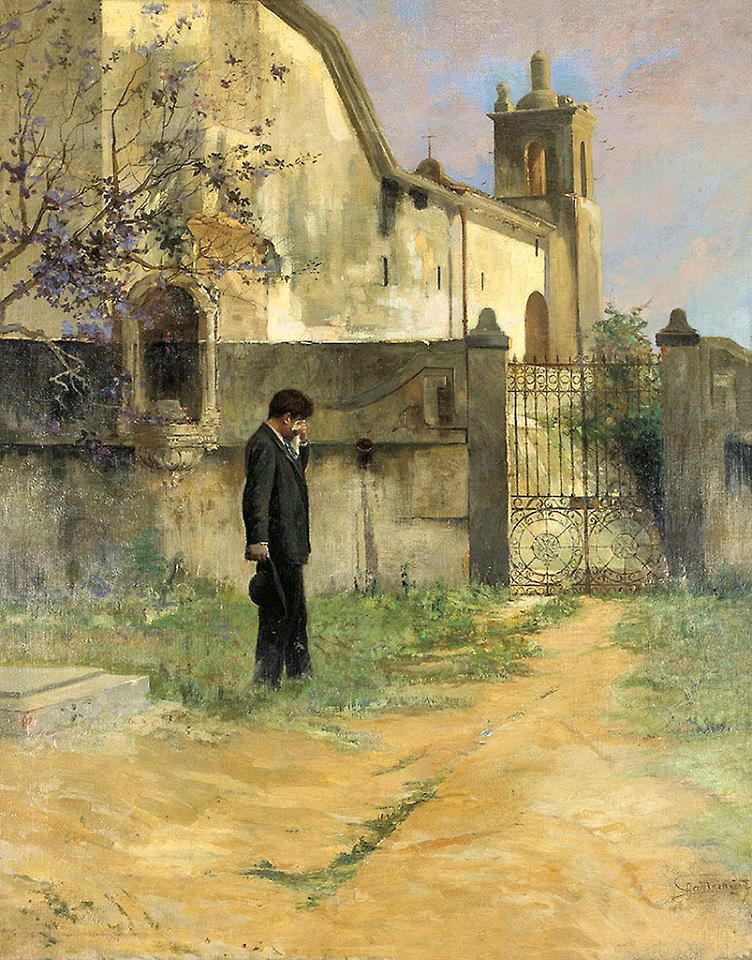
Nostalgia and Longing (1910) by Antônio Parreiras [Public Domain]
Even at that young age, I had an emotional understanding of painful nostalgia and feelings of longing and loss for our own past.
Here I am, over thirty years later, deeply involved in Ásatrú – a new religious movement that looks to a distant past for inspiration and seeks to bring new life to pagan practices from long ago.
Records of Ragnarök
Much of our modern religion is based on materials written down after Christian conversion. The two Icelandic Eddas (Poetic and Prose), the major sources of Norse mythology, date to the 1200s – over 200 years after Iceland’s official conversion to Christianity in the year 1000.
Although they contain some much older elements – as shown through the fields of comparative religion generally and Indo-European studies specifically – the poetic sources that the texts preserve and retell seem to have been largely composed during the age of conversion that culminated in that national renunciation of the old paganism.
A professor of Scandinavian studies once told me that the academic study of Old Norse religion focuses on the age of conversion, because that’s when the sources are from and that’s what the sources cover.
These points above can be argued, of course, but they’re broadly true.
And they help to explain why, within the surviving texts to which we repeatedly turn, there is a heavy emphasis on tales of Ragnarök (“doom of the powers”), the final battle that marks end of the mythology and the death of most of the deities venerated by ancient and modern Pagans.
There are younger gods who will rise after the end of the mythology – as there is a younger religion that has risen after the end of the old paganism – but the age of myth functionally ends with that cataclysmic clash.
Ragnarök seems to loom disproportionately large in the sources because they were composed as the religion was being overwhelmed and written down by the Christian descendants of the pagans such as Snorri Sturluson, an antiquarian whose love for older poetry inspired him to write down the myths to which the old courtly poems regularly alluded.
End of an age
So, nostalgia for the pagan past is already encoded into the written sources that we so often – and perhaps mistakenly – see as authentic records of pagan belief.
This sense of endings that looms over our modern reception of the mythology and colors our imagination of the religion to which it belonged gives a rearward-looking sense to what is already in and of itself a fascination with the past.
I’ve always wondered what it would have been like to have lived through a massive changeover in history. Not to be a mighty hero of glorious tales, but just to be a regular person during a time of historical upheaval, when everything you were raised with is disappearing.
In grade school, we took a field trip to the Art Institute of Chicago. For the little boys obsessed with Dungeons & Dragons, the most exciting part of the collection was the display of medieval and Renaissance armor and arms. The objects that most fascinated us were the bladed weapons that incorporated pistols.
I vividly remember our nerdy little gang acting out imaginary scenes and saying, “Yes, dear sir, I surrender unto thee. Here, I hand thee my dagger as a gesture of submission and… BANG! BANG! BANG! Hahahahaha! My revenge is now complete!”
We had all sorts of very serious discussions about the failure of knightly armor in the face of firearm development.
Part of the reason that this bit of the collection made such an impression on us is that it showed the ultimate end of the D&D era of armor classes in the face of modern military developments. It was an early introduction to the experience of epochal turnover.
The Leopard is about this experience of change, and arguably so are the Norse myths that survive. The novel and the mythology capture this feeling of an era reaching its inevitably melancholy conclusion.
This is a feeling that I now have every day.
Backpack full of books
I’ve been an obsessive book reader and book collector across six decades.
I remember details of scenes from books I read in the 1970s and 1980s. The imagery that played in my imagination back then is still permanently rooted in my mind.
I remember the layouts of the used book shops, book fairs, and comic book stores that I haunted as a kid and teen. I remember exactly where I picked up my first issue of Action Comics, where I found a box of Heavy Metal magazines, what book I found on what table in what tent of the Brandeis Book Sale.
All of the shops are long gone. The tent sale stopped many years ago.
I get it. Businesses come and go. Things evolve. But the world seems fundamentally different now.
The last few times that I’ve flown on an airplane, I was the only passenger reading a book, the only person who had a backpack full of books (in case I finished the first one and the second one and the third one).
It’s not that others were reading eBooks or articles on their phones and tablets. Every single person was watching video of some sort. I felt like some ancient mariner who had wandered out of the past, clutching old sea scrolls and cuneiform tablets.
I’m not just imagining it.
Between 2003 and 2023, daily reading (aside from school and work requirements) in the United States plummeted by 40%.
Mass market paperbacks – those wonderful novels that nearly fit in your pocket and that formed the bulk of the books I read for decades – are over.
Sales of eBooks have declined, and the supposed resurgence of print is a questionable media narrative.
Drowning in slop
AI-composed books are surely on the way, and AI-generated movies and TV are already in development. I have zero interest in any of this. If no one can be bothered to create them, why should I be bothered to read or watch them?
As a professional musician, it’s depressing to watch the surge in AI music overtaking music made by humans. There’s more slop on the way.
I’ve been playing bass for 40 years and still get hyped to hear Geezer Butler, Bob Daisley, Gary Thain, and all the great players. I have absolutely no interest in hearing an AI performer.
So much of what used to be the fabric of daily life has faded away or is in serious decline – radio, newspapers, magazines, physical music media, phone conversations, professionalism in public leadership, democracy.
And on and on and on.
In various history courses, I learned that centuries aren’t clear demarcations of era. Historical change doesn’t fit so neatly into our human constructs of time measurement. Eras tend to spill over.
Two and a half decades into the 21st century, I think we’re finally seeing the last twilight of the 20th century and the dawn of a new period.
Change happens. That’s just the nature of reality.
Our kids will grow up with the new paradigms and accept them as normal.
But it’s difficult for white-bearded wizards like me.
The kids are alright
I’m not going to drown in nostalgia like an elderly Sicilian prince. I embrace positive change. I welcome it and celebrate it.
So many things are better for so many people than they were in the past decades of my lifetime. This is necessary and good.
I self-identify as a progressive. I believe in progress. I believe in working to make the world a better place for everyone, a place that celebrates diversity, equity, and inclusion. Will I get a visit from ICE for mentioning these words?
Enough of the good stuff about the old ways continues, much of it in improved form.
Our local junior high has an active Dungeons & Dragons club, but – absolutely unlike when I was a Stranger Things sort of kid playing D&D in basements in the 1980s – it has entire parties full of girls looking to fight monsters.
The majority of the comic book shops I patronized across 30 years were run by weird dudes who treated kids terribly and didn’t mind putting extremely violent and sexual comics side-by-side with kiddie books. Now, I can recommend multiple comics stores in the Chicago area with friendly staff and books organized by age appropriateness. While my folks were probably right about the seediness of the shops I went to, these new places host fun activities for kids.
I’ve also heard wondrous tales of kids racing each other at libraries to grab the latest graphic novels, to sign up for summer book club, and to fill their arms from the piles of recommended new books for various age groups. Librarians are the secret heroes of the nation.
Maybe these kids can turn back the drift away from reading and show the old folks something.
Odin’s teachings
I’m also not going to give up hope that we can stop the negative change from taking root. Catastrophic restructuring isn’t inevitable, despite how much it may seem so when doomscrolling the night away.
Yes, we’re definitely seeing a descent into violent nationalistic fascism after ninety years of “it can’t happen here.”
No, the final victory of repressive forces isn’t a foregone conclusion.
I’m exhausted by the so-called moderate centrists who insist that the only way to beat the fascists is by voting for right-of-center Democrats who adopt Republican talking points and turn on vilified minorities.
If we all decide together to vote for the unpurchased, non-corporate, progressive candidate, they will win.
If we all decide together that we will rein in an out-of-control federal government by sustained, constant, unrelenting nonviolent shutdowns of official buildings, we can stop the outrages.
If we all decide together to follow the model of de-Nazification in postwar Germany, we can push through the de-Epsteinization of our own political, educational, cultural, technological, and business elite.
But this would mean waking up from our technologically induced slumber and actually doing stuff.
For those of us who declare our adherence to the teachings of Odin, to the idea that “we are our deeds,” and to the ideal that evil must be called evil and strongly stood against, isn’t taking action for the good of the community our highest calling?
Sleepwalking into Ragnarök
Many years ago, I spent some hours listening to the life experiences of a woman I thought of as the Lois Lane of Peoria.
She had worked her way up from cub reporter to editor-in-chief of the newspaper there, and she told me about the famous Illinois city earning a 1940s Life magazine cover story as the most corrupt city in the United States.
Peoria’s central location had led to it being the truce town and party city for the various mobs of all the big Midwestern cities. City hall was literally surrounded by bars, gambling joints, and whorehouses.
When the magazine was shipped to American soldiers fighting the Axis powers overseas, the Peoria boys were mercilessly razzed by their comrades as coming from a mob playground.
When they came back home after the war, the Peoria veterans got together, ran as cleanup candidates, won the elections, and turned the city around.
Imagine that. We actually can be the change.
Do we have the chutzpah, the pep, and the moxie to do what they did?
Do we have the energy to actually do what needs to be done?
Or will we just sleepwalk into Ragnarök?
The Wild Hunt is not responsible for links to external content.
To join a conversation on this post:
Visit our The Wild Hunt subreddit! Point your favorite browser to https://www.reddit.com/r/The_Wild_Hunt_News/, then click “JOIN”. Make sure to click the bell, too, to be notified of new articles posted to our subreddit.