
TØNSBERG, Norway — It sounds like a scene from high fantasy novels: the adventurer brushes aside a thin layer of earth and suddenly glimpses gold. “A ring! Is it magical?”
For archaeologist Linda Åsheim, the moment was less theatrical but no less electric as she described in a statement. Excavating just a few inches beneath the surface in the heart of Norway’s oldest town, she paused, stared, and her first thought: “Shit, is that gold?”
It was.
The discovery, announced in December by the Norwegian Institute for Cultural Heritage Research (NIKU), is a finely crafted medieval gold ring set with a deep blue stone. Unearthed roughly seven centimeters below the surface near the intersection of Storgaten and Prestegaten in central Tønsberg, the ring lay within a cultivation layer in an area long protected as part of the medieval city. A spruce twig from the layer above has been radiocarbon dated to between 1167 and 1269, placing the ring securely within the High Middle Ages.
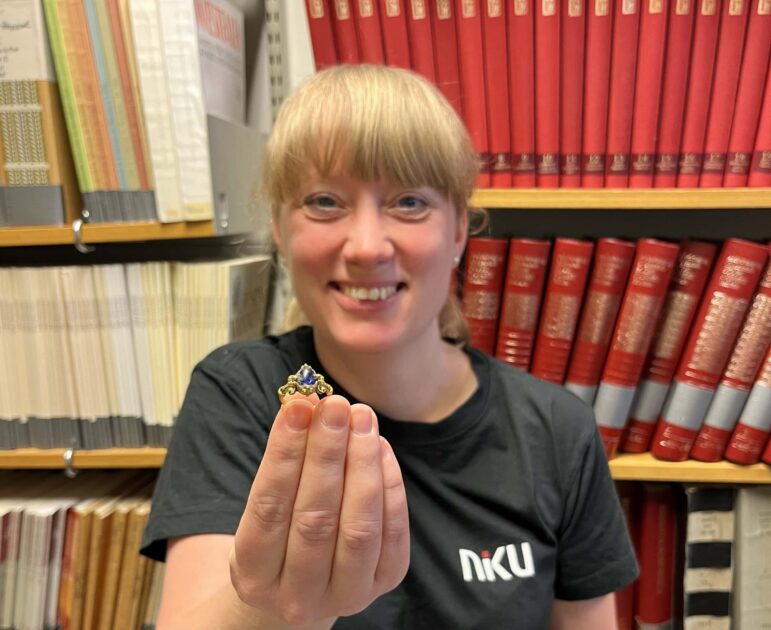
Åsheim and the ring. image via NIKU Photo: Johanne Torheim, NIKU.
Project leader Hanne Ekstrøm Jordahl described the find as both rare and exquisite. It has been fifteen years since a gold ring was last found in Tønsberg. Nationally, only 220 gold rings are registered in Norway’s artifact database, and just 63 of those date to the medieval period.
Åsheim has worked on major projects in Oslo and Tønsberg since 2015. Nevertheless, she described herself as shaking when she realized what she had uncovered. For an archaeologist accustomed to fragments of pottery, nails, and soil stains, the sudden gleam of worked gold was extraordinary.
Three Rings
The ring is small, estimated at size 50–55 (US size 5 to 7.25), and likely belonged to a woman of high social standing. Its band is adorned with delicate filigree, a technique that uses thin gold wires twisted, bent, and soldered into intricate patterns. Spirals crown the upper portion of the shank, each embellished with tiny gold granules. The craftsmanship reflects artistic traditions that reached Norway in the early medieval period from the Byzantine world, sometimes through Carolingian goldsmithing networks.
Marianne Vedeler, professor at the Museum of Cultural History at the University of Oslo, notes that the spiral motifs resemble rings dated to the 900s and early 1000s in both present-day Norway and England. Two similar rings with inset stones and granulation have been found in Roskilde, Denmark. While no exact parallel exists, stylistic comparisons confirm the Tønsberg ring’s medieval origin.
The blue stone, oval and set prominently, is likely glass colored to resemble sapphire. Medieval artisans could produce such hues by adding cobalt to molten glass. Though the gem may not be a true sapphire, its color was anything but incidental.
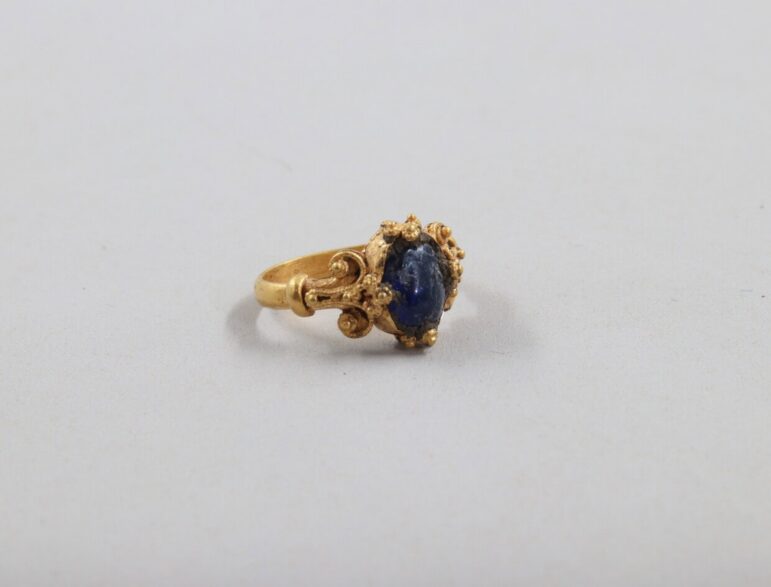
The ring, moments after discovery. Via NIKU Photo: Linda Åsheim,
Blue with Spritual Power
In the medieval jewel craft, gemstones were not merely decorative; they were potent reservoirs of spiritual and medicinal power. According to scholarship by Vedeler and Røstad, blue sapphires symbolized divine force. They were believed to heal boils and infections, preserve chastity, and cool what texts described as “inner heat,” a concept tied to both bodily imbalance and uncontrolled passion.
The ring from Tønsberg may therefore have functioned as more than an ornament. Even if its stone was glass rather than a precious gem, its color would have evoked sapphire’s magical properties. The manifested inherited lore imbued the object with power.
Cooling “inner heat” carried layered meanings. In humoral medicine, excess heat could produce illness or inflammation. Spiritually, inner heat might signify lust, anger, or moral disorder. A blue stone, luminous against gold, offered visible reassurance: divine calm, chastity safeguarded, the body and soul tempered.
The ring’s circular form added another dimension. The unbroken circle symbolized protection and eternity. In medieval Scandinavia, rings could represent binding oaths, marital fidelity, and alliances. Scholars have also noted the circle’s apotropaic function: its power to ward off evil. Worn on the body, the ring formed a literal and symbolic boundary between the self and harm.
Combined, gold, circle, and sapphire-blue created a compact theology of healing and guardianship. Gold signified wealth and status, but also incorruptibility. The blue stone signaled divine favor and bodily well-being. The circle is enclosed and protected.
Life in Tønsberg
Tønsberg was no provincial backwater. Situated beneath the formidable royal fortress of Tunsberghus at Slottsfjellet, the city was a significant medieval center visited by kings and clergy. The excavation area has revealed houses, streets, defensive structures, and even a burned building with preserved roof elements. The ring’s owner likely moved within elite circles—perhaps connected to the royal court or ecclesiastical networks.
Åsheim says she will carry the memory of that flash of blue and gold in the soil into future excavations. But how the ring came to rest just below the soil remains unknown. It may have slipped from a finger during daily life, lost amid trade, prayer, or domestic work. For its owner, the loss would have meant more than the disappearance of valuable metal. It may have meant the sudden absence of a protective charm, losing the power to steady the body, cool passions, and align the wearer with divine order. The ring reminds us how spirituality was not abstract but immanent. Faith and healing were worn on the hand, set in gold, and trusted to shape destiny. Hopefully, though, this ring does not have “a will of its own.”
The Wild Hunt is not responsible for links to external content.
To join a conversation on this post:
Visit our The Wild Hunt subreddit! Point your favorite browser to https://www.reddit.com/r/The_Wild_Hunt_News/, then click “JOIN”. Make sure to click the bell, too, to be notified of new articles posted to our subreddit.