

NEW YORK – I left New York City a year ago, and it’s given me time to properly appreciate the embarrassment of riches the city offers with respect to visual art. Not only can one see multiple great exhibitions in a day, most of the galleries are free and open to the public. Without museum admission, I saw the work of several great artists in a single say, beginning with a Celia Paul show at Gladstone Gallery, for which my husband had insisted we take the train in from hours away. But as we looked at the map to see what else was on offer, I was delighted to find a show called “Shape of Dreams,” featuring sculptures and a tarot deck from the 20th century British-Mexican surrealist Leonora Carrington.
Known primarily as a painter, Carrington’s work diverges from that of most of her contemporaries in that it concerns itself with myth and magic rather than the Freudian psychology that was all the rage of her era. Following a period of involuntary psychiatric confinement and treatment for psychosis, Carrington was determined to explore her own sexuality and dream images. She moved to Mexico and got into a relationship with fellow painter Remedios Varo. Together, the two immersed themselves in the study of the magical and mystical ideas that influenced their respective best-known work: alchemy, Jewish mysticism, and the Mayan mystical writings known as the Popol Vuh.
However, the show that I walked into at L’SPACE Gallery focused on Carrington’s earlier work: a collection of sculptures that emerged from her personal and professional relationship with German artist Max Ernst. The two lived together in France before the second World War, and Carrington concentrated on lost wax bronze figures that represented the fanciful and animalistic figures of her own dreamscape.
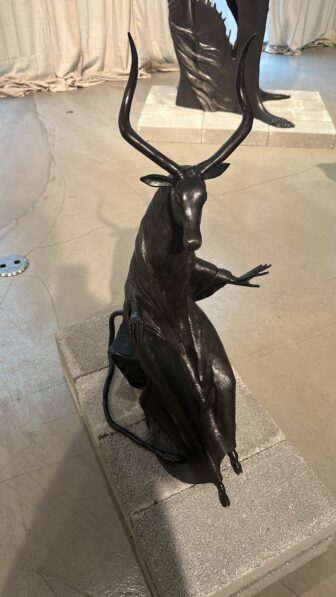
Leonora Carrington, La Inventora del Atole, 2011, Lost wax bronze [M. Elison]
These often take anthropomorphic forms, such as La Hija del Minotauro, which has the graceful figure of a woman with the head and horns of a gazelle. There are also animals that become inanimate objects, like the beguiling Cocodrilo, a crocodile shaping itself into a bench that sits dead center of the room and fairly begs to be sat upon.
Each figure in the show seems to invite interaction, with beguiling faces, delicate limbs, and beckoning gestures. I wove between the animals and women, some tall and imposing, some short and elfin, and imagined myself in a dream or a Guillermo del Toro film. There was distinct but indefinable sense of pre-Christian mythology about them, perhaps because many of the pieces appear as human-animal hybrids as seen in Egyptian and Mayan depictions of gods. Others suggest religious gestures, such as the raised hands of The Palmist or the womb-cradling gesture of Catwoman, without the trappings of modesty, with halos more suggestive of a frilled lizard than a saint.
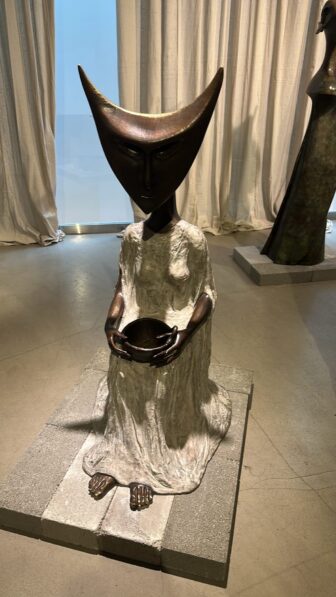
Leonora Carrington, La Inventora del Atole, 2011, Lost wax bronze [M. Elison]
I stood a long time before La Inventora del Atole, a short figure with a head shaped like an upturned crescent moon. I had to look up the word atole: it described a drink made of hot corn and sweetener, almost like thin porridge or gruel. I wondered if it was meant to be a figure of comfort, or suggest a hidden meaning in the brew, as anyone who has stirred a cauldron knows that something simple might contain complex layers of meaning when given from body to body.
Looking In, a flat bronze face, looked out over us all, suggesting moon and sun both, suggesting a face at the window and a knowing visage as glimpsed in a dream. The farther I got from the street, the quieter the other guests of the gallery became. At the far back, there was a hush as we moved around the cold bronze, imagining the dreamer who had shaped them in life.
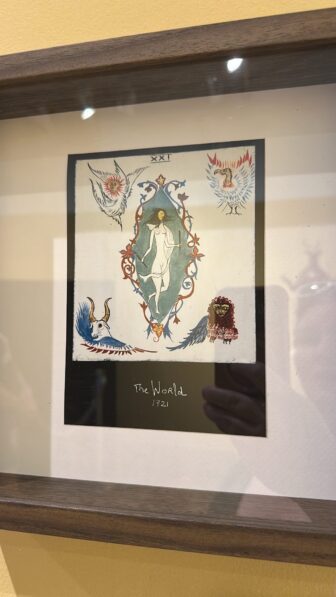
Print of Leonora Carrington’s “The World” tarot card from “Shape of Dreams.” [M. Elison]
“Shape of Dreams” offers art lovers a rare opportunity to see these sculptures in the United States. It is presented in cooperation with the Leonora Carrington Council and the Consigna Gallery of Mexico City. It also offers tarot enthusiasts, Witches, and other practitioners the opportunity to view some of the images incorporated into Carrington’s own tarot deck, completed in 1956. However, the L’SPACE exhibit is not showing the originals of the artist’s depictions of the major arcana, but framed prints along with the deck, which is available for purchase. Disappointingly, the gallery has chosen to include “an interactive Tarot Reading Booth in which visitors encounter Carrington’s voice, reconstructed through AI, delivering intimate readings from the deck she designed.”
I remain an AI skeptic, and believe that there are many uniquely human tasks that should not be trusted to a faulty and unproven machine. Divination requires human communion with the divine and a sense of intuition; two things that a machine in a booth cannot offer. Moreover, remembrance of the dead is best left to those who knew us in life, rather than a cheap necromancer’s puppet show featuring the chopped and rendered voice of a woman who cannot give consent to this trifling resurrection.
Though I saw many wonderful and thought-provoking things at this exhibition, perhaps the best of them was the empty black booth set up for tarot readings. No voice spoke from inside it, and no one queued with interest to enter.
In the main gallery, a beautiful woman in a green dress twirled before Carrington’s tall and enigmatic Catwoman, directing video of her own joy. I can live with that integration of technology into our appreciation of art and our communion with the divine.


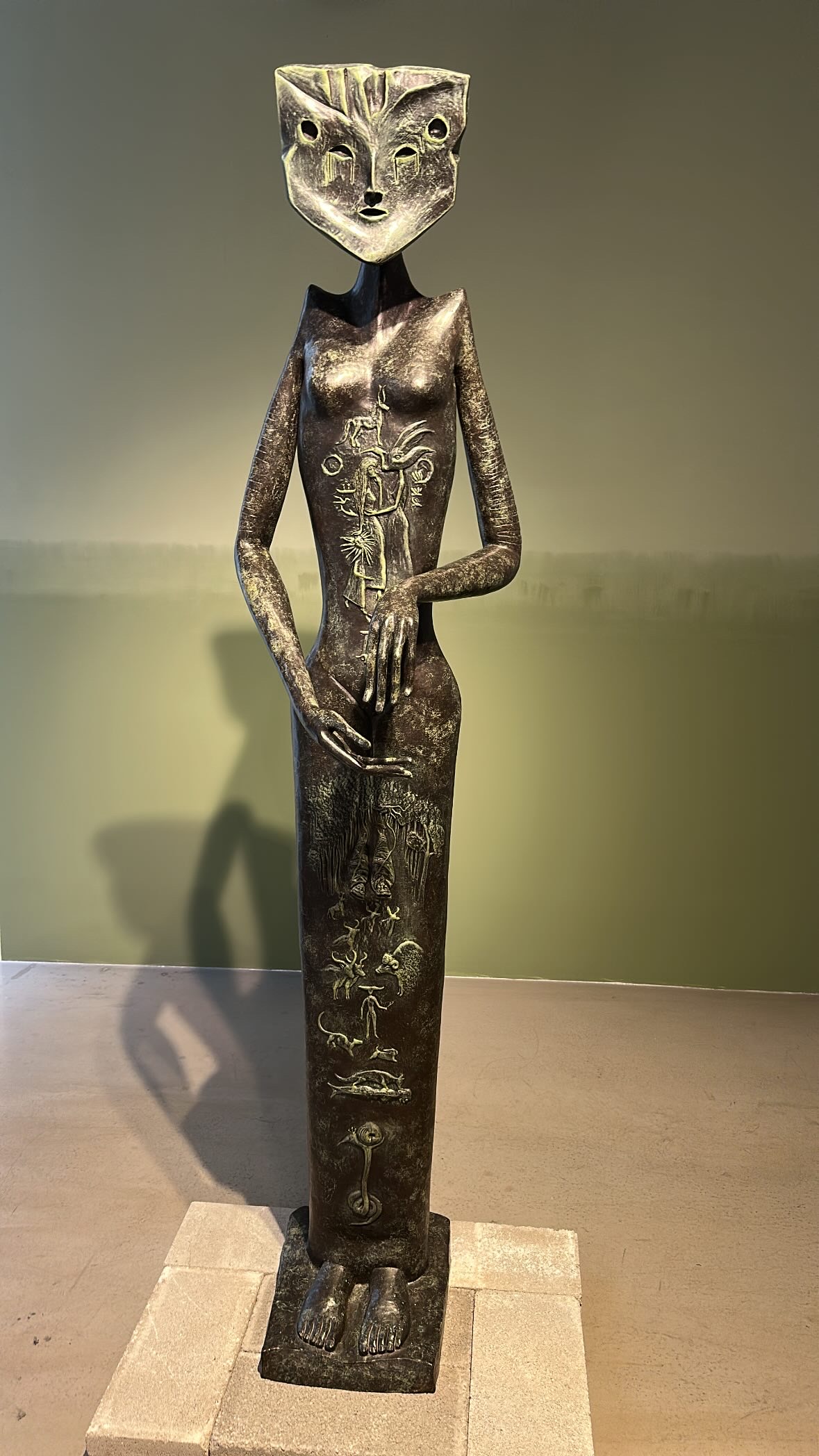
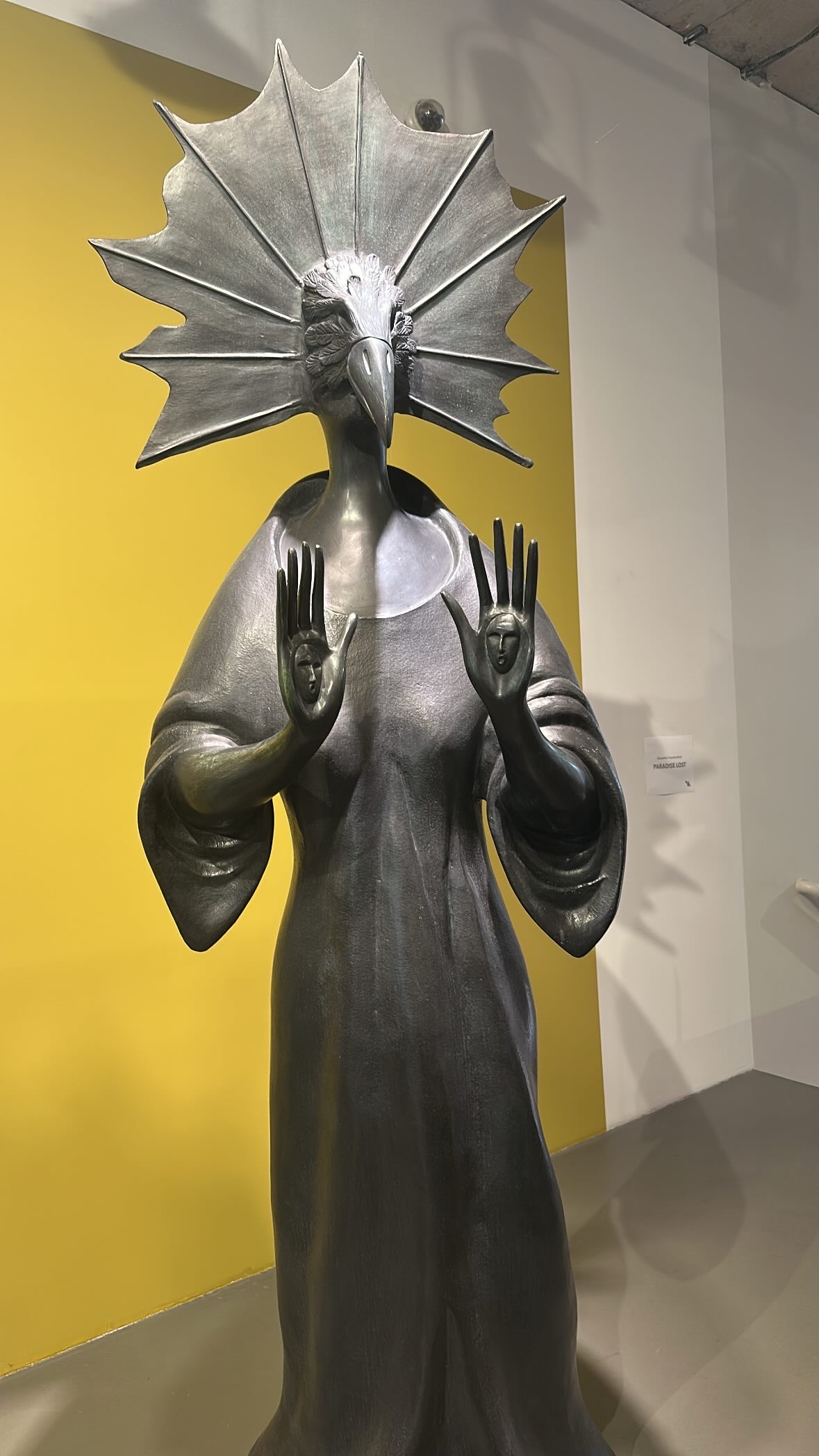
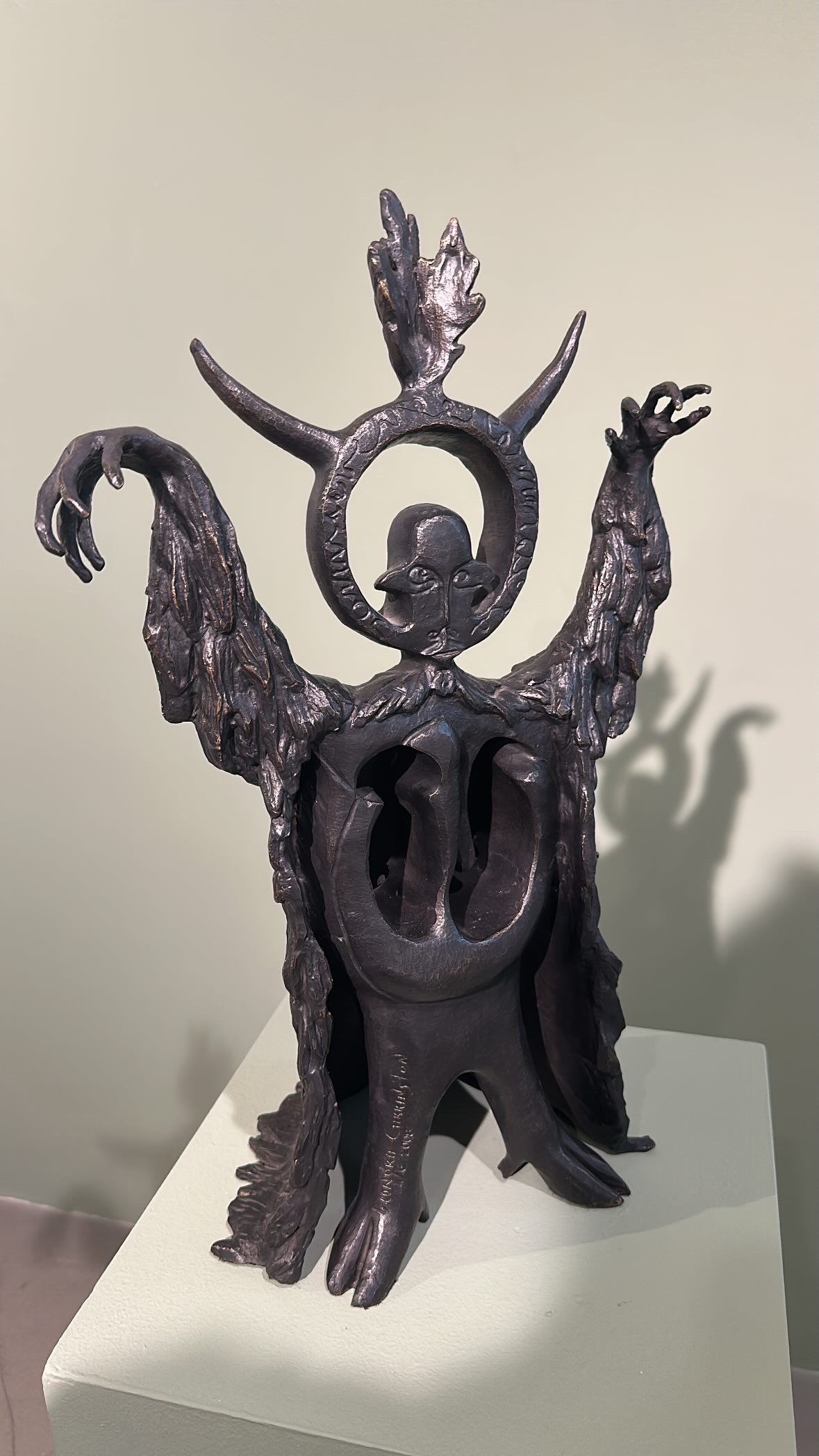
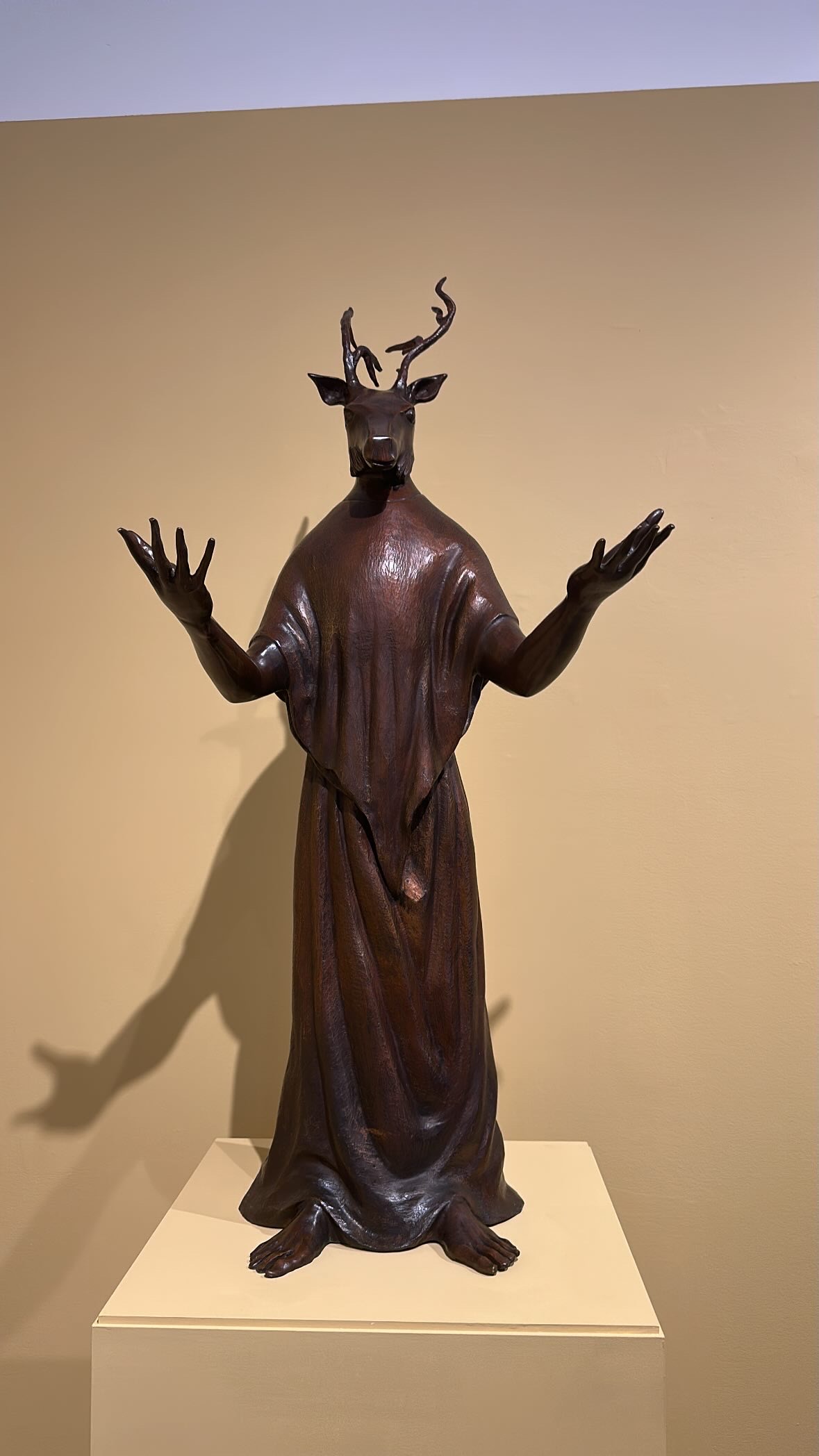
“Shape of Dreams” will remain at L’SPACE gallery in New York City until July 25th.
The Wild Hunt is not responsible for links to external content.
To join a conversation on this post:
Visit our The Wild Hunt subreddit! Point your favorite browser to https://www.reddit.com/r/The_Wild_Hunt_News/, then click “JOIN”. Make sure to click the bell, too, to be notified of new articles posted to our subreddit.