

“Dionysos, inspire us!” came the call, and “Dionysos, inspire us!” came the answer.
Dozens of us were gathered in the humidity of the June afternoon beneath the trees of Tower Grove Park to sing the Orphic Hymns during the main ritual of the St. Louis Pagan Picnic. The ritual, devised by the Kansas City Sorcerous Arts Collective, seemed deceptively simple: one member of the group stood on one side of an altar, reading the hymns out loud in their original Ancient Greek, while on the other side, another read the poems aloud in English. Every so often, the hymns would land on a refrain, and the crowd would sing the words back.
We sang the hymns of more than a dozen deities, including Eos, goddess of the dawn, Mnemosyne, the goddess of memory, and the Agathodaimon, the holy guardian spirit. But it was obvious that some of the gods elicited a more enthusiastic response. When they called for Dionysos, the crowd cheered louder than for anyone prior; I compared it to a crowd hearing the opening chords of a band’s biggest hit during a concert.

Dionysus as a child riding upon a satyr. Museo archeologico nazionale di Napoli. [public domain]
And this makes sense, both for the ancients and for us today. The Orphic Hymns are a corpus of poems in praise of Greek deities, likely composed in Asia Minor in the 2nd or 3rd century C.E. They are so named because according to tradition, they were the work of poet-hero Orpheus, most famous for the myth of his failed attempt to rescue his beloved Eurydice. Although the hymns praise a multitude of deities, Dionysos is the most popular god in the collection, with eight hymns dedicated to him out of 87 in the collection, and scholars suspect Dionysos was likely the central deity of the religious community that sang these hymns.
As for us moderns, Dionysos remains broadly popular with the Pagan community for all the reasons you would expect: as a god identified with wine, theatre, and abandon, he has a potent appeal to those seeking a divinity who embraces the ecstatic side of life. Where conventional religion enforces strictures, staidness, restraint, Dionysos seems to welcome excess and revelry. (Whether this stereotype completely accords with how the realities of his worship in classical times is a different question, but this vision of Dionysos has been the dominant mode since at least the time of Nietzsche.)
My four-year-old burst into the ritual circle as we called for Dionysos, giggling and manic, and ran across the field with me tumbling after him. As we chanted the hymns, some of us wandered through the sacred space to secondary altars filled with grapes, which the sorcerers told us we could both eat ourselves and also offer as a gift to the gods. My child grabbed a fistful of green grapes from the bowl as I snatched him up in my arms, and I guided him to the sacrificial bowl on the main altar. “Say thank you, Dionysos,” I told him, and he said something more or less similar in reply. He stopped at the bowl, waving his hands over the collection of shining purple and green, before he took off again back across the field, laughing like a satyr.
The rite concluded with a spell taken from the Greek Magical Papyri, a collection of magical texts written over the centuries between the 100s BCE and the 400s CE.
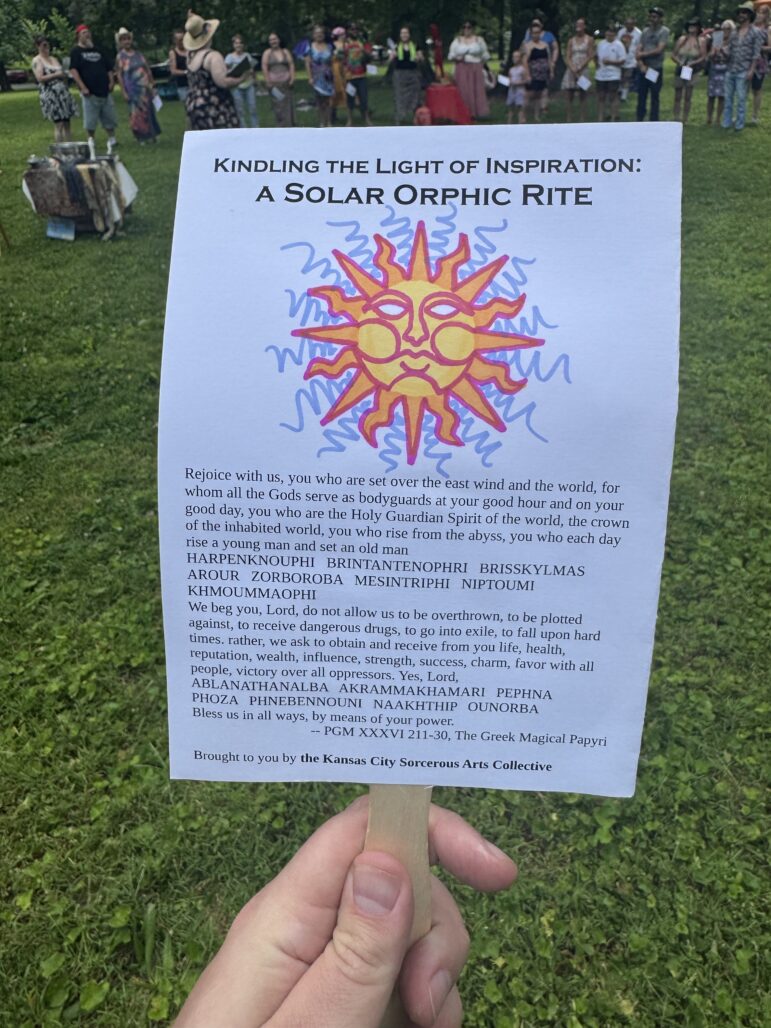
Solar Orphic Rite fan from the 2026 St. Louis Pagan Picnic. [Kansas City Sorcerous Arts Collective]
“Rejoice with us, you who are set over the east wind and the world for whom all the Gods serve as bodyguards at your good hour and on your good day, you who are the Holy Guardian Spirit of the world, the crown of the inhabited world, you who rise from the abyss, you who each day rise a young man and set an old man.
“HARPENKNOUPHI BRINTANTENOPHRI BRISSKYLMAS AROUR ZORBOAROBA MESINTRIPHI NIPTOUMI KHMOUMMAOPHI!”
These last words are untranslatable, “barbarous words” that may have origins in non-Greek languages but were valued for the power of their sound more than any literal meaning. The collective smartly printed the spell onto paper fans so that we could reference the strange speech while trying to cool off in the heat; even still, most of us tripped over the syllables as we tried to follow along. Still, I felt their power; the sonic quality is true, perhaps further increased by their mystery.
I caught up with Rae, who had been standing next to me in the ritual circle. Rae has been coming to the Pagan Picnic with her parent for several years, but had never taken part in a ritual before. “I felt nervous,” she said. “And excited.” She noted that she was anxious about pronouncing the Greek words – “I was worried I would be put on the spot” – but she was glad that she did went through with it – now she finally had the experience of being in ritual.
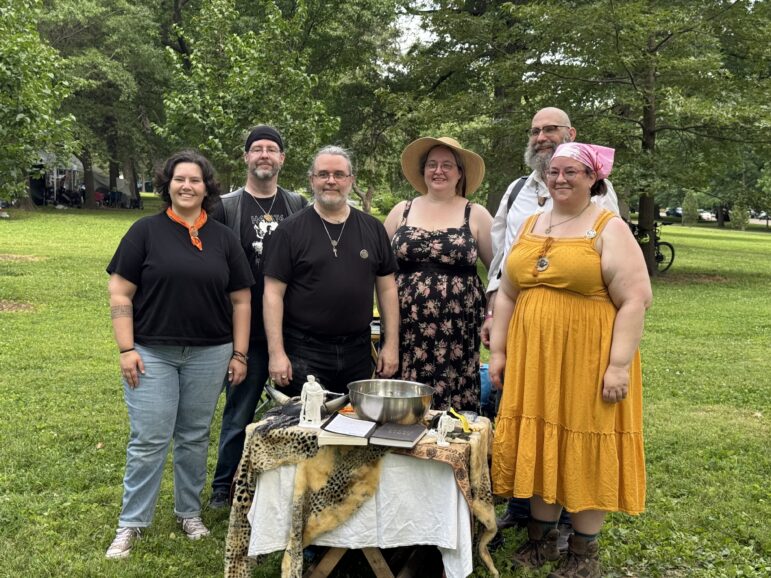
Members of the Kansas City Sorcerous Arts Collective at the 2026 St. Louis Pagan Picnic [E. Scott]
Afterwards I spoke with the collective to ask them how they felt it had gone. “The methodology was 100% hubris,” said Patrick, one of the members of the group. Since the ritual happened in June, they were looking for something with a solar theme, and they felt this had the right “Orphic kick.”
The collective has performed this ritual several times recently. Previous to the Pagan Picnic, they have performed versions at Kansas City’s Pagans in the Park, at Oak Spirit Sanctuary in Mid-Missouri, and at Paganicon. The group noted it was a version of a much longer rite they have developed for their personal use, adapted for a shorter time span, for public performance, and for people who would be entering the ritual unfamiliar with the sources.
“We got a bunch of people who had never heard of the Greek magical papyri to shout barbarous words into the sky,” said Jeffrey, another member of the collective. He considered that a victory in itself.
The Wild Hunt is not responsible for links to external content.
To join a conversation on this post:
Visit our The Wild Hunt subreddit! Point your favorite browser to https://www.reddit.com/r/The_Wild_Hunt_News/, then click “JOIN”. Make sure to click the bell, too, to be notified of new articles posted to our subreddit.