

MINNEAPOLIS/ST. PAUL – Since early December, the Twin Cities of Minneapolis and St. Paul have been the site of an extraordinary operation by federal law enforcement agencies, primarily Immigration and Customs Enforcement (ICE) and Customs and Border Protection (CBP). “Operation Metro Surge,” as it is officially known, has involved the federal government deploying more than 2,000 officers to Minnesota, and specifically the Twin Cities, to conduct “the largest immigration enforcement operation ever carried out.”
To many in the Twin Cities, Metro Surge has been less of an operation and more of an occupation. Daily life in Minneapolis and St. Paul has been widely disrupted, as ICE and CBP conduct daily raids on businesses, schools, and other public institutions. Minneapolis Public Schools have had to close due to CBP agents arriving at Roosevelt High School during dismissal, where they “began tackling people, handcuffed two staff members, and released chemical weapons on bystanders.” Over 3,000 people have been detained or arrested, many of them flown to detention centers as far away as Texas, including children as young as five years old and U.S. citizens. And two people – Renee Good and Alex Pretti – have been killed by federal agents in the streets of Minneapolis, joining dozens who have died in ICE detention since the beginning of the second Trump administration.
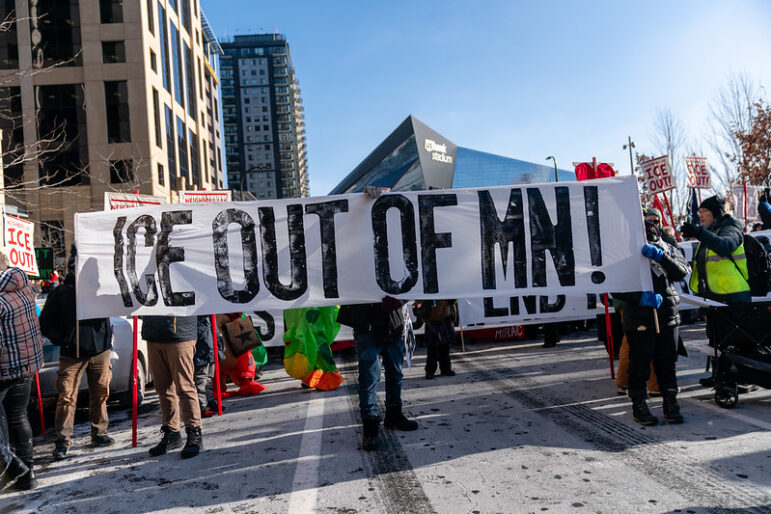
Protesters prepare to march at the Ice Out of MN march in Minneapolis, Minnesota [Lorie Shaull, Flickr, CC 2.0]
Widespread resistance to the operation has blossomed in the Twin Cities. Some of that resistance has been in the form of “ICE Watchers” like Pretti and Good, who attempt to document federal agents’ activity, warn neighbors when federal agents are present, and otherwise impede operations in the moment. Some has come in the form of mass rallies, demonstrations, and even the first American general strike in nearly 80 years.
But much of the opposition to Operation Metro Surge takes the shape of an extensive, decentralized network of mutual aid. Hundreds or thousands of Minnesotans have taken it upon themselves to look out for their neighbors by delivering groceries and other supplies, raising money for rent, escorting children to school, and otherwise helping those who fear being targeted by ICE and CBP.
Among those people are members of the Twin Cities’ large and vibrant Pagan Community. Minneapolis and St. Paul are known as a mainstay of American Paganism, to the point that the Twin Cities have sometimes jokingly been called “Paganistan.” People of diverse Pagan traditions call the region home, and have both experienced the disruptions to daily life caused by Operation Metro Surge and participated in various responses to it.
The Wild Hunt spoke with two members of the Twin Cities Pagan community for their thoughts on the past two months, their experiences as Minnesotans and as Pagans, and for the messages they hope to share with other Pagans for the future.
“Courage in the fear”
“What’s happening in our city,” says Sister Donyelle Headington, “and I think is unique to this movement right now, is that we have such a deep community connection, and we’ve worked so hard to build community, that we don’t have to have a centralized organized group of people making things happen. You just hear something, and you show up, and you see someone you know, and you make a decision about what happens next.”
Sister Donyelle describes herself as a folkways practitioner and a biracial Black woman living in Minneapolis’s North Side. She is in her 50s and is involved with many different Pagan paths in the Twin Cities community, including connections with African Traditional Religions, the Völva Stav Guild, and a longstanding Kemetic community. She is also part of the group that runs the Pagans of Color and Culture Suite annually at Paganicon. She frequently leads circles and teaches classes in the area.
For Sister Donyelle, daily life in Minneapolis goes on under Operation Metro Surge, but with a different character. “We’re living our lives very ‘in the city,'” she says. “There is this surprising level of normalcy. People who can go to work are still going to work. People who can go to school are still going to school. But instead of going out on Friday night, people are bundling their kids up and going to vigils.
“There is a lot of sadness,” she continues. “A lot of people seem very heavy. But then there’s this other piece that’s happening. There is a level of kindness and patience and presence that individuals are having with one another. Our smiles linger a little bit. We’re scared – that’s the truth. But there’s also a level of courage in the fear.”
Sister Donyelle has long been involved in community organizing and response. “I’m part of a rapid response group of Northside moms,” she says. “We respond to crisis – shootings, housefires, uprisings. If a water main breaks, usually one of us is on the scene making sure we’re collecting money for repairs. It’s not a formal organization, just a group of women who hold space for our community.”
Sister Donyelle says that she has been involved in this kind of decentralized community organizing for more than a decade, since the weeks of Black Lives Matter protests that followed two Minneapolis police officers shooting and killing Jamar Clark in 2015. “When Jamar Clark was murdered, we were just done,” she says.
“What we’ve been doing, our little pocket of folks,” says Sister Donyelle, “we’ve picked 15-plus families who can’t leave their homes.” Sister Donyelle and other people in her circle have been providing these families with groceries and other assistance.
“They literally can’t leave their homes, not even going out in their backyards, for three weeks. People with babies,” she says. “There are groups of midwives and birth-workers who are helping these folks have their babies at home.”
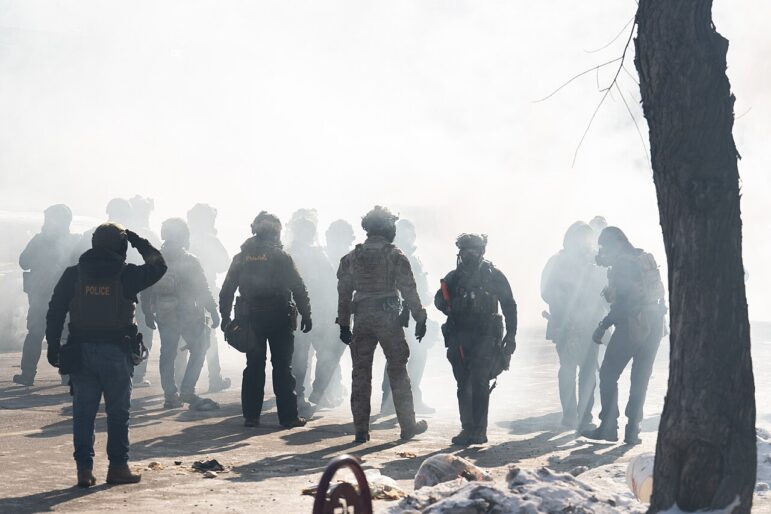
ICE and Border Patrol agents on Nicollet Avenue on January 24, 2026. This follows the shooting death of Minneapolis resident Alex Pretti. Pretti is the second person killed and third person shot by federal agents in Minneapolis this month.]
For Sister Donyelle, the deep history of community organizing, especially anti-racist organizing, has been key to this moment. “Minneapolis is such a segregated city,” she says, noting that public schools in the Twin Cities have a long history of racial segregation. “Very segregated, but also very connected. We have a longstanding network of anti-racist and anti-fascist action.” She points to groups like the Minneapolis Baldies, an anti-racist skinhead crew who clashed with Neo-Nazis in the Twin Cities punk rock scene in the 1980s.
“Because we have this deep history of organizing,” Sister Donyelle continues, “we’re not afraid to knock on somebody’s door. I have a neighbor, I saw their work truck had not moved for two weeks, hadn’t seen the kids. I knocked on their door several times, didn’t get an answer. I brought someone who speaks Spanish, told them we were around to help them. We know because we reach out. It is completely ground-up.
“It’s so fucking beautiful,” she says.
In her experience, while many Pagans may be involved in the community response to Operation Metro Surge, most are not talking about it publicly. “Folks are careful here,” she says. “Some Pagans are on Tiktok saying ‘I’m doing this, I’m doing that,’ but people doing organizing are not on Tiktok, because we’re up against the federal government. We know what they’ve done in Guatemala and Honduras and Gaza.
“I know a Heathen leader who ventured through a cloud of tear gas to get to a new Pagan mother a block away from where Renee Good was murdered to welcome her newborn baby,” says Sister Donyelle. “Is she going to get on Facebook to tell people she was doing that? No. But is she doing it? Yes. There is another Pagan leader in my community who has donated thousands of dollars of her own money to cover the rent of four families for two months.
“Are there Pagan leaders helping to organize things? Sure,” she says. “Are they talking about it? No they are fucking not.”
Sister Donyelle notes that in the midst of all the confusion, pain, and toil of the past two months, Pagan practices have been a great source of comfort to people in her community. “I work with a lot of newbies, people who are really just connecting with their own magical heritage, and they are so scared, they’re so angry,” she says. “To have something else they can do besides protests and mutual aid, that there are practices within their lineages that empower them – it’s been such a relief for them, such an important part of their sustaining action. It helps them go out and face big men with rifles.”
“There are no breaks anymore”
“Back in late November, early December, I noticed this marked uptick in media targeting Somali Muslims in our community,” says Benjamin Kowalsky-Grahek, an Ásatrú gothi in Minneapolis. “A lot of agitating media focused on this idea of widespread fraud. For the most part, that was old news for us in Minnesota. It had been exposed in the Biden administration. But then we saw influencers coming into our communities, filming childcare centers, and I thought to myself, ‘This feels like a prelude to something bad.'”
Kowalsky-Grahek is part of the Twin Cities Heathen community, and serves as a gothi, or priest, throughout the region, though he is not affiliated with any particular Heathen kindred in Minnesota. (Kowalsky-Grahek wanted to be clear that his comments for this article do not necessarily reflect those of any of the groups he is involved with.) Though his family is from Winona, Minnesota, he grew up in Connecticut, where he became involved with Heathenry in 2004. He moved to Minneapolis in 2011 and has been there ever since.
Kowalsky-Grahek says one of his goals as a gothi has been to build a sense of community in Twin Cities Heathenry that goes beyond individual kindreds. “One of the things I’ve tried to do is make it more of a bazaar or a faire,” he says, “where nobody in the Twin Cities ever feels like they can’t find a kindred if they want to. The goal has always been to make Minneapolis the most welcoming city in Heathenry, as the Pagan community had done for us.”
Part of that community building has involved organizing monthly meet-up events, such as gathering at a local meadery. One of those events was supposed to happen in December, but it coincided with events in support of the Somali community in Minneapolis. “There was this rally to support our Somali Muslim neighbors at the Karmel Mall in Minneapolis, and some Heathens went to the rally,” Kowalsky-Grahek says. “There was a followup day of action and reaction in December around Yuletime. We were supposed to meet up at a restaurant, but one of our community members said this was a multi-faith event where we could stand with members of all faiths, and this felt exactly in line with how I feel as a gothi – to make Heathens part of the family of faiths here, at the table with everyone else.”
All the organizing that followed in Minneapolis began in solidarity with neighbors, says Kowalsky-Grahek. “And from the beginning, Heathens were there as a part of it.”
He also noted that following the day of action, his group went to dinner the Black Forest Inn, which is at the same intersection where Alex Pretti was killed by CBP agents a month later.
As Sister Donyelle also noted, daily life during Operation Metro Surge still has all the same responsibilities as it did before ICE arrived, but now Kowalsky-Grahek notes there are many more demands on peoples’ time and energy. “My bills, my mortgage, my daughter’s doctor’s appointments don’t care what’s happening outside,” he says. “Every single Heathen in the city would tell you the same thing. But the thing that is giving me a lot of hope, but in the tiny scraps of what we might call free time, many of us are filling that with supply runs – groceries, medicine, household essentials – for people who are too afraid to leave their homes for fear that they will be taken.
“There are so many Minnesotans who respond to that,” he continues, “but every single Heathen I know has participated, coordinating or being a driver or a packer. We’re not just doing that amongst ourselves but in coordination with Muslim, Christian, Jewish groups engaged in that kind of work.
“And yes, there have been Heathens at protests, and Heathens who have come face to face with the worst of this stuff,” he says. “But there are also Heathens who are doing that support work every single day. There are no breaks anymore. We used to be able to sit down and play Elden Ring; we don’t do that anymore. This is hundreds or thousands of people in the Twin Cities Pagan community – it feels like a complete mobilization of this community here. Pagans are not sitting this out; we are as engaged as any other religious community is.”
Kowalsky-Grahek feels that privileged people – which he, as a white man, acknowledges that he is – have gotten a lot of messaging before and during this operation telling them to stay home and not get involved. “It would be better for you, safer for you, if you just let these people go” – that’s the aim of the propaganda, he says.
“But no one is expendable,” he says. “We cannot allow ourselves to accept the idea that someone is not worth it. Don’t delude yourselves – we as Pagans are not on the ‘good list.’ If we start looking at religious persecution, it won’t be long before it comes to us.”
Something to lose
TWH spoke with Kowalsky-Grahek and Sister Donyelle only a few days after the general strike on January 23rd, the killing of Alex Pretti on the 24th, and the ouster of CBP “Commander At-Large” Gregory Bovino on the 26th, which was thought to signal a draw-down of the operation.
“This changes nothing for us,” Kowalsky-Grahek says. “If there is still a family in hiding, then we will get them food and medicine. If there is one person who is isolated and needs community, we will be there for them. The Twin Cities is forever changed by this, the entire state. There are terrible things that we are going to have to think about and have nightmares about for the rest of our lives. But at the same time, there is this sense of purpose and togetherness and camaraderie that is not going to go away.”
“They’ve overstepped by 20 steps, and they’re going to take three steps back,” says Sister Donyelle. She is concerned that symbolic gestures like removing Bovino will lead to some people trying to pretend things are back to normal. “We’re concerned that it’s going to cause folks who are uncomfortable with all of this, with the knowledge the government is going after its people, with going out in negative temperatures, with empathizing with immigrant families – that it will give space for people to go back into their comfort zones, and it will allow ICE to continue with their brutality.”
For Kowalsky-Grahek, the key for the rest of the Pagan community in the U.S. is to start building bonds now, so that they are already in place when a crisis hits. “If anything, it’s my genuine hope that every other Pagan community in the US to start thinking of this need for community,” he says. “Start doing this work today. The time to start calling the people you haven’t talked to in a while, making connections, and planning how you’re going to show up for each other – even if it’s just meeting up at a coffee shop once a month – that’s how you build the bonds of community. That’s what we’re supposed to be about as Heathens.
“Don’t start stocking up on canned food and toilet paper,” he concludes. “Start by talking to the people in your Pagan community, because those are the people that are going to get you through.”
Sister Donyelle, meanwhile, puts this struggle into a global context. “One of my students is a naturalized citizen from Guatemala,” she says. “She told me about the revolution she witnessed there, how she remembered hearing people saying as they stood up against these death squads that they didn’t have anything to lose.
“What I’m so grateful for, she said, is the privilege of having something I can lose – a family, a house. There is a level of stability here that a lot of people don’t have.'” Sister Donyelle pauses. “We do have something to lose. I feel like that’s the spirit of our city.”
The Wild Hunt is not responsible for links to external content.
To join a conversation on this post:
Visit our The Wild Hunt subreddit! Point your favorite browser to https://www.reddit.com/r/The_Wild_Hunt_News/, then click “JOIN”. Make sure to click the bell, too, to be notified of new articles posted to our subreddit.