

LONDON – Anne Boleyn (c.1501–1536) remains one of the most consequential and contested figures in English history. As the second wife of King Henry VIII, her life and death reshaped the political, religious, and cultural landscape of England in ways that continue to reverberate centuries later.
Boleyn was educated early in the courts of the Netherlands and France. She returned to England fluent in multiple languages, highly accomplished, and deeply shaped by the humanist and reformist currents of continental Europe. Her intelligence, wit, and religious curiosity set her apart at the Tudor court, where she quickly became both admired and feared.
She became the interest of Henry VIII, and her refusal to become his mistress altered the course of English history. Henry’s pursuit of marriage to her led to his break with the Roman Catholic Church, the repudiation of papal authority, and the establishment of the English monarch as head of the Church of England. Crowned queen in 1533, Boleyn used her position to support evangelical scholars, encourage the translation of scripture into English, and patronize learning and the arts.
Her queenship was precarious from the start, however. When she failed to produce a male heir, despite giving birth to the future Queen Elizabeth I, court factions turned against her. Boleyn was arrested in 1536 on charges of adultery, incest, and treason. She was convicted and executed at the Tower of London.
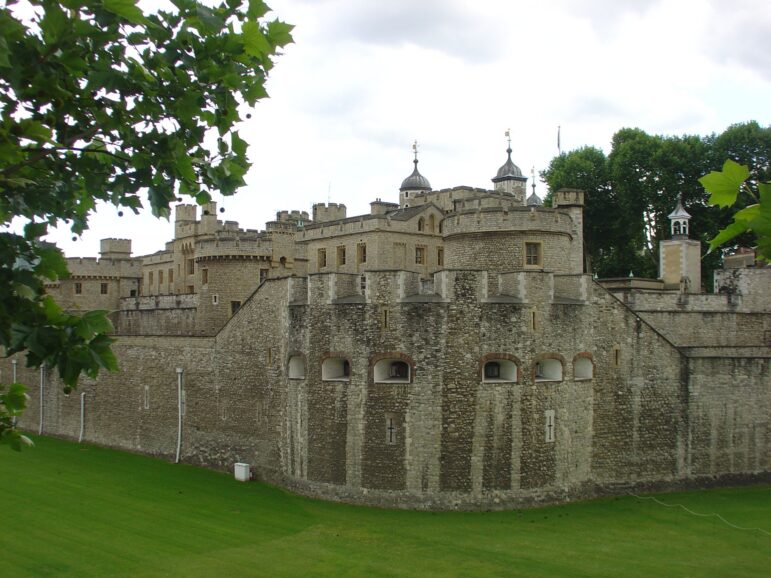
The Tower of London [MJTM
Most modern historians agree the charges were fabricated, making her death a stark example of the lethal politics of the Tudor court.
Alongside these formal accusations, Anne Boleyn was also subjected to rumors that she practiced witchcraft or the occult. These claims never appeared in formal accusations, her indictment, or were never part of any legal proceeding. Instead, they circulated informally, especially among hostile Catholic polemicists who portrayed her influence over Henry as unnatural or enchanted.
Witchcraft accusations were a familiar, deeply gendered weapon in early modern Europe, frequently deployed to discredit powerful, independent women whose authority disrupted established social and religious hierarchies.
In Boleyn’s case, later writers embellished these rumors with claims that she bore physical “marks,” such as an extra finger, tropes commonly used to associate women with moral corruption or diabolical influence. Witchcraft did not even become a felony in England until the Witchcraft Act of 1542, six years after her death, underscoring how symbolic and political these attacks truly were.
A new exhibition and related research now revisit these myths through the lens of art history and scientific analysis.
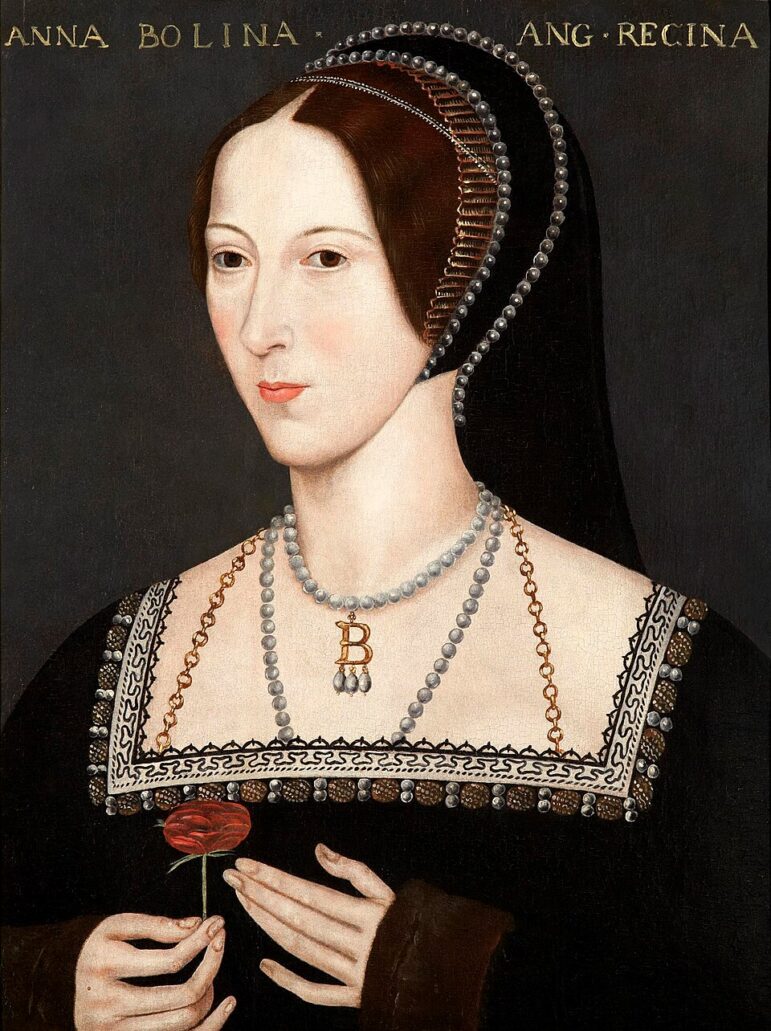
Anne Boleyn portrait at Hever Castle, c. 1550 [public domain
Capturing a Queen: The Image of Anne Boleyn brings together the largest-ever collection of portraits believed to depict Boleyn, including a newly identified contemporary image revealed for the first time. Developed from research by Hever Castle historian Dr. Owen Emmerson, the exhibition traces how Anne’s likeness has been interpreted, altered, erased, and revived over more than five centuries, inviting visitors to examine the evidence and consider which image comes closest to the historical woman.
At the center of this study is the famous “Hever Rose” portrait, housed at Hever Castle, Anne Boleyn’s childhood home. The portrait shows Boleyn holding a red rose, wearing her distinctive “B” pendant and French hood. New scientific analysis, including dendrochronology and infrared reflectography, has revealed striking evidence beneath its painted surface. Researchers uncovered an underdrawing that initially omitted Anne’s hands entirely, suggesting that the artist deliberately altered the design to display both hands with five clearly defined fingers.
This discovery appears to be a direct response to slander circulating during the reign of Elizabeth I. After Elizabeth ascended the throne in 1558, Catholic activist Nicholas Sanders attempted to undermine her legitimacy by claiming that Boleyn was “unnatural” and had six fingers on her right hand. The revised composition of the Hever portrait, with its emphatic display of five fingers, functions as what Emmerson described to The Guardian as a “visual rebuttal to hostile rumours and as a defence of Boleyn – and, by extension, of her daughter Elizabeth’s legitimacy.”
Kate McCaffrey, assistant curator at Hever Castle, emphasized the political significance of this artistic choice. “Her appeal lay in her intelligence, confidence and charisma. That is what caught Henry’s eye and heart,” McCaffrey said. She also noted that the portrait’s revisions align closely with a moment of intense religious and political anxiety in Elizabethan England. “It’s Elizabeth’s way of not only reclaiming her own legitimacy and lineage, but also restoring the legitimacy of her mother,” McCaffrey told The Guardian. “It’s impossible to say that Elizabeth herself commissioned this portrait, but it certainly seems too much of a coincidence for it not to be in response to rumours that were circulating at this time.”
The research supports long-standing scholarly theories that Anne Boleyn’s posthumous image was consciously rehabilitated during Elizabeth’s reign. The prominence of her hands in the Hever Rose portrait likely served to counter witchcraft claims. Helene Harrison recounts the theory of Boleyn’s rehabilitation in her 2025 book The Many Faces of Anne Boleyn. The new scientific findings now reinforce that interpretation.
Capturing a Queen: The Image of Anne Boleyn opens on 11 February, running until 2 January 2027
The Wild Hunt is not responsible for links to external content.
To join a conversation on this post:
Visit our The Wild Hunt subreddit! Point your favorite browser to https://www.reddit.com/r/The_Wild_Hunt_News/, then click “JOIN”. Make sure to click the bell, too, to be notified of new articles posted to our subreddit.