
WASHINGTON – It’s a busy week for worrying about sin and immoral behavior, not just in America but around the world.
As Washington, D.C. hosts two closely linked but distinct faith-and-politics events this week, the National Gathering for Prayer and Repentance and the National Prayer Breakfast together illuminate the growing influence of Christian nationalist theology in U.S. public life, while also exposing the fault lines around pluralism, church–state separation, and who is included in America’s civic rituals.
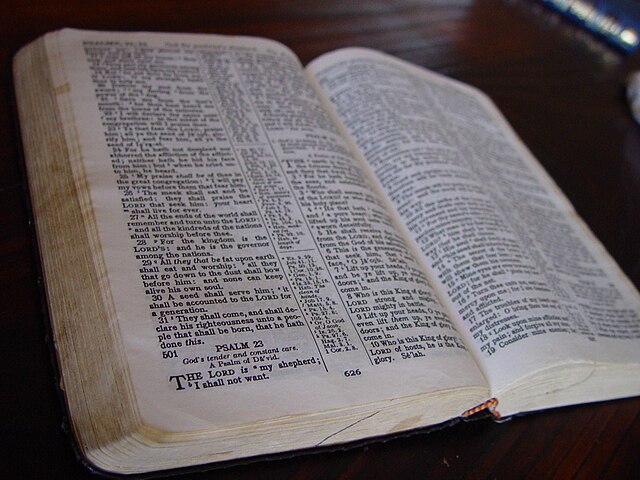
Holy Bible. Photo Credit: Leon Brooks [Public Domain
Held this morning at The Museum of the Bible, the National Gathering for Prayer and Repentance (NGPR) framed itself as a solemn, explicitly Christian call for national repentance under the theme “America needs God.” Unlike a conference or rally, organizers emphasized that NGPR is intentionally a “no-breakfast prayer meeting,” designed to prioritize what they described as a “vertical” relationship with God over speeches, applause, or social interaction.
Co-founded by Jim Garlow and Tony Perkins, the gathering brought together members of Congress, evangelical leaders, and intercessory prayer groups. Its stated purpose was to confess personal sin, sins within Christian churches, and what speakers characterized as national moral failures, while urging a return to “biblical foundations.”
Organizers linked the event explicitly to the upcoming semiquincentennial of the United States. NGPR wrote that as the nation approaches its 250th anniversary in 2026, Americans should not merely celebrate history but “seek the God who gave it purpose,” asserting that liberty can only flourish when grounded in Christian faith, humility, and dependence on God.
Speaker of the House Mike Johnson attended and praised the gathering, calling the anniversary an auspicious milestone. Johnson described the United States as “the most powerful and most benevolent nation in history,” attributing that status to what he repeatedly termed America’s “Judeo-Christian heritage.” Quoting English Christian apologist G.K. Chesterton, Johnson argued that the nation’s founding principles, particularly the Declaration of Independence’s assertion that all are “created equal,” rest on the belief that rights come from God. “They don’t come from a king,” he said. “They come from the King of Kings.” Johnson then led a prayer asking for national repentance.
The program included a video presentation invoking what organizers called the “Abraham Sermon,” explicitly tying the American founding to “Judeo-Christian” theology. Representatives from multiple U.S. states followed, each offering prayers of gratitude, repentance, and petitions for protection and guidance on behalf of their respective states.
As the event progressed, speakers such as Pastor Berger of One Church and Donna Rice Hughes led prayers focused on what they described as America’s moral sins. These included familiar evangelical talking points: sexual immorality, no-fault divorce, and LGBTQ+ identities and relationships. In the final hour, several speakers from minority backgrounds shared testimonies centered on conversion narratives. Among them were individuals introduced as a “former trans-identifying male,” a “former lesbian,” and a “former homosexual,” each attributing personal healing, marriage, and family formation to divine intervention.
The gathering concluded with prayers offered by participants from other nations—including Canada, the United Kingdom, several European countries, and representatives from Cuba, Iran, India, Pakistan, and Peru—followed by closing remarks from Garlow and Perkins. Both urged attendees to work and pray for America’s return to what they repeatedly called its spiritual foundation, particularly whenever the 250th anniversary is invoked in public discourse.

(U.S. Air Force graphic)
The National Prayer Breakfast
Tomorrow’s National Prayer Breakfast presents a different tone, though it shares overlapping theological roots. Established in 1953 after President Dwight Eisenhower accepted an invitation to pray with members of Congress, the breakfast has been held annually for more than seven decades. The National Prayer Breakfast Foundation now organizes it under the leadership of bipartisan congressional co-chairs.
While organizers emphasize that “all faiths are welcome,” it remains unclear how that inclusivity functions in practice. The National Prayer Breakfast website explicitly frames the event through Christian scripture, citing the Gospel of John: “According to the Scriptural record in John 21, Jesus invited a few of his friends to join him on the shore of the Sea of Tiberias. At this breakfast, he demonstrated the power of God with an abundant catch of fish; the love of God in his reconciliation with Peter who had denied him; and the transcendent importance of gathering people to eat together, fellowship together and pray together.”
To date, Pagan faith traditions are not known to be represented, raising questions about how non-Christian participants are expected to engage within an explicitly Christ-centered framework by a long-standing, historically Christian evangelical event
Traditionally held at the Washington Hilton on the first Thursday in February, the National Prayer Breakfast attracts more than 3,500 participants from over 100 countries. While its spiritual framework remains distinctly Christian, organizers describe the event as a space for reflection rather than worship, and for dialogue rather than debate. This year’s theme, “Unity in Purpose and Peace in Practice,” encourages attendees to consider prayer as a bridge toward human dignity and reconciliation across political, cultural, and ideological divides.
In recent years, the event’s structure has evolved. Following expressions of support from the White House and Speaker Johnson, congressional co-chairs Ben Cline and Jonathan Jackson announced that beginning in 2026, prayer events held at the Capitol and the Hilton will reunite as a single gathering. The 2026 breakfast will take place February 5 at the Washington Hilton, with Senators Kirsten Gillibrand (D-NY) and Roger Marshall (R-KS) serving as honorary co-chairs.
Not everyone views the breakfast as benign. Americans United for Separation of Church and State has sharply criticized the event, calling it an annual Christian nationalist ritual that promotes what it describes as the false claim that America was founded as a Christian nation. The group argues that the breakfast represents a long-standing alliance between government officials and a secretive religious network historically associated with its early organizer, Abraham Vereide, and later known as The Fellowship or The Family.
Two events, one conversation
Taken together, today’s National Gathering for Prayer and Repentance and tomorrow’s National Prayer Breakfast reveal two faces of religion in American public life. One is overtly confessional, prescriptive, and rooted in a narrow theological vision of national identity. The other presents itself as conciliatory and inclusive, even as critics question whether its Christian framing and political entanglements undermine genuine religious pluralism. Different in tone but aligned in purpose, both place Christian nationalist assumptions squarely in public view.
The Wild Hunt is not responsible for links to external content.
To join a conversation on this post:
Visit our The Wild Hunt subreddit! Point your favorite browser to https://www.reddit.com/r/The_Wild_Hunt_News/, then click “JOIN”. Make sure to click the bell, too, to be notified of new articles posted to our subreddit.