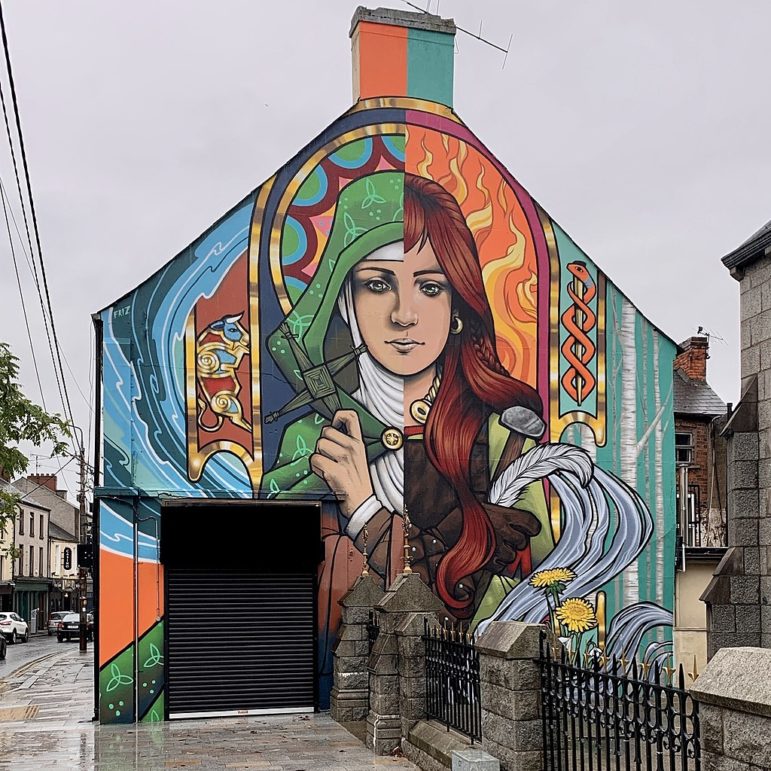
Brigid, goddess and saint. Urban art mural of the Seek Festival, Dundalk, County Louth [DSexton, Wikimedia Commons, CC 4.0
From February 1–2, many communities marked Imbolc alongside the Feast of St. Brigid. Imbolc is the festival dedicated to the goddess Brigid (also known as Bride), the flame-haired deity of the forge, healing, and poetry and thus patroness of smiths, healers, and poets. She is often associated with swans, lambs, and snowdrops—symbols of purity, renewal, and the first stirrings of spring. Closely linked with sacred fire, Brigid is traditionally welcomed with the lighting of candles, honoring both her presence and the returning light, though in recent years the season has also been marked by many festivities.
We found several videos recapping Imbolc and Brigid-related events in Ireland, offering a glimpse into how the season was observed there this year. St. Brigid’s Day is now officially a public holiday in Ireland; since 2023, St. Brigid’s Day / Imbolc has been recognized as an annual public holiday, observed on the first Monday in February unless February 1 falls on a Friday, in which case that day is observed instead. While many of the videos were titled St. Brigid’s Day, the imagery and practices shown often reflected a distinctly Pagan sensibility.
🔥🔥🔥
🔥🔥🔥
🔥🔥🔥
🔥🔥🔥
And, here is a lesson about the history of Imbolc from the Irish History Podcast “St Brigid’s Day was marked very differently in the past than it is today. In this video, I look at how people across Ireland once marked the eve and feast of St Brigid, focusing on the rituals, customs, and everyday practices that surrounded the day. Drawing on accounts collected in the late1930s, this explores how households and communities marked what was a very important day in the Irish calendar.”
https://www.youtube.com/watch?v=G3gzJfYNrG4
Via Lactea Sanctuary Reaches Property Tax Settlement in New York
PHOENIX –
Via Lactea Sanctuary, PMA, is a Neo-Pagan educational center in Central New York organized as a congregational “church” under a 508(c)(1)(a) Free Church and private member association structure. The Sanctuary’s mission is to recover, develop, and teach sacred practices at the intersection of ancient religion and regenerative, subsistence agriculture.
On January 9, Cortland County, New York taxing authorities agreed to accept Via Lactea’s settlement offer, bringing to an end the Sanctuary’s two-year legal challenge before the New York Supreme Court, Sixth Judicial District, regarding its claim for property tax exemption as a religious organization.
Local tax authorities had maintained that Via Lactea’s primary activities were not religious in nature. As a result, the Sanctuary faced the prospect of a costly, lengthy, and stressful trial in order to secure property tax exemption under New York State Real Property Tax Law. (Via Lactea had already established its exemption from federal taxation upon legally organizing as a Free Church.)
In legal filings contesting the Sanctuary’s exemption, the opposing tax assessor explicitly stated that a primary concern in denying tax-exempt status for Via Lactea’s 62 acres—comprised of pasture, forest, wild riparian woodland, barns, and outdoor (building-less) festival grounds—was to avoid setting a precedent for other groups in the county or state that might engage in sacred agriculture.
Sanctuary Director Rev. Priestess Valerie Hahn responded:
“Apparently, local authorities forgot that before the hegemony of the Roman Catholic Church, the worship of pagan Ancestors across the so-called ‘Old World’ centered on agriculture, for example Demeter and Persephone, Dionysus, Osirus and Isis, Hathor, Freyr, the Dagda and many more. The authorities also failed to admit the possibility, or did not understand the concept, that in a Neo-Pagan theological framework, the essence of animist agrarian practices can be recovered and are central to our worship!”
Under the terms of the settlement, Via Lactea will receive a 60 percent reduction in future property taxes, reimbursement of overpaid taxes for 2025, and the opportunity to reapply for full exemption in three years. Hahn reflected on the outcome, stating:
“We were told that if Via Lactea won 60%, to consider that a smashing victory and go home. Going home means doing our mission—not fighting to be able to do it.”
Hahn also explained the meaning behind the Sanctuary’s name:
“‘Via Lactea’ is Latin for Milky Way. The Milky Way is literally a seminal mythic trope for many ancient European peoples, and it centers Via Lactea’s commitment to positioning traditional dairy husbandry and the body of myth and practice surrounding dairy agriculture as part of a viable path to recovering an ancient indigenous worldview—agrarian animism. Like our Ancestors, our worship is the practice of creating harmonious relations with our Mother, the Earth, through harmonious relations with our more-than-human co-creative partners. Cows chief among them!”
For more information about Via Lactea Sanctuary and a calendar of upcoming Wheel of the Year events, visit vialacteasanctuary.org.
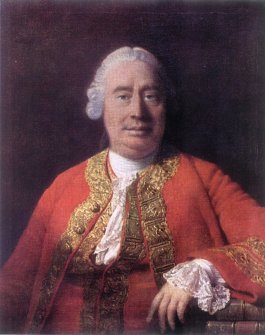
Reportedly ‘satanic’ symbols used to vandalize Philosopher David Hume’s Grave
David Hume portrait [public domain]
Recent reports from The Scotsman and The Guardian describe the discovery of vandalism and what authorities termed “disturbing occult-style paraphernalia” at the mausoleum of David Hume in Edinburgh’s Old Calton Burial Ground.
Hume has also been the subject of modern controversy; in 2020, a University of Edinburgh building bearing his name was renamed following Black Lives Matter protests that highlighted his writings on race.
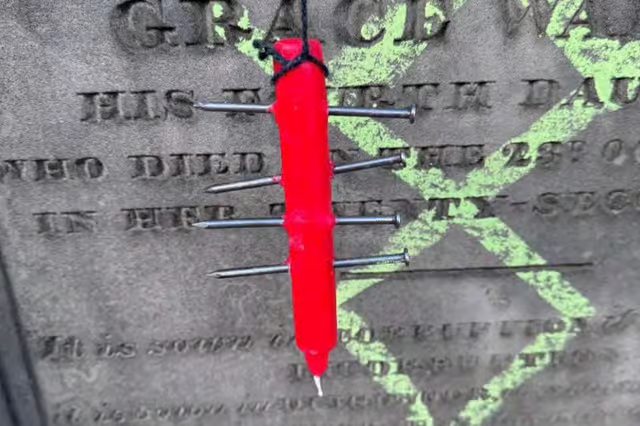
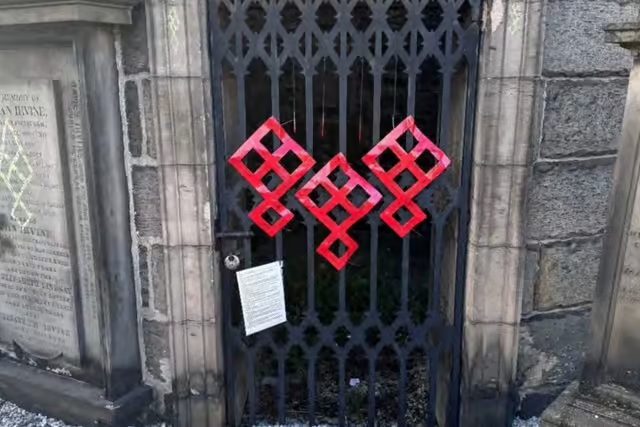
A tour guide raised the alarm on November 19 after finding chalked symbols on the 18th-century monument, along with various objects and drawings attached to or near the mausoleum. These reportedly included red candles pierced with nails, red electrical tape bearing coded writing, chalk markings on surrounding memorial stones, and a drawing depicting a naked woman holding a knife and an infant suspended by a noose. The guide removed some items but contacted the Edinburgh Council after being unable to remain on site.
The incident occurred amid broader concerns about antisocial behavior at Old Calton Burial Ground, a Category A-listed site that has faced repeated nighttime closures in recent years due to underage drinking, drug use, and so-called “cave raves.” Edinburgh Council confirmed that officers removed the materials promptly and stated there have been no further incidents. The damage was deemed temporary and was not reported to police; the site does not have CCTV coverage.
Candle with nails left on Hume’s grade via Edinburgh Council
Conservative MSP Miles Briggs described the images as “disturbing” and said he hoped authorities had investigated the matter further. Council culture and communities convener Margaret Graham said she was “appalled” by the vandalism and emphasized the site’s historical significance.
Reported;y “satanic” symbols on Hume’s grave via Edinburgh Council
The Guardian additionally reported that a now-deleted Telegram channel, purporting to be linked to similar grave vandalism elsewhere, shared photographs resembling those found at Old Calton, including references to Edinburgh’s EH1 postcode. Authorities have not publicly identified those responsible.
Old Calton Burial Ground, opened in 1718, is the final resting place of several notable figures. Hume’s mausoleum was designed in 1776 by architect Robert Adam.
Thank you! Thank you! Thank you!
If you’ve been thinking about supporting The Wild Hunt, now is the time.
As always, our deepest gratitude to everyone who has brought us this far.
Satanic Temple lawsuit moves forward
The Satanic Temple logo
A federal judge has declined to dismiss a lawsuit brought by The Satanic Temple against the Boston, allowing claims of religious discrimination to move forward. The ruling means the city will now have to defend its actions in court rather than end the case at an early stage.
The dispute centers on Boston’s former third-flagpole program. After denying The Satanic Temple’s request to raise its flag, the city placed all flag raisings “on hold” and later revised its policy, declaring that any flag flown would represent the city’s official views and require approval via a mayoral proclamation or council resolution. Despite that change, Boston raised a Christian flag shortly afterward—an act the city later characterized as a court-ordered remedy under the old policy.
Complicating matters further, Boston has since flown other third-party flags without publicly identifying the required approvals. When The Satanic Temple submitted public records requests seeking documentation, the city delayed for months and ultimately claimed no responsive records existed, including the Temple’s own application submitted through the city’s website.
The Satanic Temple sued in April, alleging viewpoint discrimination and violations of Massachusetts public records law. Boston moved to dismiss the case, arguing its revised policy cured any constitutional issues and that no records existed because the forum had been closed.
U.S. District Judge Angel Kelley rejected most of those arguments, ruling that The Satanic Temple plausibly alleged discriminatory treatment, preferential treatment of a Christian group, and unlawful withholding of public records. While Michelle Wu was dismissed as a separate defendant, all substantive claims will proceed.
“This means TST’s lawsuit now moves into the discovery phase,” the organization said, where Boston will be required to produce documents under oath. The case serves as a reminder that equal treatment under the First Amendment is not optional—and that selective enforcement carries consequences.
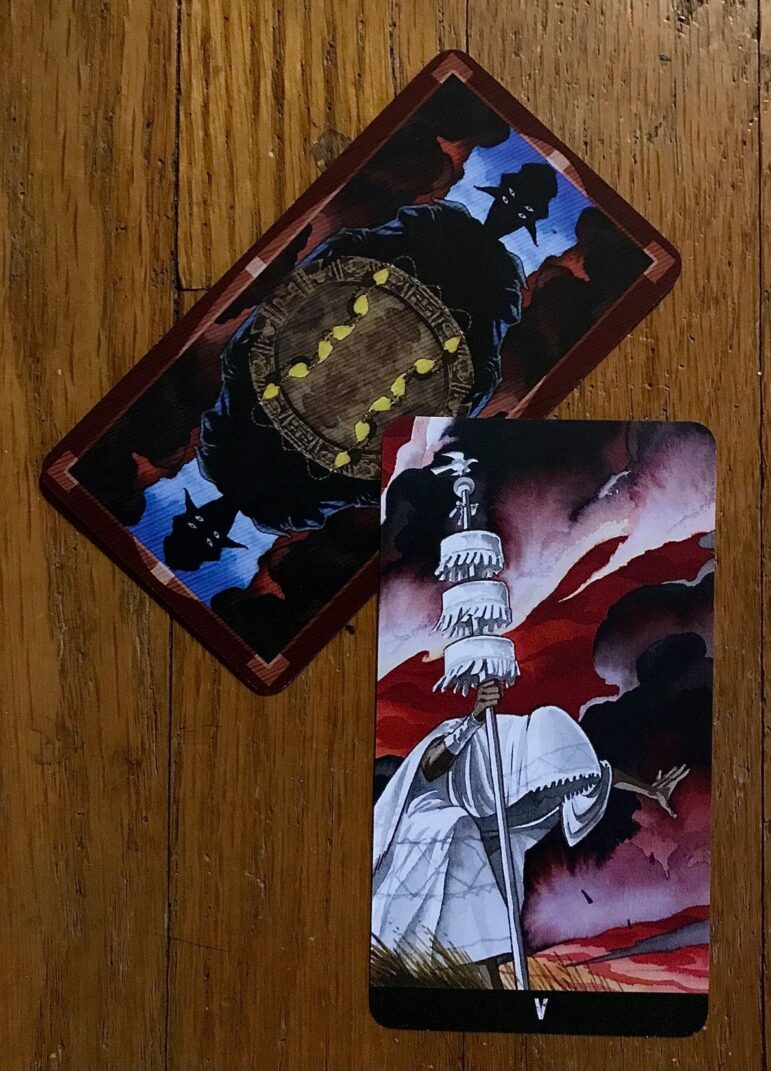
Deck: Afro Brazilian Tarot, by Alic Santana, artwork by Guiseppe Palumbo, published by Lo Scarabeo.
Card: Major Arcana V, The Hierophant
This week, an emphasis on spiritual values and beliefs is likely to be a major focus, as well as clarifying the scope and parameters of those beliefs. For those who have felt a lack of spiritual traditions or practices in daily life, a renewed drive to either establish a daily practice or resume traditional practices that have been set aside for a time. There is also the potential for seeking further formal training with a spiritual mentor or guide with attention to furthering peace, universal love, and compassion.
Conversely, feelings of being frustrated or tired of going along with whatever the status quo demands are liable to result in rebellion and forging new paths and ways of practice. A serious examination of core beliefs and values is likely to lead to widespread questioning that may encompass everything previously held to be true.
As always, our deepest gratitude to everyone who has brought us this far.
The National Prayer Breakfast: As Predicted
Official portrait of President Donald J. Trump, Friday, October 6, 2017. (Official White House photo by Shealah Craighead)
Yesterday, The Wild Hunt examined the National Gathering for Prayer and Repentance and the National Prayer Breakfast, noting that while the two events projected contrasting tones, they shared a common theological framework. Together, they highlighted how Christian nationalist ideas about sin, repentance, and national identity are increasingly being woven into American political and religious life, as explored inSin, Repentance, and Christian Nationalism on Display in Washington.
This morning’s National Prayer Breakfast met all expectations.
President Trump explained he has returned religion, and Christianity in particular just to be clear, to the center of American politics and public life. He pointed to efforts to promote prayer in schools, policies targeting transgender people, and the creation of a White House faith office. Trump also announced plans for a May 17 event on the National Mall that he said would “rededicate America as one nation under God.”
“Some major politicians refuse to say the word God. They don’t want to say it. I say it,” Trump said, adding that “there are many signs that religion is coming back” under his leadership. “It’s coming back so strong. You know, your churches are filling up. You didn’t have that two years ago,” he said.
Meanwhile in New Hampshire….
We may be getting a preview of how some of these ideas are taking legislative form at the state level. Republican lawmakers there have proposed a constitutional amendment that would elevate Christianity above all other religions and permit local communities to elect public school teachers—effectively opening the door to selecting educators based on shared Christian beliefs.
The proposed constitutional amendment concurrent resolution would grant towns, parishes, corporate bodies, and religious societies the authority to elect their own public teachers and would extend additional constitutional protections specifically to Christian denominations. Its stated aim is to promote public morality and governance rooted in evangelicalism:
“As morality and piety, rightly grounded on evangelical principles, will give the best and greatest security to government, and will lay in the hearts of men the strongest obligations to due subjection; and as the knowledge of these, is most likely to be propagated through a society by the institution of the public worship of the Deity, and of public instruction in morality and religion; therefore, to promote those important purposes, the people of this state have a right to impower, and do hereby fully impower the legislature to authorize from time to time, the several towns, parishes, bodies corporate, or religious societies within this state, to make adequate provision at their own expense, for the support and maintenance of public protestant teachers of piety, religion and morality:”
The Wild Hunt is not responsible for links to external content.
To join a conversation on this post:
Visit our The Wild Hunt subreddit! Point your favorite browser to https://www.reddit.com/r/The_Wild_Hunt_News/, then click “JOIN”. Make sure to click the bell, too, to be notified of new articles posted to our subreddit.



 Deck: Afro Brazilian Tarot, by Alic Santana, artwork by Guiseppe Palumbo, published by Lo Scarabeo.