
As Pagans know, tonight begins Imbolc, the festival dedicated to the Goddess Brigid (also Bride), the flame-haired deity of the forge, healing, and poetry. She is often accompanied by swans, lambs, and snowdrops—symbols of purity, renewal, and the first stirrings of spring. Under the name Brigid, which is commonly translated as “fiery arrow,” she is closely associated with sacred fire, and candles are traditionally lit to welcome her presence and the returning light.
Today, many modern Pagans and polytheists continue to observe Imbolc as a fire festival sacred to Brigid, patroness of poets, healers, and smiths. While the celebration traditionally falls on February 1 or February 2, practical concerns such as work schedules and community logistics mean that many groups hold rituals and gatherings throughout the surrounding week and weekend.
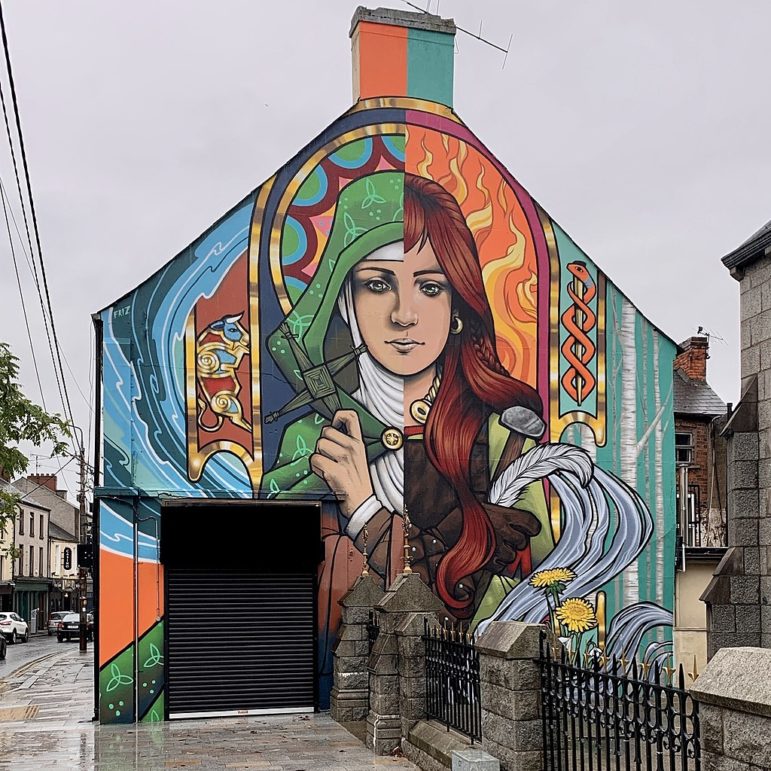
Brigid, goddess and saint. Urban art mural of the Seek Festival, Dundalk, County Louth [DSexton, Wikimedia Commons, CC 4.0]
Writing in 1982, Ralph Whitlock noted how the older Pagan festival endured beneath later Christian observances:
“Outside the Roman Catholic Church, Candlemas Day, February 2, now has little significance in Britain. In the ecclesiastical calendar it is the feast of the Purification of the Virgin Mary… Actually it supersedes a much older pagan festival, the feast of Imbolc…. A Celtic quarter-day in pre-Christian Britain, Imbolc belongs to a pastoral calendar which preceded the agricultural one… Imbolc was important in marking the traditional beginning of the lambing season.”
Whitlock further explained why this seemingly inhospitable time of year mattered so much to pastoral communities:
“The first week of February, when some of the worst winter weather can be expected, may seem a particularly inclement season for starting lambing, but there are good reasons… Lambs born then are just the right age in April and May to make full use of the spring grass… they are ready for marketing… in early July, when prices are at their peak. So February lambs are worth the extra trouble.”
That agricultural logic grounds Imbolc firmly in lived experience, not abstract symbolism. The festival marks a threshold—still winter, yet undeniably turning.
February 1 also marks the feast day of Saint Brigid of Ireland, patron saint of poets, dairymaids, blacksmiths, healers, cattle, midwives, fugitives, and newborn children. In Kildare, a perpetual flame is maintained in her honor, echoing older traditions. Celebrations of Lá Fhéile Bríde there began on January 29 and continue through February 5, with the hosting center now marking its 25th year.
Beyond Ireland, Brigid appears in related forms across the Celtic world. The goddess Brigantia, venerated in Late Antiquity among Gallo-Roman and Romano-British peoples, was also honored at Imbolc. Towns bearing her name—such as Brigetio in Hungary, Briançon in France, Bragança in Portugal, and A Coruña and Betanzos in Celtiberian Spain—attest to her wide geographic reach.
The late Alexei Kondratiev described Brigantia’s fire as both solar and generative:
“The fire of Brigantia was both the fire of fertility with the earth and the fire of the sun, which gradually gained in strength as the days lengthened… Traditionally, Imbolc marked the point after which it would no longer be necessary to carry a candle when going out to do early morning work.”
— The Apple Branch: A Path to Celtic Ritual
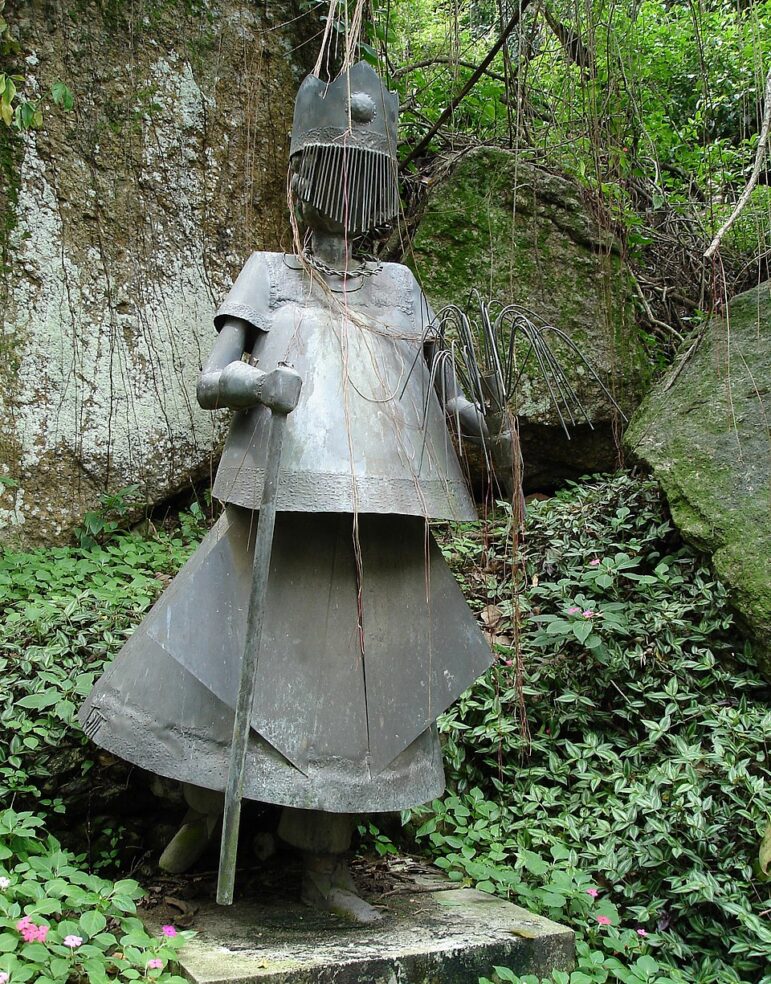
“Iansã”: sculpture at the Catacumba Park, Rio de Janeiro, Brazil, by Tatti Moreno [Eurico Zimbres, Wikimedia Commons, CC 2.5]
February 2 also holds meaning beyond Celtic traditions. In several African-diasporic religions, including Lucumí and Ifá, the vigil for the Feast of Oyá, orisha of winds, storms, and radical change, begins the evening of the first and into February 2. Oyá governs thresholds, life and death, the marketplace, the cemetery gate, and communicates with the ancestors. Her presence underscores Imbolc’s broader theme of transition and transformation, and her fire lights the way of memory.
Other observances cluster around these days as well. In some Celtic Reconstructionist traditions, this period honors Cú Chulainn’s three-day combat with his foster brother Fer Diad, described in the Táin Bó Cúailnge as occurring during the dark heart of winter. In the Urglaawe Heathen tradition, February 2 marks the beginning of the twelve-day observance of Entschtanning (“the emergence”), a time to cleanse hearths and honor feminine spirits and female ancestors.
On February 3, Japan observes Setsubun, the Shinto festival marking the division of seasons and the final day of winter. Often called the bean-throwing festival, Setsubun involves casting soybeans to drive away the harmful spirits of winter and welcome spring’s renewal. This seasonal liminality echoes Imbolc’s own themes of clearing, protection, and hope.
These ideas carry through even into secular observances, such as EarthSpirit Community’s Feast of Lights and, of course, Groundhog Day.
In the Southern Hemisphere, meanwhile, modern Pagans are moving into the harvest season, celebrating Lammas, Lughnasadh, and related festivals as autumn approaches—another reminder that the wheel turns differently depending on where one stands.
University lecturer, psychologist, and Wiccan high priestess Vivianne Crowley reflects on Imbolc’s relevance today:
“As Pagans, we honor our warrior goddesses… To ride safely through the changes to come, we must hold true to ideals and values… We must honour science, history, and fact… Sometimes bad changes can bring new light and dawning… Let the light of strength and wisdom shine in the darkness on Brigid, Bride, Brigantia’s day.”
— Light in the Darkness on Brigantia’s Day
Finally, the morning of February 2 carries an echo of much older forms of divination. In ancient Rome, haruspicy, the reading of animal entrails, was a respected religious practice, inherited from Etruscan tradition and attested in texts such as the Libri Tagetici. It was practiced elsewhere, and even the Hebrew Bible records it in Ezekiel 21:21:
“For the king of Babylon… will examine the liver.”
Thankfully, no such offerings are required today. Instead, another form of animal augury survives, gentler, if no less theatrical, at Gobbler’s Knob in Punxsutawney, Pennsylvania.
Before sunrise, members of the Punxsutawney Groundhog Club’s “Inner Circle,” clad in black top hats and Victorian coats, will process to the stage and administer Phil’s “Elixir of Life.” The crowd will cheer. The omen shall be read. The augury will be complete. complete. We shall know the weather of the future, and more importantly, Phil will live on.

A young groundhog in a field of clover [Ladycamera, Wikmedia Commons, CC 4.0]
As the first light of Imbolc kindles in the north, may the returning sun find you where you stand—at the threshold of winter and spring, hope and endurance. May Brigid’s fire warm what has grown cold, sharpen what has grown dull, and illuminate the work still waiting to be done.
For our readers in the Southern Hemisphere, as Lughnasadh and the first harvest approach, may the fruits of your labor be gathered with gratitude. May you recognize what has ripened, release what has run its course, and carry forward only what will sustain you through the darker months ahead.
Wherever you are on the turning wheel, may this season offer clarity, resilience, and the steady courage to tend both hearth and community. May the light, growing or waning, be enough.
The Wild Hunt is not responsible for links to external content.
To join a conversation on this post:
Visit our The Wild Hunt subreddit! Point your favorite browser to https://www.reddit.com/r/The_Wild_Hunt_News/, then click “JOIN”. Make sure to click the bell, too, to be notified of new articles posted to our subreddit.