

The funny thing about Bell, Book, and Candle is that it’s a Christmas movie.
I just assume all films about Witches have a Halloween angle; the cover art on this one doesn’t lean into the Yuletide. But Richard Quine’s Bell opens in the moody, jazzy vibrance of 1958’s Christmas Eve in Greenwich Village, and Christmas looms as a character within the film. We never leave the season of Epiphany. This all becomes the cozy backdrop of a complex comedy about a woman sorting out if she wants to keep an urban, exotic, single life or settle into the wedded countryside of the Christmas carols.
(Editor, cue Bo Burnham’s Turning 30, please. Also refresh my drink, would you, darling?) (Editor’s note: work, work.)

Kim Novak as Gillian Holroyd in BELL, BOOK, AND CANDLE (1958) [Columbia]
Our Witch, Gillian Holroyd (Kim Novak), owns a “primitive art” store featuring elaborate art from various African nations, including what is either a recreated rendering of a shrunken head or an Olegua statue that is designed to make me very uncomfortable.
Gillian opines to her Siamese cat, Pyewacket, that she is in a rut, sick of the same old things and same old people day after day. The way that would be solved in this film is to get married, an enterprise notorious for its monotony. But in all the exoticism of her city and life, she would like to be in a church with carols, and she implies she would like to marry someone different and traditional.
Well – she never outright says married. As an audience member, I filled it in, and only noticed the absence on rewatch.
Would normalcy suit Gillian better than her tedious life of independence? It certainly would suit the expected audience better, that much is clear. A woman and her cat, like a conservative fable.
Luckily, Shep Henderson (Jimmy Stewart) has moved in upstairs, and Gillian is quite smitten with how different and yet not different he is. He even has a boring job. He’s just listed as “publisher.”
Kim Novak as Gillian is devastating, with dark brows, light cropped hair, slinky dramatic clothes, and a deep voice. She’s got a striking appearance, one that, as a queer woman, I’ve largely adopted. There’s something hunting about her. She’s a modern woman, whatever that means in 1958. And she’s looking to be swept up in the arms of Jimmy Stewart, or, if I must, Shep.
It’s clear that Gillian’s fantasy requires a stand-in man more than anything else. She wants to be in love, go dancing, and canoodle in the snow. (A girl after my own heart.) I’ve had crushes like this, who say all the right things in my head so that I don’t have to deal with the reality of them. Gillian has been dealing with the reality of magic, of friendship, of disappointment.
But Shep is not unworldly, he’s not suburban. He’s living in the same building as the shop and, despite looking like Jimmy Stewart, he fits right in. He’s a middle-aged man, 25 years older than his costar, and he says he’s never married and has actively avoided it. Yet Gillian talks about him like he’s an exotic pet. He’s the inverse of distant travel.

Jimmy Stewart as Shep Henderson in BELL, BOOK, AND CANDLE (1958) [Columbia]
The 50’s, for all their historical patina, were an age of post-war modernity and innovation: the mixer, the slow cooker, the top load dishwasher. And more than just these appliances: the invention of the nuclear family and its purity. The post-war financial boom meant more babies, more homes built and sold. It changed the idea of what an American ideal life looked like. It’s even the Red Scare, you see – to the point where Shep even asks Gillian if she’s been doing something “Unamerican.” As if the scariest thing a woman could do in a relationship were to be a Communist.
I know what I’m doing is basically time travel, a woman in 2025 trying to adjust the brightness of the political surroundings of the film to match my own. But as I sit here, watching a Christmas movie in a big city with my beloved cat, I keep waiting to empathize with Gillian’s despondancy. It feels juvenile to me, like she hasn’t aged into full acceptance but is still tottering through every narrative she can try on.
Gillian keeps revealing her modernity, though. She owns the shop, knows about African art, studied anthropology in college – hell, she went to college – and she has the fanciest bar I’ve seen outside of an actual bar. Shep reveals his tradition. His clothes give him away, as he’s always in a suit jacket that matches his actual overcoat. He’s excitable and easily scandalized while being very judgemental.
Before the “black cat/golden retriever” relationship trope existed, there was the secret lovelorn Witch and the utterly boring baffled guy with a temper who speaks at least three notches of volume above the rest of the cast. It’s in Bewitched, I Married a Witch, and I Dream of Jeanie. Gillian is the closest to a withholding version, the model of the modern Black Cat Girlfriend.
Gillian frequents a spot called the Zodiac Club, an underground jazz club where Gillian and her aunt Queenie and all their friends drink and dine. “It’s kind of a dive,” Gillian says with slight derision. But as someone who frequents the sticky-floored dives of Oakland, the Zodiac Club is not a dive. It just has a bongo player. What I think Novak really means here is that it’s diverse. It’s got modern interpretive dance, music that is unstructured, and is frequented by Witches, artists, and elderly couples in fancy hats. Cities are places of mixing, and Gillian’s fantasy of a little church is one of isolation. There are no Witches there, no others, just her and her romance and carols.
Shep is supposed get married on Christmas to his betrothed Merle (Janice Rule). He speaks warmly about her, about how excited he is to marry her. At Gillian’s mentioning of the Zodiac Club, Shep drags Merle there on a snowy Christmas Eve. The music is French, the entertainment odd. Everything about the Zodiac Club screams beatnik. Both Shep and Merle are deeply out of place.
Merle has a history with Gillian that goes back to Wellesley. Merle is a distinct contrast to Gillian’s femme fatale. She’s jewel-toned, blush on her cheeks, very beautiful but in a softer and conventional way. She gets wildly mistreated throughout the movie. Off-screen she’s supposed to be a terrible person who steals men and writes poison pen letters, but Merle’s harm is confined to the perimeter. Gillian’s harm, meanwhile, is that she’s lying to us, but mostly she’s lying to herself.
I don’t believe that Gillian is unhappy; she’s bored and tired of dealing with her relatives. She casts a love spell to “justifiably” steal Shep away, and it works like, well, a charm. Shep brutally breaks up with Merle. Gillian’s love spell works just as tradition says it should – jealously and without consideration for others. Marriage is just, and any actions one takes en route to marriage are therefore also just.
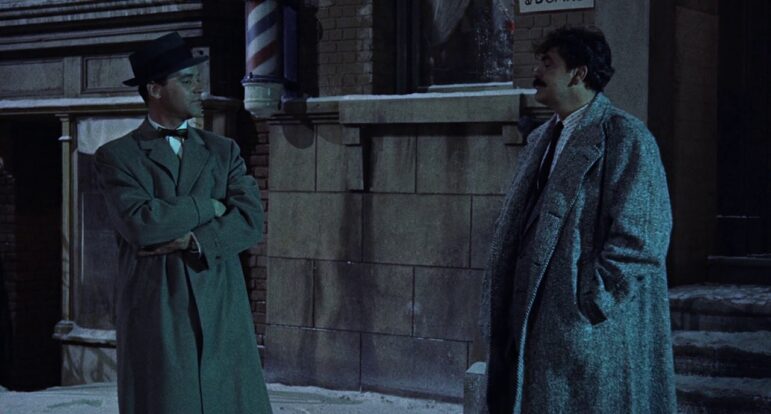
Jack Lemmon as Nicky and Ernie Kovacs as Redlich in BELL, BOOK, AND CANDLE (1958) [Columbia]
Meanwhile, Gillian’s Warlock brother Nicky, played by Jack Lemmon in somehow his queerest role, summons the author Redlich (Ernie Kovacs), the author of Magic of Mexico, a fictional best-seller rivaling the Kinsey Report. Redlich wants to publish a book with Shep exposing the secrets of Gillian and her Witch family. Nicky wouldn’t mind that, as long as he gets a share of the royalties, but Gillian can’t stand the idea. She wants to keep control of her fantasy.
Although Gillian seems adamant that her friends are ruining her attempts at a normal life, she is uncompromising in the aesthetics that keep her as an other. She wears dramatic animal prints and low cut backs; there’s no softening to her edge. She’s engaging in the fantasy of love, knowing it’s outside her emotional scope. She’s a Witch, and they can’t love – they can only cast spells and hope that somehow the fantasy is enough. There’s a subtext there: do Witches, or single women, or queer people, even have the capacity to love? Can they cry? Can they bleed?
The actual romance between Gillian and Shep is tedious. There’s no particular passion, just the satisfaction of a woman who correctly cast her play. But when Shep proposes marriage in a lovelorn haze, she gets cold feet. “I just don’t think I’m cut out for marriage.” She realizes her lack of skills, and ultimately, interest. She’s jealous, vindictive, living for the extraordinary.
Shep calls her on this, quite hurt, and accuses her of playing the man’s part in the marriage dance. Gillian is queer again, deviant again, a single woman blurring tradition and gender expectations. She’s denied him marriage twice, and even used his own excuses for breaking up with Merle to justify her stance to him. Her emotional vacation is ending. It’s time for her to buy her souvenirs and end it.
But in the last act, Shep does manage to remove the spell. He fails to get back together with Merle. And when he reunites with Gillian, everything about her has changed: her store sells seashells instead of African art, her clothes become looser and less glamorous. It’s when she’s lost everything that made her interesting that Shep understands Gillian loves him, and has lost what made her a Witch in the process. Her magic is something to be domesticated through the humiliation of pastels.
She cries, and they fall into each other’s arms. The marriage is just because it always is.
Editor? Pour me another drink.
The Wild Hunt is not responsible for links to external content.
To join a conversation on this post:
Visit our The Wild Hunt subreddit! Point your favorite browser to https://www.reddit.com/r/The_Wild_Hunt_News/, then click “JOIN”. Make sure to click the bell, too, to be notified of new articles posted to our subreddit.