

NEW YORK – The New York Country District Attorney’s Office held a ceremony on Monday to return several artifacts that date back to the classical era to the nation of Turkey. These repatriations represent a milestone in a years-long investigation by the New York D.A.’s Antiquities Trafficking Unit into items looted from Turkey in the 1960s and subsequently trafficked through New York by way of Switzerland or the United Kingdom.
Two major artifacts were repatriated at the ceremony. The first is a marble head of Demosthenes, the ancient Athenian orator, which had been in the collection of the Metropolitan Museum of Art. Demosthenes is most famous for recognizing the dangerous rise of Philip II, the father of Alexander the Great, and the emerging Macedonian Empire that the father and son would conquer throughout the 4th century BCE. The head is a copy of a Greek bronze original from 280 BCE and originated in Turkey near the modern city of Izmir.
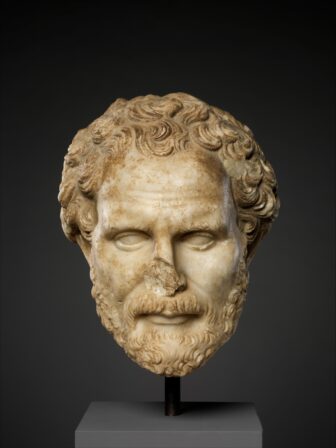
Marble head of Demosthenes, Roman, 2nd century CE, Copy of a Greek bronze statue by Polyeuktos of ca. 280 B.C. [public domain]
Though the Met had a provenance in hand for the object that traced its history back to the “Mussienko Family Collection of Maryland” in 1973, the D.A.’s office discovered that the provenance had been forged by the Ariadne Galleries, who were the first art dealers to put the object up for sale.
“Ariadne Galleries allegedly falsely claimed that it had bought the Marble Head from Fortuna Fine Arts—claiming to have done so two years before Fortuna Fine Arts even existed,” said the D.A.’s office in a statement. “Ariadne and Fortuna, which is currently under indictment in federal court for fraud, also allegedly falsely claimed that the Marble Head had previously been in the collection of Boris Mussienko—a name Fortuna and other galleries allegedly frequently used to create false provenance.”
The second major object repatriated was a larger-than-life headless statue, identified as the “Nude Emperor,” dated to between 50 and 250 C.E. The “Nude Emperor” comes from the Sebasteion of Lycia, located near the modern city of Bubon, a shrine that contained monuments to Roman emperors. The shrine was looted in the 1960s and its contents trafficked through Izmir by the antiquities dealer Robert Hecht. (The Wild Hunt has previously covered other repatriations related to Bubon.)
“The looting into ancient sites like Bubon were extensive,” wrote the District Attorney, Alvin Bragg, in a statement, “and I am pleased that our investigation has yielded such significant results. I thank the work of our prosecutors and analysts for their dedication to uncovering these trafficking networks that target ancient sites rich with cultural heritage.”
The “Nude Emperor” was in the collection of medical technology venture capitalist Aaron Mendelsohn, who had purchased the object for $1.33 million from the Royal-Athena Galleries, according to Artnet News. The Royal-Athena Galleries were involved in the trafficking of numerous objects from Budon, according to the D.A.’s office, and has since shuttered.
Mendelsohn filed two lawsuits against the New York D.A. to prevent the return of the statue, one alleging the D.A.’s office had attempted to intimidate him through criminal procedure rather than the more common civil procedure and another claiming the D.A. did not have jurisdiction because Mendelsohn lived in California. Ultimately Mendelsohn returned the statue and dropped his suits in exchange for a deferred prosecution agreement from the D.A.’s office.
Along with these two major pieces, 41 terracotta plaques looted from a 6th century B.C.E. Phrygian temple located in Düver were also returned to Turkey. These plaques were voluntarily surrendered from the collections of the Virginia Museum of Fine Arts, who recognized another of the plaques seized in a previous New York D.A.’s investigation and contacted the office.
“It takes real courage to challenge what is unjust,” said Gökhan Yazgı, the deputy minister for Turkey’s Ministry of Culture and Tourism. “Today, the dedicated Antiquities Trafficking Unit of the DA’s Office is repatriating artifacts stolen from the Turkish people decades ago. The strong partnership we have built and sustained with determination has carried our national efforts onto the international stage.
“These restitutions,” continued Yazgı, “not only reunite the heroes of these cases, but also send a clear message to the world: do not buy cultural property removed illegally from its country of origin. This is how a single return becomes a powerful tool against illicit excavations—and why this work matters more than ever.”
The Wild Hunt is not responsible for links to external content.
To join a conversation on this post:
Visit our The Wild Hunt subreddit! Point your favorite browser to https://www.reddit.com/r/The_Wild_Hunt_News/, then click “JOIN”. Make sure to click the bell, too, to be notified of new articles posted to our subreddit.