

Author’s note: Spoilers for Wake Up Dead Man follow.
When I settled in to watch the new Benoit Blanc movie, what I wanted was a rollicking good time with the last of the gentlemen sleuths. Following Knives Out (2019) and Glass Onion (2022), Wake Up Dead Man is the third film to feature Daniel Craig as the drawling, be-suited Blanc, a detective made distinguished by his relentless and insightful search for the truth – but moreso by his compassion.
Blanc, like the better versions of Sherlock Holmes, is portrayed as a detective whose morals are strongly aligned with what’s right, even when that does not line up exactly with what’s legal. When Knives Out came out in 2019, I was immediately fond of this character who was willing to hold off his judgment and bend the rules in order to make sure that, at the end of the day, good people were given every chance at the life they deserved.
I expected similar shenanigans in this newest installment: Blanc and a seemingly-guilty sidekick taking on the world to identify the real corruption at the heart of a murder. I did not expect a movie where Blanc spends the vast majority of the run time protecting a Catholic priest.
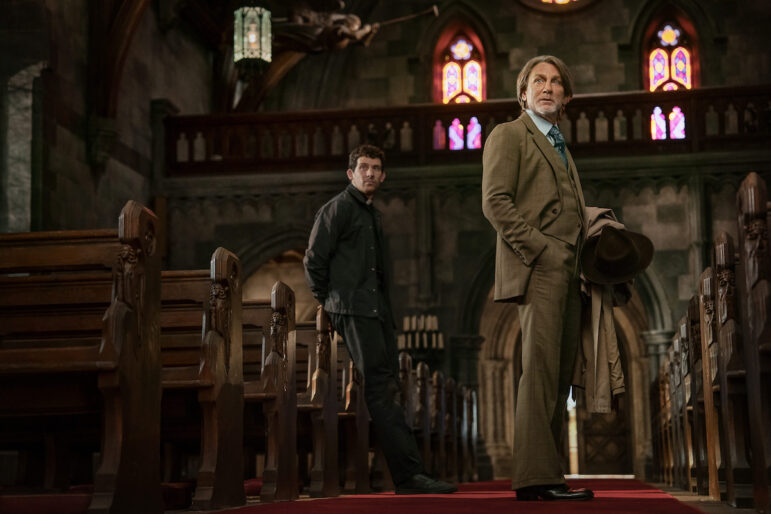
Josh O’Connor as Father Judd and Daniel Craig as Benoit Blanc in “Wake Up Dead Man” (2025) [photo by John Wilson, Netflix
Wake Up Dead Man is, on the surface, a movie about Catholicism. The plot revolves around Father Jud Duplenticy, a young priest sent to a small church whose current leader, Monsignor Jefferson Wicks, has cultivated an increasingly small and extremist following. Father Jud, who came to the priesthood after his own dark night of the soul, is a true believer. Monsignor Wicks is crass, cruel, and self-evidently using the church to shore up his own power over his congregation. When Wicks drops dead in the middle of service with a knife in his back, Blanc is called in to consult on a seemingly impossible murder.
Most of the action takes place either in the church or on the way there, with Father Judd serving as prime suspect, protagonist, and point of view character. His internal narrative is very much about his faith and the strength that he continually finds by leaning on it – but Johnson does not let that drive the movie. It is, instead, a movie about religion – how it works, what it’s for, and what it looks like when it is done right.
What keeps this from becoming a Christian movie is Blanc’s avowed and unwavering atheism. Johnson takes the opportunity to give Craig a few excellent and emphatic monologues about the damage done by Catholicism. Throughout the movie, in the face of miracles and professions of fath, Benoit Blanc is moved but untouched, a clear-eyed devotee of logic. This gives the audience two moral compasses in the film, and creates enough distance to see Father Judd’s actions as a religious leader outside of the specific faith that shapes them.
I watched this film in theaters two weeks ago, long before it dropped on Netflix. Father Judd is why I have been thinking about it every day since then. It’s a complicated film, with more twists than characters in its star-studded cast. Even attempting to outline the plot would take a map, a timeline, and a lot of red thread. But at the core of it is Father Judd, who, while he often gets as caught up in the plot as the audience, grounds the narrative again and again in his understanding of what he has been called to do – help people.
The scene I keep returning to happens just as the plot is really spinning up. Blanc and Judd are tracing the paperwork for an equipment rental, and Judd calls the local office to ask who placed the order. They’re in a hurry, hot on the trail – until the woman on the other end of the phone tells Father Judd that her mother is sick, and it has just been really hard to feel hopeful.
Judd stops in his tracks and redirects. The entire movie takes a break, as Father Judd sits and talks with this woman, offering what support he can in an impossible circumstance. He is, in that moment, reminded what he is supposed to be doing for his community. Throughout the movie, but especially after this point, he tries to show up physically as the love, forgiveness, and redemption he believes in, providing guidance and service to other characters. Unlike Monsignor Wick, Father Judd does not do this for fame or power – he does it because he knows how much of a difference it can make in someone’s life.
While the movie plays with the symbolism of Catholicism, there are no angels or true miracles. It is, however, very clear that the kind of religious leadership Father Judd offers does work. Untouched in his atheism, by the end of the movie even Blanc foregoes his own aggrandizement to offer a chance at redemption for the true murderer. Rather than power, the movie argues, spiritual leadership should be about service and support. It is possible to reach people who have been manipulated and harmed and draw them back into community with each other. It is possible for religion to be something that gives us what we need to be kind to each other.
Like Blanc, I grew up in the church and left it when I saw the damage it has caused. While my own religious path has gone much further afield than atheism, watching this film I felt a kinship with the gentleman detective as he watched with clear disbelief as his young sidekick insisted that religion could do something great and necessary for his community. Like Blanc, I wished that I believed it was true.
There are a million things in the way of my community having this sort of leadership. Without the infrastructure of the Catholic Church (or even the state-funded Ásatrúarfélagið), American Pagan clergy do not have an organization providing for their livelihoods or worship spaces while they serve their community. Leadership positions in Pagan organizations are often staffed by overworked and underprepared volunteers with very few resources or peer groups to help navigate the legal codes for nonprofits, much less the interpersonal issues of a diverse community. The huge variety of groups mean that spiritual leaders often go unnoticed for their best work, with only major controversies bringing them into the limelight. In the worst scenarios, the seclusion and cliquishness that allowed Monsignor Wicks to radicalize a community in need of support flourishes in Pagan spaces. In most scenarios I’ve seen, burnout takes the true believers like Father Judd and scatters the community long before anything else has a chance to take root.
Wake Up Dead Man doesn’t offer solutions to any of these problems. It is, after all, mostly concerned with a murder. All it did was remind me that it is, in theory, possible to have religious leaders who support their community and enrich their spirituality. It got me started, after a long time, imagining what that could look like for me.
(It was, also, a rolicking good time.)
The Wild Hunt is not responsible for links to external content.
To join a conversation on this post:
Visit our The Wild Hunt subreddit! Point your favorite browser to https://www.reddit.com/r/The_Wild_Hunt_News/, then click “JOIN”. Make sure to click the bell, too, to be notified of new articles posted to our subreddit.