

Uncovering the Past
YALVAÇ, Türkiye — More than a century after archaeologists first uncovered a small temple in the mountains of southwestern Türkiye, researchers now say they have identified its long-forgotten occupant: Hecate.
The discovery resolves a question that has lingered since the structure was first excavated in 1912 and 1913 within the Sanctuary of Men near modern Yalvaç in Isparta Province. For decades, the building was tentatively attributed to Demeter, the Greek goddess of agriculture and fertility, although no inscription or other conclusive evidence supported that identification. Unable to determine its dedication, archaeologists simply referred to it as the “Small Temple.”
Now, after nearly two decades of renewed excavations and analysis, a team led by Professor Mehmet Özhanlı of Süleyman Demirel University says the evidence points instead to Hecate, making the building only the second archaeologically documented temple dedicated to Hecate in Türkiye after the famous sanctuary at Lagina in ancient Caria. The finding provides rare archaeological evidence for one of antiquity’s most influential goddesses, whose worship continues today in a number of contemporary Pagan traditions.
“Our biggest discovery this year is a small temple here; it was built right in front of this rock,” Özhanlı said. “This place was excavated in 1912-13, but it was defined as the ‘Temple of Demeter.’ Demeter is a Greek goddess.”
“However, in our studies here, we documented that there is a temple belonging to ‘Hekate,’ the local goddess of Anatolia. Because figurines and reliefs of Goddess Hekate were unearthed in previous excavations and in our excavations. It has [been] proven that this is the Temple of Hekate.”
The temple stands within the Sanctuary of Men Askaenos, one of the best-preserved sanctuaries dedicated to the Anatolian lunar god Men. According to the excavation team, that context became one of the strongest arguments against the earlier identification with Demeter.
While Demeter’s cult centered on agriculture, fertility, and the seasonal cycle, Hecate shared stronger symbolic and theological connections with Men. Both deities were associated with the moon and the mysteries of night, while Hecate’s role as a guardian of liminal spaces and the dead complements the sanctuary’s broader religious landscape.
Explaining the identification, Özhanlı pointed to Hecate’s long-standing connections with western Anatolia.
“She is depicted as ‘triformis,’ that is, with 3 bodies and 3 heads, dominating the earth, sky and sea,” Özhanlı said. “He has a high polo, and this cap has a crescent depiction on it. In connection with Men, it represents both the moon and the dark side of the moon. So it represents death and the afterlife. In that respect, it is very important. It makes more sense to have Hekate in the Sanctuary of Men. Because the Moon God has no connection with Demeter. This is definitely the temple of one of the oldest goddesses of Anatolia.”
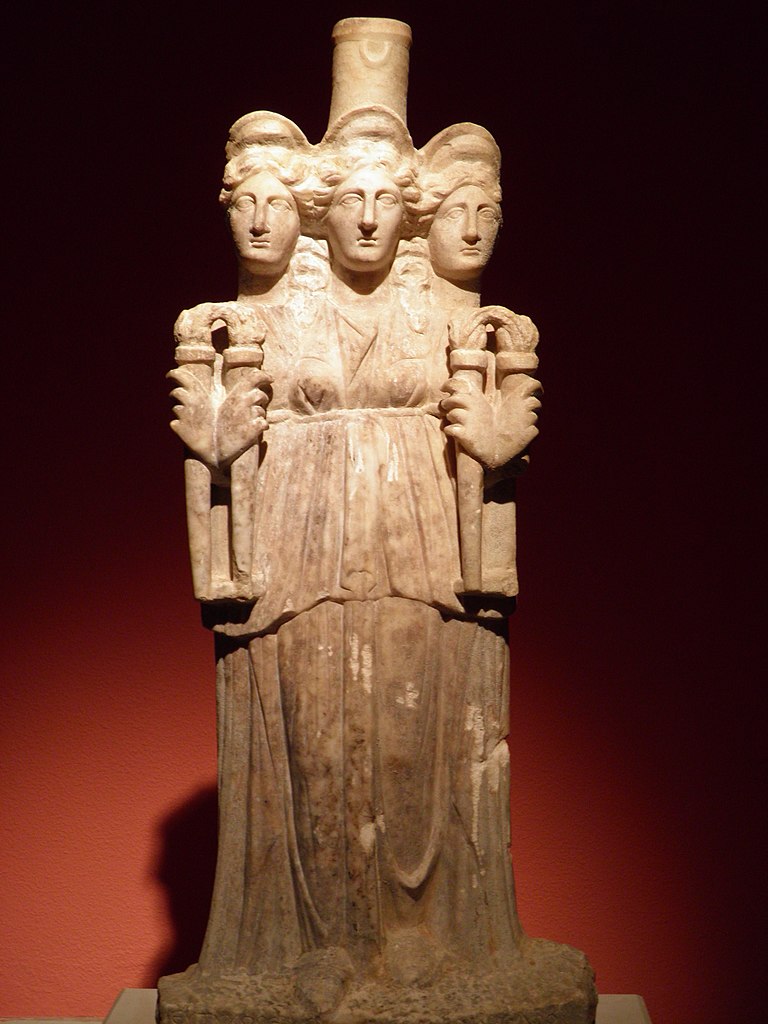
Statue of Hecate, 3rd century CE, Antalya Museum, Turkey [Carole Raddato, Wikimedia Commons, CC 2.0
Özhanlı also observed that Hecate remains an important figure for some contemporary Pagan practitioners and expressed hope that identifying a second Hecate temple in Türkiye would increase both scholarly and visitor interest in the site, alongside the better-known sanctuary at Lagina. His comments about contemporary Paganism, which included a brief description of Wicca in the original Turkish reports, have been paraphrased here because that description appears to contain translation errors and possible factual inaccuracies regarding modern Wiccan beliefs.
The identification rests on more than symbolism. Archaeologists recovered figurines and reliefs depicting Hecate during both the original excavations and recent fieldwork. Taken together with the temple’s location inside the sanctuary, the finds convinced researchers that the building was dedicated to the goddess.
Although Hecate later became widely known as a goddess associated with crossroads, magic, and the underworld, archaeological and literary evidence suggests her earliest cult emphasized protection, liminality, and lunar associations. The newly identified temple suggests her worship extended farther into inland Anatolia than previously documented.
Additional supporting evidence may come from another nearby excavation.
At Pisidian Antioch, also under Özhanlı’s direction, archaeologists previously uncovered two sacrificial dog burials. Dogs were among the animals most closely associated with Hecate in antiquity and frequently appear in myths surrounding the goddess.
“In many myths, Hekate is a goddess who rules over ‘Kerberos,’ which we call the ‘Hell dog’ of Hades, the underworld,” Özhanlı explained. “The most sacred animal is the dog, and we found two sacrificed dog graves during the Antiocheia excavations. These two sacrificed dog graves also archaeologically document that there was a Hekate cult in Antiocheia. Now we are standing in front of the temple.”
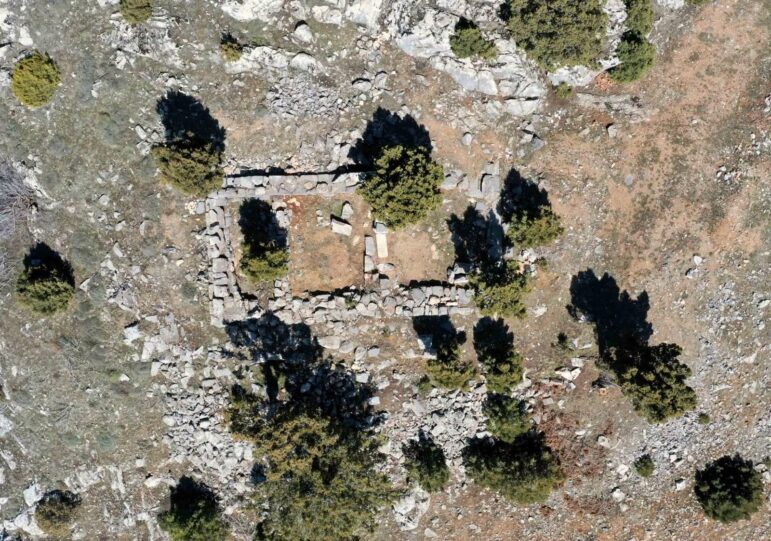
The site of the Temple [Courtesy DHA, via Instagram
The temple itself survives primarily at foundation level, but enough architectural elements remain for archaeologists to reconstruct its original plan. The building included a pronaos, or entrance porch, a central naos where the cult statue stood, and an opisthodomos at the rear. An octagonal stone pedestal remains in the center of the naos, preserving the location where the statue of Hecate once stood.
“The temple has a front area called pronaos, a back area called opisthodomos, and a middle area called naos,” Özhanlı said. “In ancient times, it was not possible for the public to enter the temple. Only the priest could enter, and the base on which the statue of the goddess stands inside the naos has also been preserved.”
Like the neighboring Temple of Men, the sanctuary suffered during the Christianization of the Roman Empire, when many traditional temples were dismantled or abandoned. Much of the Hecate temple was reduced to its foundations, although many original architectural blocks remain scattered nearby.
Özhanlı said the excavation team hopes to re-erect portions of the structure using the surviving stones.
“With the work we have done in recent years and the work we will continue to do, the material is already on the side; we will raise it up again and provide that appearance of the temple,” he said.
For modern Pagans and scholars alike, the identification adds a rare monument to one of antiquity’s most enduring and often misunderstood goddesses. The discovery not only resolves a 113-year-old archaeological question but also restores Hecate to the religious landscape of ancient Pisidia.
The Wild Hunt is not responsible for links to external content.
To join a conversation on this post:
Visit our The Wild Hunt subreddit! Point your favorite browser to https://www.reddit.com/r/The_Wild_Hunt_News/, then click “JOIN”. Make sure to click the bell, too, to be notified of new articles posted to our subreddit.