
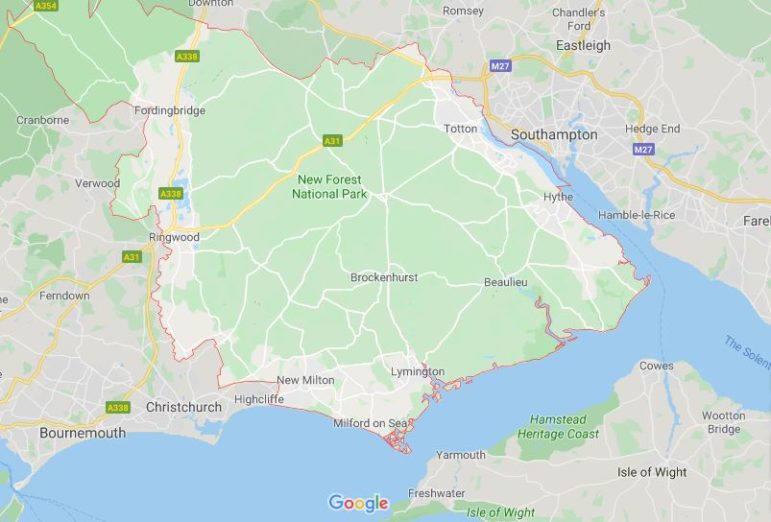
SALISBURY, England — Benjamin Lewis, who has admitted stealing lambs and depositing animal carcasses outside churches in Hampshire’s New Forest, has been detained in a medium-secure hospital this week. Lewis, who appears to believe that he will live forever if he drinks blood and who has a fascination with graveyards and vampires, left the remains of stolen lambs and road-killed deer outside and inside churches, sometimes accompanied by inverted crosses and Tarot cards. Local communities were understandably distressed, including clergy, churchgoers and local pagan groups, and the Hampshire police have devoted considerable resources to identifying the perpetrator.
Lewis was arrested after traces of his DNA were found on the remains of a lamb. He admitted causing “religiously aggravated intentional harassment, alarm or distress and the theft of lambs.” Rather than imposing a prison sentence, the judge made a hospital order under the Mental Health Act after concluding that treatment was the appropriate response.
Lewis did not confine his activities to local churches, but also targeted an NHS mental health unit in Hampshire: Anchor House, where he was receiving treatment. He was placed in seclusion after assaulting his psychiatrist, Dr Gauruv Malhan, who (understandably) told the police that his patient was likely to escalate to attacking humans.
At Lewis’ address, a suitcase was found with newspaper clippings of similar crimes dating back to 2003, when Lewis was jailed after terrorising a vicar and the vicar’s family near his home. Along with another man, he made abusive and frightening telephone calls, set off fireworks and posted obscene images on the church noticeboard.
At the time, he reportedly claimed to be a vampire, making the earlier offending strikingly similar in theme to the current case. Judge William Mousley KC, presiding over the current case, said that Lewis’s previous convictions, although “a long time ago,” demonstrated “worrying similar behaviour.” At the age of 13, Lewis left a dead frog on a cross in a church, suggesting that these behaviours extended back into adolescence – this is evidence heard from the consultant forensic psychiatrist rather than a criminal conviction. He is also reported to have harmed animals as a child.

New Forest, Hampshire – Image credit: Robert Linsdell, St. Andrews, Canada – Wikicommons CCA 2.0
PC Jess Surman said: “We’ve had people who were so upset and frightened by it that they couldn’t go to church, or see loved ones who are buried in the church grounds because they’ve been scared of bumping into him. It’s only through perseverance and getting enough evidence that we’ve got a really good result this time, and I can only hope that the community can sleep at ease with it.”
We are grateful to note that reports in the UK press, including the Guardian, have made the effort to make at least some distinction between Lewis’ beliefs and overall Pagan or occult practices. It is important not to mistake symbolism for identity, and most cases of this nature have nothing to do with any Pagan or occult paths.
Tarot cards are obviously used by Pagans and ceremonial magicians, Jungian therapists, artists, secular readers and people with no religious affiliation whatsoever. Likewise, an inverted cross has a complicated history. In Christian tradition it is associated with the martyrdom of St Peter; in popular culture it has become shorthand for anti-Christian sentiment. Neither symbol, in isolation, identifies a coherent belief system.
The police say that they carried out surveillance on ecclesiastical sites at particular phases of the moon and on significant dates in the Satanic calendar, although it’s not clear which one: genuine Satanist organisations observe different dates, many drawn from older European seasonal customs (such as Walpurgis Night), but including dates such as one’s birthday. To speak of “the Satanic calendar” as though it were a universally recognised system risks oversimplifying a landscape of beliefs that is already poorly understood by the public.
Doing so risks reinforcing stereotypes that modern Pagans have spent decades trying to dispel.
This distinction is important because conflating mental illness with religion does a disservice to everyone involved. It misunderstands psychiatric conditions, misrepresents minority faiths and obscures the actual reasons such crimes occur. Lewis’ case shows a consistent personal pathology spanning more than two decades, rather than someone participating in an identifiable Pagan or occult religious tradition. The continuity is not in any recognised belief system, but in Lewis’s own obsessions and behaviour.
Pagans in the New Forest have told the Wild Hunt that this has been an awful experience, and hopefully some closure can now be achieved with Lewis’ hospitalisation.
The Wild Hunt is not responsible for links to external content.
To join a conversation on this post:
Visit our The Wild Hunt subreddit! Point your favorite browser to https://www.reddit.com/r/The_Wild_Hunt_News/, then click “JOIN”. Make sure to click the bell, too, to be notified of new articles posted to our subreddit.