

What if Practical Magic’s Maria Owens had had the sense to curse the men responsible for her attempted execution, rather than her own descendants?
That’s the pitch for the 1942 romcom that clearly inspired the television show, “Bewitched,” René Clair’s I Married a Witch. Aside from the silliness and the long shadow of Salem, this film contains one of my favorite-ever uses of witchcraft committed to immortal celluloid: the stealing of an election.
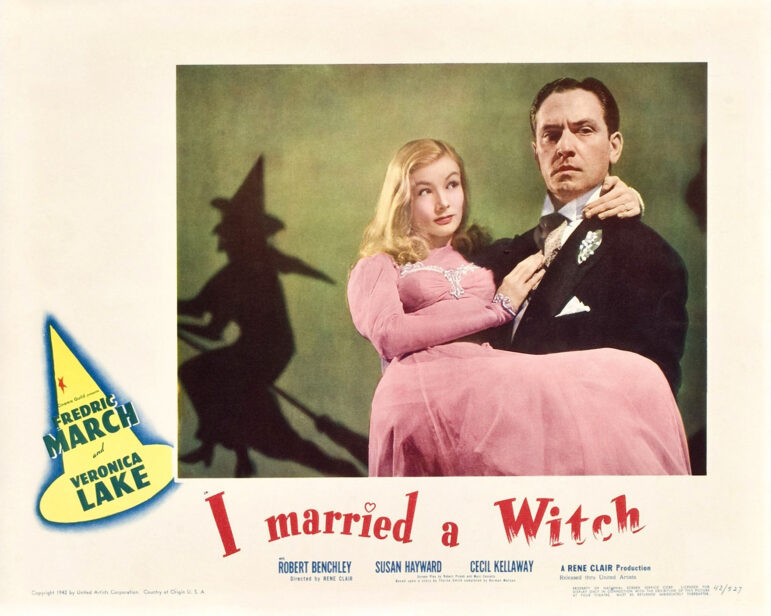
Lobby card for “I Married a Witch” (1942) [United Artists]
Jennifer, the titular witch (Veronica Lake), is freed from the tree that imprisoned her spirit after being burned in the Salem witch trials to become a mortal woman once again. She sets out to get revenge on Wallace Wooley (Fredric March), the descendent of the Puritan who burned her, by ruining his upcoming nuptials with Estelle Masterson (Susan Hayward). The old curse says that every Wooley man will be unhappy in love, but since this is 1942 that means one thing: shrewish wives. Determined to disrupt this curse by becoming an incredibly hot blonde, Jennifer begs for a body.
And what a body it is: Lake is a unblemished and burnished silver goddess in the black-and-white glow of the film, wearing nothing but a mink, a pair of darling little fur-trimmed heels, and an unblinking determination to seduce a boring New England politician. Only one problem: she must do so without her witchcraft. An absolute babe, and a babe in the woods.
Armed with nothing but a face card that never declines, the slim figure of a runway model, and the petulant demeanor of an iPad baby, she tortures the object of her affections by curling up in an armchair and stroking her pussycat. Dogging Wallace’s heels and demanding his attention, Jennifer (who has no last name until she is wed) slowly gathers an actual wardrobe and drops sly hints about her strange origins. Wallace, discombobulated by her broad appeals and unflinching criminal trespass, tries to turn her down while bridal-carrying her around the set and offering her money to go away.
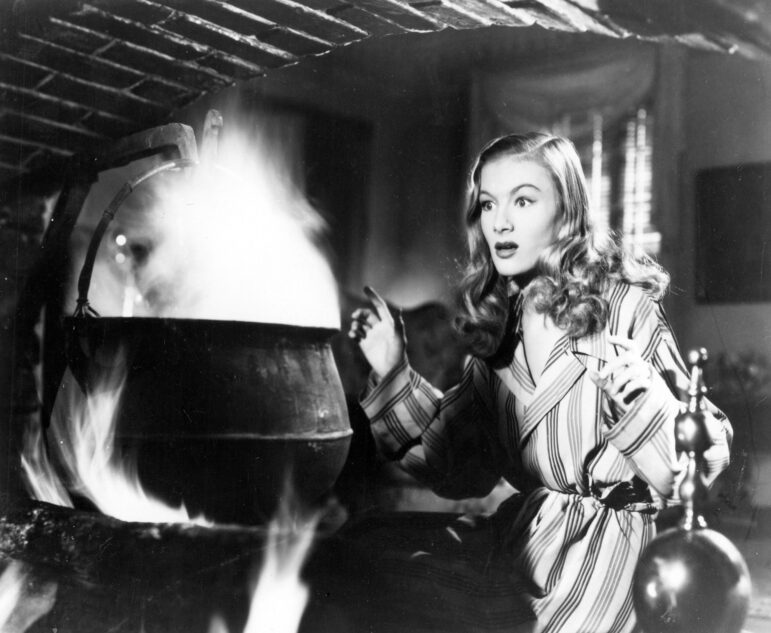
Veronica Lake as Jennifer in “I Married a Witch” (1942) [United Artists]
I’m tired of stories where witches fight fair, where they seek balance with nature and consent from everyone even distantly involved. I’m sick of the warning about love potions and I cheered with glee when Jennifer drank the one she intended for Wallace to imbibe. I don’t want to see one single movie where the triumph of the witch rests on the goodwill of her community or the desperate desire to assimilate and be loved by the people who imprisoned her, had her killed, or kept her down. The real way to curse a man’s bloodline isn’t to wish him ill; it’s to print copies of your own face on his grandchildren and ensure that he never gets away from the sound of a woman that loves him. A witch who is not concerned with ideas of fairness or moral rectitude can do great things.
Like steal an election.
Wallace Wooley, inheritor of puritan property and propriety, is running for governor. He doesn’t believe Jennifer at all when his new bride confesses that she’s a witch, placating and patronizing her all while she tries to explain where she came from and what she can do. What could be more compelling than a confession of witchcraft? In 1671, not much. In 1941, a wedding night with Veronica Lake might do the trick. Despite their misunderstanding, Jennifer uses her considerable powers to push the entire election her husband’s way. Not ‘entire’ like a landslide, ‘entire’ like every single vote, including the vote of his opponent in the race.
The witch in this story does not try to make it look natural. She doesn’t play fair, split the difference, or win graciously for the sake of appearances. She wins utterly, with one bootheel on her political opponent’s neck and the other on her enemies-to-lovers husband’s. Naturally, the patriarchy (Thorne Smith, who wrote the short story on which the film is based, Robert Pirosh and Marc Connelly who wrote the screenplay, director Clair, and the men at Paramount Pictures) insist that this makes her too powerful: Jennifer’s powers are stolen from her by her father, a warlock named Daniel, who was also burned by the Wooleys.
Never one to play fair, however, she pulls the double-cross. Getting her father drunk and trapping him in the bottle, she reclaims her body and returns to a life that has taught her that “love is stronger than witchcraft.”
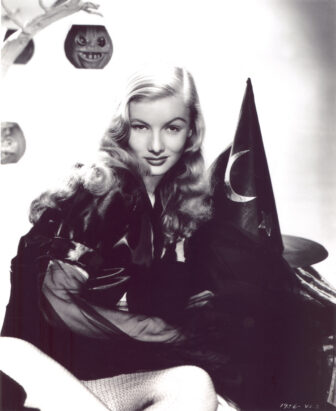
Veronica Lake as Jennifer in “I Married a Witch” (1942) [United Artists]
I’m not sure that’s true. We are living in a terrible tug of war where love and witchcraft are pulling on the same end of the rope against cruelty and emptiness. I think love and witchcraft are both irrational expressions of desperate human needs. They’re both things we do without knowing why, both carrying terrible power in our myths and in our minds. Both of them run on sacrifice and perpetuate themselves in spring spits of live red and dead white. Both of them drive Jennifer to her choices, and in the end the status of her powers is indeterminate. What her father claimed he could take from her is born again in her daughter. As long as there are children to learn it, the Craft goes on and on.
I Married a Witch is about love and witchcraft: two games in which no one has to play fair. Ripped off in “Bewitched” and echoed in Bell Book and Candle, it, too, passes on its mischievous genes to the next generation.
The Wild Hunt is not responsible for links to external content.
To join a conversation on this post:
Visit our The Wild Hunt subreddit! Point your favorite browser to https://www.reddit.com/r/The_Wild_Hunt_News/, then click “JOIN”. Make sure to click the bell, too, to be notified of new articles posted to our subreddit.