

Failure is a sacrifice. Failure is life. Failure is how we move forward.
Thirty years ago, Dorothy Allison wrote in her classic memoir Two or Three Things I Know for Sure, “Change, when it comes, cracks everything open.” Her memoir explores trauma and survival, poverty and abuse, and the ways the self is defined and redefined through experience.
Change in Allison’s world exposes truths, including how the stories we tell ourselves can cross generational lines. Our sense of self evolves with each step along the path that only we can see.
Failure is change. Success requires change, which requires failure.
How often do we snatch failure from the jaws of success by downplaying the subtle negative aspects of life that need to happen before we can embrace and enjoy its joys? How often do we ignore strengths that others can see in us in lieu of trumpeting our flaws, mistakes, and comedic life errors?
It is far easier to complain about what is not going right instead of seeing the value and treasure that lies within. We cannot see the jewels we are when we live this way.
When we ignore the warnings of our own internal wisdom, we risk falling from the skies like Icarus, testing wings that melt in the heat of the sun.

The Fall of Icarus, 17th century, from Musée Antoine Vivenel – collector and architect Wmpearl, Public domain, via Wikimedia Commons
I must confess: Five months ago, I thought I failed myself and my community because my body failed me.
Now, reality check: my surgery was a physical and emotional reminder that life is not only filled with change, but opportunity. Major surgery from which one emerges a) alive and b) renewed, albeit with a few missing pieces, should be considered a win.
For days I lay in a hospital bed, angry even as the air filled with beeps and squeaks of various medical equipment throughout the room. I was angry with the intrusion at 5 in the morning to stab my arm to check levels pre- and post-surgery. hated the feel of needing a potassium IV, which burns like nothing else, to the point of needing a warm pack to keep from scratching and pulling the IV out of my hand. Four of those torture devices had me wondering if the worst part of being in the hospital was not the surgery, but the preparation before and the recovery after.
A medical emergency never occurs at the right time in anyone’s life. Scheduled presentations on numerology and astrology at Paganicon were cancelled as I was barely five days post-surgery, and truly was not in a space to be around a lot of people.
If you have met me in person, then you know I love to “people”. I thrive on seeing new people, hugging friends old and new, and I’ve never met a stranger I didn’t like.
My past surgery made me aware that I need to be around my fellow humans. Missing a planned event meant devastation because of something I could not control: my body’s own pain—a cry that maybe I needed to take a time out.
Indeed, as Dorothy Allison noted, change did crack everything open, including my anger at myself and at life.
I resented time missed with friends. I objected to wasting vacation time for time in the hospital rather than relaxation with others. I hated how reality upset my carefully crafted plans.
Being angry at life circumstances prevented me at first from seeing the real issue: I hadn’t paid attention to my body’s signals for months that something was wrong.
As Americans, we live in a fast-paced, work-obsessed culture. Increasingly, rest is a luxury. It takes two resources many just do not have: time and money. In a world where the current economy has many deciding between paying for food, medicine, rent, or transportation, we have less of the first and maybe none of the second.
One can know that as humans we need nourishment for body, mind, and spirit. The words come easy. The reality is that rest intrudes when you hit the wall.
Like Icarus, my failure was in forgetting that when I don’t listen, I get a nice wake-up call. Surgery reminded me to pay more attention to being fully present for myself instead of racing through what passes as full-time work in our society where one cobbles several jobs together to make a living wage. In that world, saying “no” can be problematic.
As humans, we don’t say no. We do more. We race harder.
To be honest, some of my fellow humans are lucky. They do not appear to have this issue.
I have no beef with them and wish continued blessings of the Gods upon them.
They are brave individuals who either figured out things far earlier than the rest of us or have hit the end of the line and just tapped out. Some might just have a ton more energy.
Our bodies are amazing machines that can mend broken bones, fend off viruses, and close wounds. Anyone who has recovered from a broken arm, wrist, or leg can attest to the body’s remarkable capacity for healing. Given time and support, bones can knit and strengthen over weeks and months.
Anything that creates a wound needs time to heal completely.
Going from a world of perpetual motion to days when “nap attacks” of three to five hours were common showed me how allowing time to sleep or just let my brain wander provided a different type of healing.
Broken bones have casts to hold the parts in place while the bone re-knits.
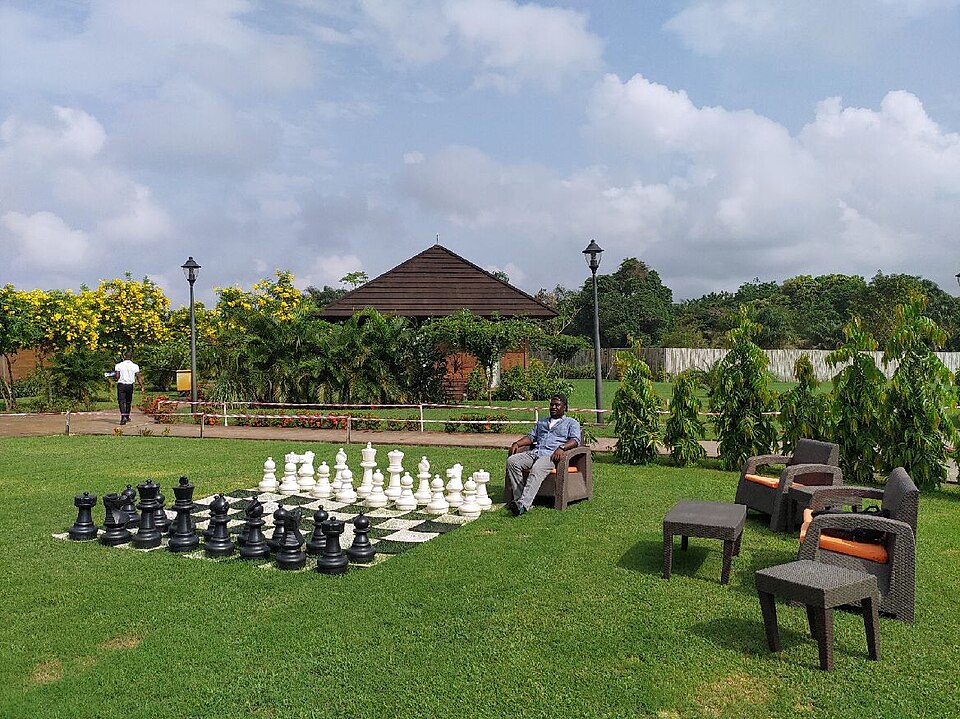
Relaxation at a Resort Dotun55, CC BY-SA 4.0 <https://creativecommons.org/licenses/by-sa/4.0>, via Wikimedia Commons
I also felt failure in my favorite grocery store right after two dear friends picked me up from the hospital. Just a trip to pick up my prescription and two food items had me racing for the parking lot after only 25 minutes. Mentally, it was too overwhelming to be around so many people. I was having a painful out-of-body experience. I wondered for a few days whether I was now, post-surgery, agoraphobic.
Good news: I’m not, and I just needed rest. My emotional receptors were wide open, and while the writer and storyteller in me loved the experience, my wounds—mental, emotional, and physical—did not.
What I learned was that sometimes the best healing, especially for Earth-based tradition folks, is to not only listen to the body but to be alone—or rather, to allow the body to progress at its own pace.
We talk a lot about listening to nature, to the physical world around us, and that includes our physical selves.
When we wish to rebalance the self after a time of perceived failure, we are attempting to find grace and a new state of balance.
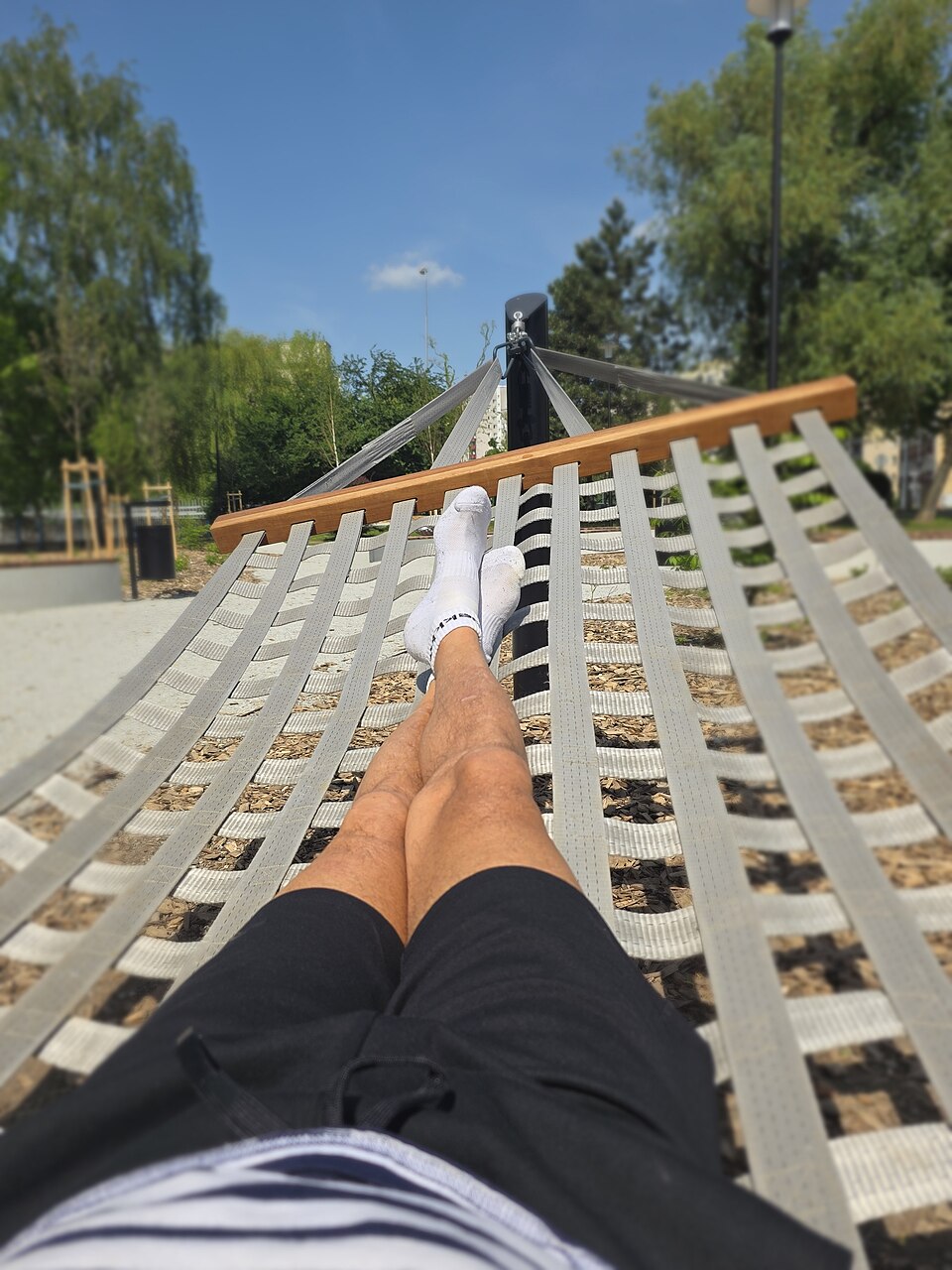
Person relaxing in Hammock Auctor quaerendae, CC BY-SA 4.0 <https://creativecommons.org/licenses/by-sa/4.0>, via Wikimedia Commons
Larger body parts require time to dissolve the stress that inhabits the body: spiritually, mentally, and physically.
It is a subtle change.
It is a time to relearn the rhythm of life: not the “musts”, “coulds”, and “shoulds”, but life as it stands after a disruption.
Steps are tentative because they are unfamiliar and unknown. The path to success lies in accepting change as it comes, not forcing the body and spirit to return to what was known.
While returning to the familiar might seem more natural, it can work against the healing required to move forward.
Sometimes healing is just relaxing and allowing the body to soak in the sunshine or snuggling under the warmth of a down comforter when the day is rainy and cold and watching nothing.
Doing nothing. Watching life go by and being okay that this is where you are.
We have our connection with the Gods, the ancestors, the spirits, the elements, or whatever combination works for our paths to remind us that when we are in tune with what keeps us whole, then everything turns out right. Our health, how we view the world, and how we view ourselves depend on finding that sense of grace and balance even during times of perceived failure.
Sometimes failure is a gift to show us the way to life. Often it is just a cry to slow down and just be. Find a place to rest and let the self heal.
The Wild Hunt is not responsible for links to external content.
To join a conversation on this post:
Visit our The Wild Hunt subreddit! Point your favorite browser to https://www.reddit.com/r/The_Wild_Hunt_News/, then click “JOIN”. Make sure to click the bell, too, to be notified of new articles posted to our subreddit.