

Sometimes, just when we think that the world can’t get crazier, we get a reminder that life can surprise us.
April is a curious month, filled at times with rain, snow, or sunshine. The current full moon in Libra asks us to consider balance. February’s Saturn conjunction with Neptune at zero degrees Aries was the wave of the green flag, letting us know that we could and should accelerate to full speed as we begin this part of our journey. Late February into March provided us with one last Mercury Retrograde in Pisces to re-see and re-view some matters.
I asked for clarity and evaluation.
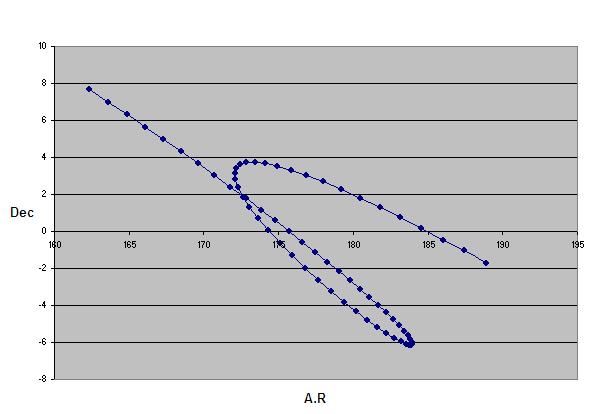
Mercury Retrograde Path – Agestevez, CC BY-SA 4.0 & ;https://creativecommons.org/licenses/by-sa/4.0>, via Wikimedia Commons
This most recent Mercury Retrograde in Pisces (February 26 – March 20, 2026, the Spring Equinox), made a blessed return of events from Mercury Retrograde in Libra (September 27 – October 18, 2021). My column based on sudden events occurring on October 13-22, 2021, and specifically, the midnight hour of October 14, was one that I never thought would happen ever again.
Never say never.
Mercury Retrogrades gets a lot of shade as being a horror, and a time to “re-” everything: re-evaluate, re-flect (and pause), re-assess, re-set (or re-charge), re-align, re-connect, and re-pair. However, sometimes life needs reconsideration, which is exactly what happened.
This time around, my surgery was three times longer than anyone expected, but it took care of what was not fully addressed the first time around – exactly what one would expect surgery during Mercury Retrograde to do.
Abdominal surgery is tough because it forces us to do what many of us either are not able or are not willing to do: rest.
Sleep is nature’s cure for so many things. We accept that at the beginning of our lives from birth through the early newborn stages when we are so cute that our parents and caregivers forget or overlook the reality of a being whose sole language is crying. New parents soon figure out for each child if the cry is one of hunger, of a need for a diaper change, of tired when the child refuses to sleep, or just one of joy.

Baby Cape fur seal sleeping at Cape cross, Namibia – Giles Laurent, CC BY-SA 4.0 <https://creativecommons.org/licenses/by-sa/4.0>, via Wikimedia Commons
We each enter this world with a polyphasic, no rhyme or reason, sleep every day. It’s why we see the baby at eight weeks in Costco sleeping happily while its parents gather orange juice and consider whether they need to add broccoli to the cart. Noise doesn’t bother them because they are following the need to sleep. Some children really do sleep through anything. The only sign that there is a child on hand is a grey thick snuggly hat and a tiny hand that is almost reaching inside of the cute bow lips of the child, strapped to its mother’s chest inside her jacket.
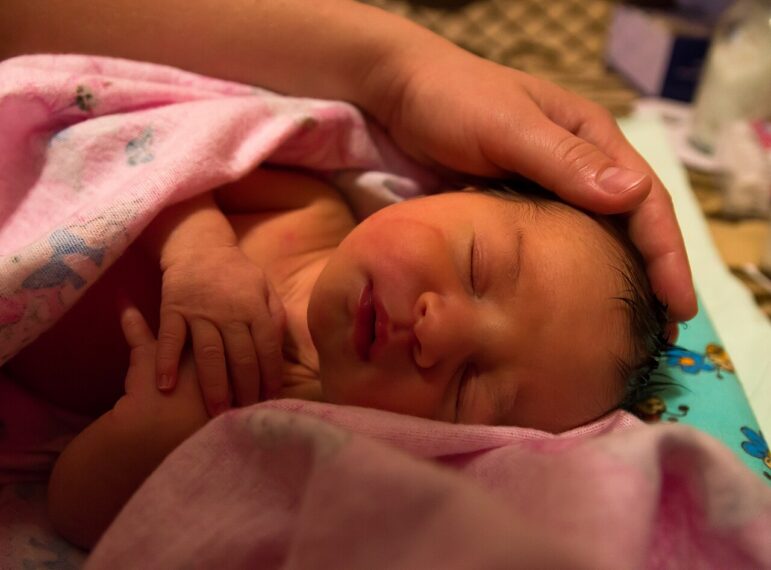
Sleeping baby. Baby’s sleep. Moscow, Russia. © Vyacheslav Argenberg, CC BY 4.0 <https://creativecommons.org/licenses/by/4.0>, via Wikimedia Commons
Barring a few possible issues, the newborn sleeps a lot, perhaps an average of 16-17 hours a day, with some sources saying up to 20 hours for the first several months. This gives parents plenty of time to attempt to rest while this new life form adjusts to being in the new world.

2023 – CDC recommendations for amount of sleep needed by age.
Now, I can hear the parents of newborns going – wait! I never get sleep!
While this is true, life does get better. After the hormonal adolescent years, when all bets seem to be off, we settle down to a “normal” phase.
As adults, we shape our lives into something that approximates our daytime (waking hours) and our nighttime (sleeping hours). For second shift (3 p.m. – 11 p.m.) or third shift (11 p.m.-7 a.m.) type of workers, we adapt with a daytime sleeping or shortened sleep schedule. True night owls who have Delayed Sleep Phase Syndrome are often rocking at midnight because their “bedtime” is not nine or even ten in the evening, but quite a bit later, such as 1 or 3 a.m.
At times, these individuals have a shorter length of “ideal” sleep, such as six hours instead of eight. I come from a family of night owls partly from relatives including a parent who worked swing shift jobs. I was relieved to find out that this can be a hereditary condition which explained why as a young child taking a nap at 2 pm, if my grandmother could get me to do so, would only ensure that I would be awake for most of the “night”, finally going to sleep around 1 or 2 a.m.
Our journey from the polyphasic sleep reality of newborns to the full nighttime monophasic sleep reality that we promote as adults means that we presume the sleep we get during our once a day session is what we need. We have grown and we can “get by.”
Sadly, although we feel as adults that we have control over our use of “rest” in terms of how we can rest, when we are able to rest, and how much rest our body needs, we end up with a deficit.
Missing rest shows up as our societal realization that we are pushing the envelope on a regular basis. It is a matter of national pride in a way: how much can we do to make ourselves relevant or to demonstrate our importance in our job? How much should we do to maintain our place in our work lives, our communities, and our familial lives? Culturally on a national level, we are known for working to excess, taking little vacation, and when in doubt, take on another job.
This is not because we do not want to rest, I believe, but because to fit in, we work.
When we think of rest, we should consider the following:
- How often do we relish sleeping in on weekends or our days off, even though sleep hygiene experts recommend that we go to bed and wake up at the same time each day to maintain consistency?
- How often do we find our bodies reacting with horror during the time change in spring when the clocks skip backwards an hour, and physically it may take more than a week for us to catch up?
- How relieved are we when we hit November and we can count that extra hour when our body gives a sigh of relief as we snuggle under the covers for a bit longer?
Pausing to rest is a very important, yet invisible component of our lives.
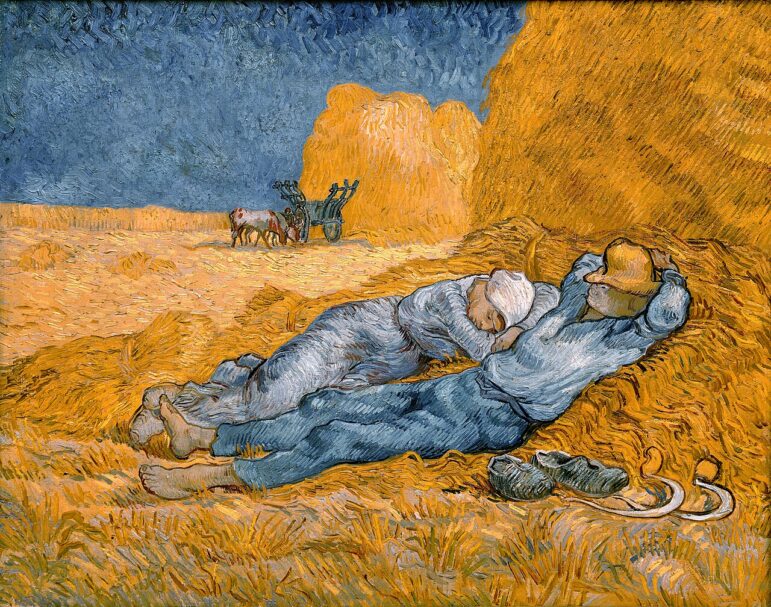
Noon – Rest from Work (after Millet)- “La Sieste” – Vincent Van Gogh Vincent van Gogh, Public domain, via Wikimedia Commons
Post-surgery this time around, all I have done for the most part is sleep. I am enjoying the rest part now, after three weeks. I no longer resent the pattern of being awake for three or four hours, then sleeping for three or four hours.
Rest is more than allowing the physical body to recover. It gives all the rarely seen bits of the body to send soothing vibes, nutrients, and instructions to the recovering body part or parts. Rest does not get enough credit for what it does. Moreover, in American society, we are taught to do many things; however, rest is not one of them.
Remember all those commercials filled with active attractive persons stretching in all different directions as the voice speaks about caring for one’s core? Or the ones where sleek toned athletes stress the importance of a particular mattress to guarantee a full night’s rest? Wealth can be listed in so many aspects, and sleep wealth is among the most important for a balanced life.
I look forward to resting because it is a luxury that you don’t know you are missing until something happens.
Thankfully, we are given the medicine we need regardless of our willingness to take it. As newborns, we sleep to grow, to heal, and to evolve as humans. As emerging toddlers, we still sleep a great deal, with eleven to fourteen hours of sleep not being out of line. Parents are grateful when the bundles of joy run out of steam and just rest.
Rest is medicine. Rest allows us to reform and reshape who we are internally on a physical and spiritual level. We need to rest to figure our next steps. When our days are a blur of rush to work and other activities, we need to stop and bring peaceful order to our lives. Sometimes it takes more than just one good night’s sleep. We consciously walk our path looking for peace and happiness regardless of our life circumstances, so give rest a chance. A pause can be just as healing as a nap.
As we celebrate this full moon of balance (Libra), and bustle about our spring activities, let’s add a little rest into our lives. We need it. Van Gogh’s painting reminds us that a nap during the workday actually might be a good thing.
Enjoy spring, and my wish for all is a good healing rest.
The Wild Hunt is not responsible for links to external content.
To join a conversation on this post:
Visit our The Wild Hunt subreddit! Point your favorite browser to https://www.reddit.com/r/The_Wild_Hunt_News/, then click “JOIN”. Make sure to click the bell, too, to be notified of new articles posted to our subreddit.