

ASSEN, Netherlands – A golden helmet and two bracelets, dated to approximately 450 B.C.E. from the Dacian civilization, has been recovered and returned to the Drents Museum in Assen, the Netherlands, Dutch authorities announced last week.
“On the golden helmet of Coțofenești, as you can see, two eyes are depicted,” said Robert van Langh, the director of the museum. “They are meant to protect both the wearer and the helmet itself against the evil eye, against misfortune. They have done so successfully for centuries, and even today they seem to prove their value.”
The artifacts, which are Romanian national treasures on loan to the museum, were stolen last year in an audacious burglary. Three men used explosives to break into the museum and steal the helmet and three bracelets from the exhibition “Dacia – Empire of Gold and Silver.”
The third golden bracelet is still missing.
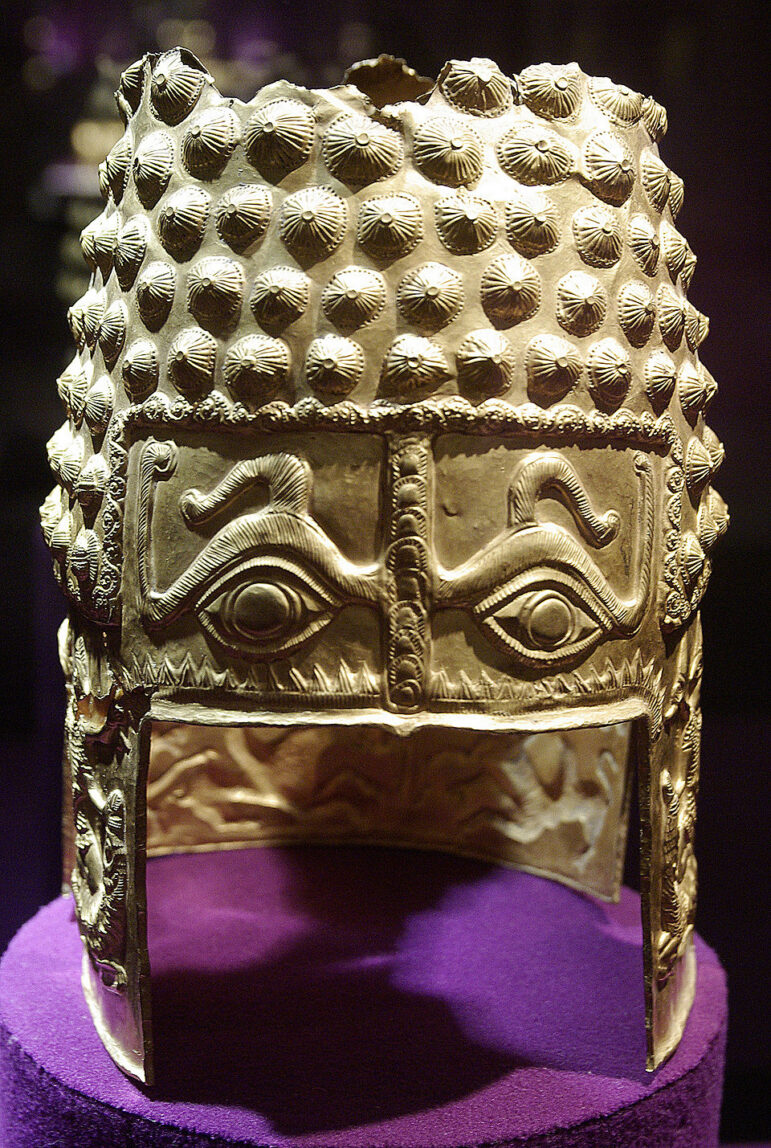
The Golden Helmet of Coţofeneşti, A Geto-Dacian helmet dating from the first half of the 4th century BC. [Courtesy Radu Oltean]
Dacia was the ancient name for a region that today mostly sits within Romania. The Dacian people, or Getae, are mentioned by ancient Greek writers like Herodotus of Halicarnassus. They were a subset of the broader Thracian culture, which lived throughout southeastern Europe. Herodotus complimented them in his Histories as “the noblest as well as the most just of all the Thracian tribes.”
The Dacian helmet was discovered in the village of Poiana Coțofenești in 1926 by a child herding sheep, who at first played with it as a toy. Reportedly, the child’s father also used the helmet as a watering trough for chickens before placing it atop his chicken coop. The helmet was bought by a merchant, who then turned it over to the Romanian Minister of Arts. The predecessor of the National History Museum of Romania purchased the helmet in 1929, and it has been a highlight of their collection ever since.
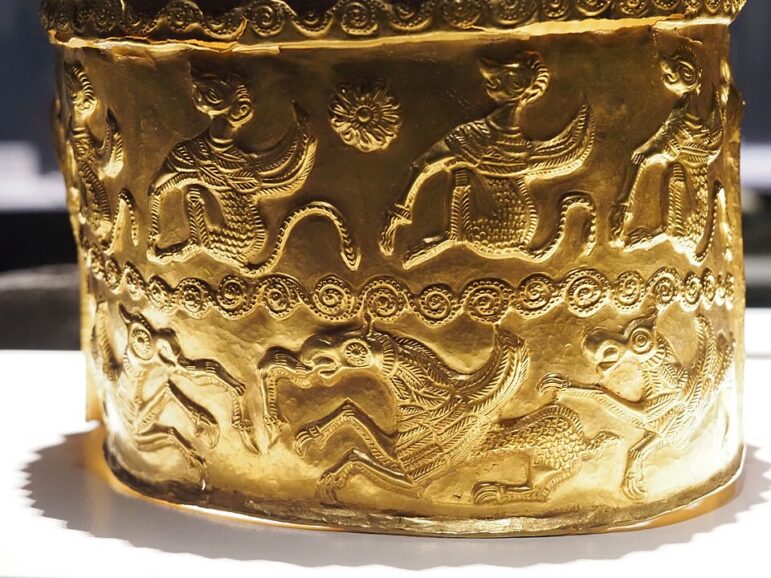
Helmet of Coțofenești (Coțofenești – Dealul Măgura, Vărbilău, Prahova County, Romania), gold, mid 5th century BC, Bucharest, National Museum of Romanian History (Inv. 11420). [public domain]
The helmet has many intricate scenes engraved on it, which likely relate to the Dacians’ history and religion. The most striking features are the two large eyes above the opening for the wearer’s face. The cheek-pieces show a man slitting the throat of a ram in a manner that resembles the famous images of bull sacrifices in the cult of Mithras. The back of the helmet shows two rows of creatures: a set of winged figures on the top register and a set of beasts facing the opposite direction on the bottom.
Unfortunately, the Dacians themselves did not leave behind written accounts, and the information we have from Greek authors is filtered through the interpretatio Graeca, the practice where Greek authors discussed the deities of other cultures as aspects of their own gods. As a result, we cannot clearly name the figures on the helmet.
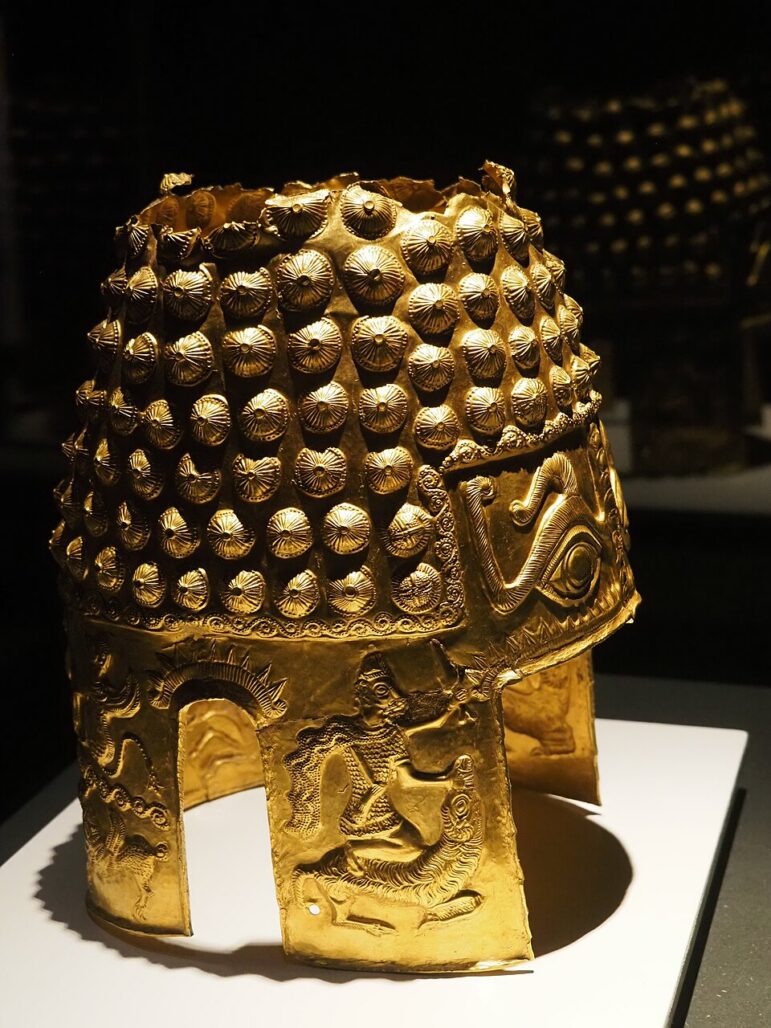
Helmet of Coțofenești (Coțofenești – Dealul Măgura, Vărbilău, Prahova County, Romania), gold, mid 5th century BC, Bucharest, National Museum of Romanian History (Inv. 11420). [public domain]
The theft of the artifacts caused great turmoil between the Netherlands and Romania. The head of the Romanian National History Museum, Ernest Oberländer-Târnoveanu, was fired for his decision to loan the items out of the country, and the Netherlands paid out nearly six million euros as insurance compensation. (It is as yet unclear whether that money will be repaid now that most of the items have been returned.)
The thieves were arrested within days of the theft, but had, up to this point, kept their silence. Dutch authorities made numerous attempts to convince the thieves – two men in their 30s and one in his 20s – to reveal the location of the artifacts. They offered one suspect a lesser sentence and attempted to convince another that an undercover police officer was a fence offering hundreds of thousands of euros in exchange for the items. The thieves face trial later this month. Corien Fahner, the Dutch prosecutor in charge of the case, said that the treasures were returned as part of a pre-trial agreement.
The authorities believe the thieves were hired by a criminal gang to steal the artifacts and likely intended to melt them down, but had not because the gang was apprehended shortly after the theft.
“We suspected that [the artifacts] had not been melted down because the suspects were arrested so quickly, within four days of the robbery,” said Arthur Brand, a Dutch art detective.
Oberländer-Târnoveanu, the sacked museum director, said that he was “relieved and more than happy” to hear of the recovery of the helmet and bracelets.
“This is a unique item in European and even global cultural heritage,” said Oberländer-Târnoveanu. “The helmet is an important social and political symbol of Dacian civilisation.”
The Wild Hunt is not responsible for links to external content.
To join a conversation on this post:
Visit our The Wild Hunt subreddit! Point your favorite browser to https://www.reddit.com/r/The_Wild_Hunt_News/, then click “JOIN”. Make sure to click the bell, too, to be notified of new articles posted to our subreddit.