
ALBUQUERQUE — Protections for Chaco Canyon are once again under threat, as federal officials move to potentially roll back a key safeguard designed to limit oil and gas development around one of the most culturally and spiritually significant landscapes in North America.
At issue is the Trump administration’s proposal via the U.S. Bureau of Land Management (BLM) to rescind or reduce a 10-mile buffer zone surrounding Chaco Culture National Historical Park.
The site was first designated a national monument in 1907 by Theodore Roosevelt, and later elevated and renamed by Congress in 1980 to reflect both the scale of the “Greater Chaco” landscape and the complexity of the culture that flourished there. The park is also recognized internationally as a UNESCO World Heritage Site.
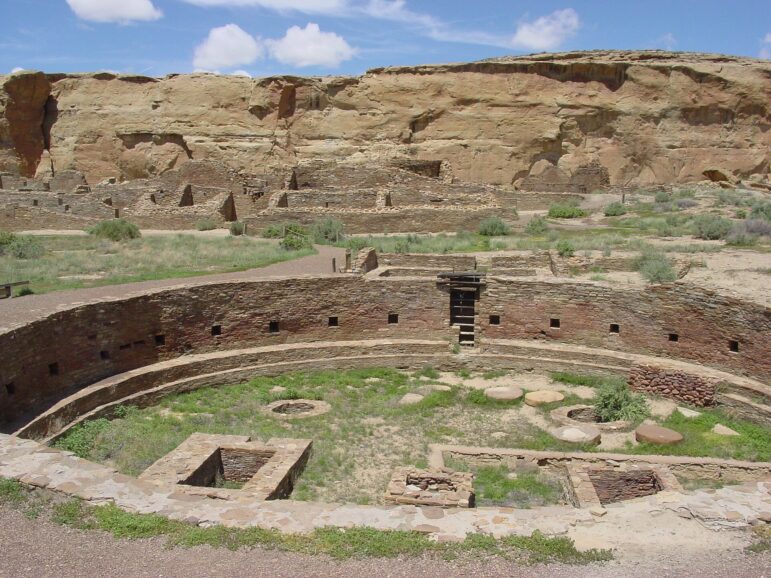
An image of the ruins of Chetro Ketl in Chaco Canyon (New Mexico, United States); shown is the complex’s great kiva. [Public Domain: National Park Service]
Established in 2023 under the Biden Administration, the current buffer zone prohibits new mineral leasing on federal lands within 10 miles of the park for 20 years, aiming to protect not only the archaeological remains within its boundaries but also the broader cultural and sacred landscape that extends far beyond them.
Chaco Canyon is far more than a collection of ancient ruins. Located in northwestern New Mexico, it contains one of the most extensive concentrations of pre-Columbian structures in the American Southwest. Between the 9th and 12th centuries, ancestral Pueblo peoples constructed monumental “great houses,” including Pueblo Bonito, along with roads, ceremonial features, and a vast network of outlying sites stretching across the Four Corners region. These sites form an interconnected system, one that reflects not only architectural sophistication but a deep integration of culture, environment, and cosmology.
That cosmological dimension remains essential. Chacoan structures are widely understood to reflect precise alignments with solar and lunar cycles, including the 18.6-year lunar standstill. For many scholars and Indigenous knowledge keepers alike, these alignments point to a ceremonial landscape shaped by careful observation of the heavens and sustained spiritual practice over generations.
For descendant communities, including Pueblo peoples of New Mexico and Arizona, as well as the Hopi Tribe, Zuni Tribe, and Navajo Nation, Chaco is a place of profound spiritual power. It is a living ancestral homeland and a place of ongoing spiritual presence.
The canyon and its surrounding landscape are a sacred space, where ceremonial knowledge, migration histories, and relationships to land continue to be maintained. For many, this is a place where the boundary between the physical and spiritual worlds is especially thin.
It is precisely because of this sacred status that tribal leaders have long opposed oil and gas development in the surrounding region. The concern is not limited to the physical destruction of sites, but extends to the disruption of the landscape itself, the views, the soundscape, and the integrity of place that gives meaning to the ceremonial world.
That broader context is central to the current controversy. While federal laws require developers to “identify and avoid” significant archaeological sites, supporters of the Chaco Canyon buffer and other sacred locations argue that such measures fail to account for the cultural and spiritual relationships embedded in the land. Even when individual structures are preserved, nearby industrial activity can fragment the larger sacred landscape, diminishing its meaning and function.
The BLM’s proposal would consider three options: maintaining the current 10-mile buffer, reducing it to five miles, or eliminating it altogether, the agency’s preferred option. The move has drawn strong opposition from tribal leaders, elected officials, and advocacy groups.
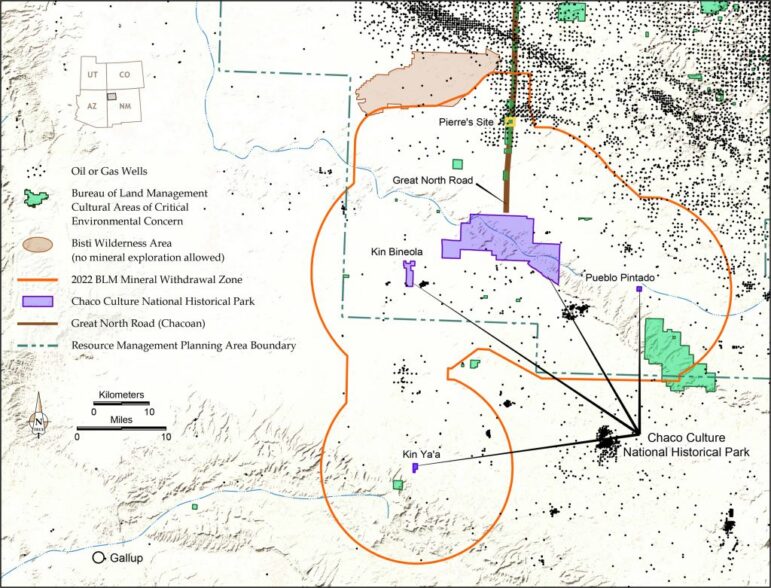
Chaco Canyon and the Greater Chaco Region face growing threats from oil, gas, and mineral extraction, with about 90% of surrounding federal lands already leased for development. (Map by Archeology Southwest/via All Pueblo Council of Governors)
The All Pueblo Council of Governors expressed deep concern, stating it was “dismayed” by the effort to unwind protections. Chairman Joey Sanchez emphasized the enduring sacredness of the site, stating, “Chaco Canyon will always be revered and respected as a sacred place by Pueblo people. We will use our collective voice to continue the fight.”
Federal lawmakers have echoed these concerns. U.S. Sen. Martin Heinrich (D-N.M.) described Chaco as “a living cultural landscape that holds deep historical meaning and is a sacred space,” adding that it is “not just one more place to drill.” Sen. Ben Ray Luján criticized the process as “inadequate and disgraceful,” noting that only seven days were allotted for public comment on what he called “the fate of a 1,000-year-old sacred site.”
New Mexico Land Commissioner Stephanie Garcia Richard called the proposal a “disastrous plan,” pointing to both the limited timeframe and the absence of public meetings. Acoma Pueblo Gov. Charles Riley raised additional concerns about accessibility, noting that requiring online submissions creates barriers for elders and others with limited internet access.
Environmental and cultural advocates have also warned of the consequences. Rev. Andrew Black of the National Wildlife Federation described the proposal as an “underhanded attempt” that could expose thousands of sacred sites to development, while Jesse Deubel of the New Mexico Wildlife Federation cautioned that expanded drilling would threaten not only ecosystems but also the cultural continuity tied to the land.
At the heart of these objections is a shared understanding: Chaco Canyon is not simply an archaeological site. It is a sacred, living landscape, one that continues to hold spiritual, cultural, and historical meaning for Indigenous peoples today.
The urgency of the moment is underscored by the timeline. The BLM’s public comment period, which opened on April 1, is set to close tomorrow, April 7, coinciding with Easter, Passover, and traditional Pueblo observances. Critics argue that the compressed schedule limits meaningful participation in a decision with far-reaching implications.
For those who wish to support the continuation of the buffer zone, there is still a narrow window to act. Public comments can be submitted through the BLM’s ePlanning system, where input will help shape the forthcoming environmental assessment.
As the deadline approaches, advocates stress that engagement matters. Whether framed as preservation, religious freedom, environmental protection, or the defense of sacred land, the future of Chaco Canyon, and the spiritual landscape it embodies, now rests, in part, on public response.
Those interested in commenting may do so via the BLM National NEPA Register.
The Wild Hunt is not responsible for links to external content.
To join a conversation on this post:
Visit our The Wild Hunt subreddit! Point your favorite browser to https://www.reddit.com/r/The_Wild_Hunt_News/, then click “JOIN”. Make sure to click the bell, too, to be notified of new articles posted to our subreddit.