

Uncovering the Past
DEVIZES, England — For more than two centuries, an Early Bronze Age burial discovered near Stonehenge was understood to belong to a man. Now, ancient DNA analysis has overturned that identification, revealing that the individual buried with tools associated with goldworking and objects interpreted as having ritual significance was a woman.
Recent DNA analysis has shown that the Upton Lovell “shaman”, a 4,000-year-old skeleton found in Wiltshire, England, in 1801–02, is not, as previously supposed, male. The figure was buried with the remains of what is believed to have been a ceremonial cloak and an array of specialist metalworking tools, indicating a high-status individual. Archaeologists have often considered Bronze Age metalworkers to have occupied a special place in society, since the ability to transform stone into shining bronze or gold must have seemed almost magical. This association between craft, ritual and specialised knowledge eventually gave rise to the label “shaman” – a description that modern archaeologists now treat with considerably more caution.
The grave goods are exceptional. They include a touchstone, used to test the purity of precious metals; stone tools interpreted as scribes or burnishers for working metal; small cups fashioned from fossilised sea sponges that may have held adhesives or pigments; a finely polished stone; and a greenstone battle axe from Cornwall, thought to have served as a hammer rather than a weapon. Microscopic analysis has revealed traces of gold on several of the tools, strengthening the interpretation that the burial belonged to an accomplished craft specialist.
David Dawson, Director of Wiltshire Museum, where the remains are held, told the press:
“It shows the depth of understanding of her craft. The people she left behind wanted her to take her toolkit into the afterlife…. It completely tears up previous assumptions. It’s a fantastic revelation of the position of women in society. We’re so used to the assumption that men do everything – men are the leaders, men are the metalworkers. Here we have smoking gun evidence of a female metalworker. And metalworking was the space science of its day.”
The discovery arose from a collaboration with the Francis Crick Institute’s exhibition We Go Way Back, which explores how modern genetics is reshaping our understanding of the past. DNA extracted from the skeleton revealed not only that the individual possessed Beaker ancestry, but also that she was biologically female. Having looked at earlier papers on this dig, however, we note that some caution was previously sounded on the assumption that the skeleton belonged to a man.
She was approximately 5 ft 4 in (1.63 m) tall and lived in the Stonehenge landscape during the Early Bronze Age. Examination of her skeleton also revealed arthritis in her right wrist, perhaps the result of years of repetitive craft work, although such evidence cannot identify a specific occupation with certainty. She is also described in the original papers on this burial as ‘stout.’
The burial itself has a remarkable history. It was excavated in 1802 by the pioneering archaeologist William Cunnington, working with the wealthy antiquarian Sir Richard Colt Hoare, during their celebrated investigations of the barrows of Wiltshire. Their discoveries were later published in Ancient Wiltshire, one of the founding works of British prehistoric archaeology.

Stonehenge (Photo Credit: Manny Tejeda y Moreno)
Within a chalk-cut grave beneath a round barrow, Cunnington uncovered the primary burial of the metalworker, laid extended on her back, together with a second burial placed above her, described as being in a “sitting posture”—probably what archaeologists would now recognise as a crouched burial. Unlike many antiquarian excavators, Cunnington kept reasonably careful notes, although by modern standards his recording was limited. Crucially, no detailed plan of the grave survives, making it difficult to reconstruct the precise arrangement of the remarkable collection of grave goods.
The title “Upton Lovell Shaman” is itself a relatively modern invention. It was not used by Cunnington or Colt Hoare. Instead, it was coined in 1962 by the archaeologist Stuart Piggott, who compared the elaborate costume and unusual artefacts with Mesolithic burials in northern Europe that had been interpreted as belonging to shamans. The evocative label captured the public imagination and has remained attached to the burial ever since. Today, however, many archaeologists regard the term as speculative. While the burial undoubtedly belonged to an exceptional individual, there is no direct evidence that she performed a religious or shamanic role. The extraordinary grave goods may instead reflect the high status accorded to skilled metalworkers in Bronze Age society.
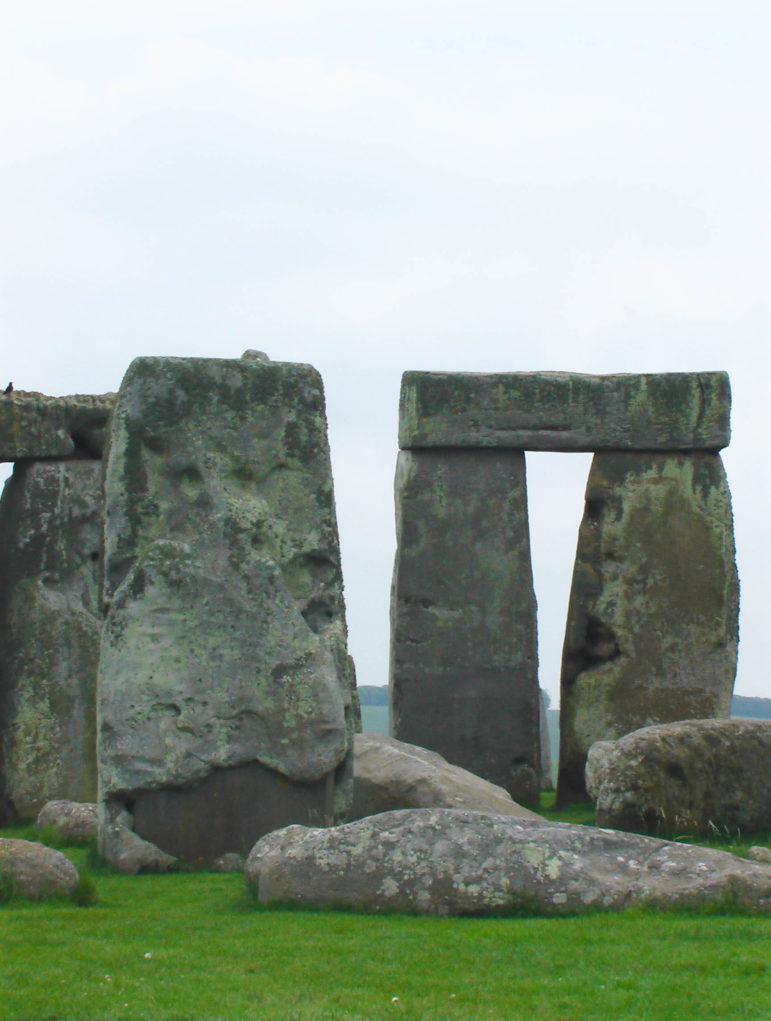
Stonehenge
Classicist Professor Mary Beard, who is involved with the We Go Way Back exhibition, comments:
“So often we have assigned the sex of an ancient skeleton partly on the basis of our own assumptions about sex and gender roles – if it is buried with a sword, it’s male; with a necklace, it’s female. As with the Upton Lovell shaman, DNA analysis can help us correct those assumptions and think harder about the roles of men and women in the deep past – and perhaps also in our own world.”
The Upton Lovell burial is therefore significant not simply because a famous “male shaman” has become a woman. Rather, it illustrates how archaeology continually re-examines its own assumptions. Two centuries after Cunnington first opened the grave, advances in genetics, microscopic analysis and archaeological interpretation continue to transform our understanding of one of Britain’s most celebrated Bronze Age burials.
The Wild Hunt is not responsible for links to external content.
To join a conversation on this post:
Visit our The Wild Hunt subreddit! Point your favorite browser to https://www.reddit.com/r/The_Wild_Hunt_News/, then click “JOIN”. Make sure to click the bell, too, to be notified of new articles posted to our subreddit.