
WASHINGTON — The United States Supreme Court on Tuesday scheduled oral arguments in St. Mary Catholic Parish v. Roy for November 3, setting the stage for a major religious-freedom dispute over Colorado’s Universal Preschool Program. While the dispute involves Catholic preschools and Colorado’s nondiscrimination protections, the Court’s eventual ruling could have broader consequences for the balance between religious exercise, access to government benefits, and civil rights protections.
Colorado’s Universal Preschool Program, known as UPK, provides publicly funded preschool for four-year-old children through public and private providers, including religious schools. Participating providers receive state funding but must comply with program requirements intended to give families equal opportunities to enroll.
Among those requirements, providers generally may not discriminate in enrollment based on characteristics including race, disability, religious affiliation, sexual orientation, or gender identity.
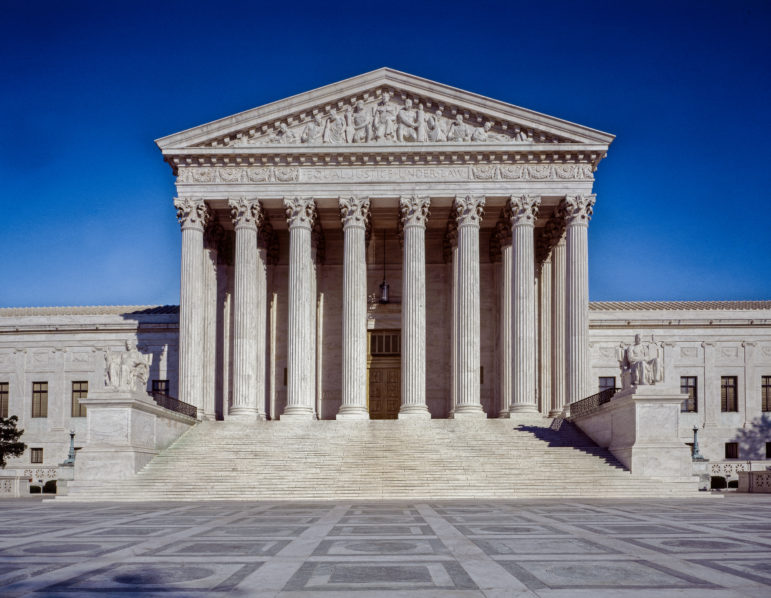
United States Supreme Court Building By Carol M. Highsmith – Library of CongressCatalog: http://lccn.loc.gov/2011631106Image download: https://cdn.loc.gov/master/pnp/highsm/12900/12912a.tifOriginal url: http://hdl.loc.gov/loc.pnp/highsm.12912, Public Domain, https://commons.wikimedia.org/w/index.php?curid=91285025
Two Catholic parish preschools in the Archdiocese of Denver sought to participate in the program while maintaining admissions policies based on Catholic religious teachings. The Archdiocese requires families enrolling children in its schools to support the schools’ Catholic mission, including teachings concerning sexuality and gender. The schools requested an exemption from Colorado’s nondiscrimination requirements, which state officials denied.
The Catholic plaintiffs, represented by the Becket Fund for Religious Liberty, argue that Colorado has forced religious schools to choose between participating in a generally available public benefit and operating according to their religious beliefs. They contend that this violates the First Amendment’s Free Exercise Clause.
Colorado sees the dispute differently. State officials maintain that religious schools are eligible to participate in UPK and that the nondiscrimination requirements do not target Catholicism or religion generally. Rather, Colorado argues that participating institutions must comply with enrollment requirements governing the publicly funded program.
The disagreement is complicated by exceptions and enrollment preferences Colorado permits for some providers. The Catholic plaintiffs argue that the state allows secular providers to prioritize or serve particular populations while refusing comparable accommodation for religious institutions. Colorado responds that these provisions advance purposes of the preschool program, including ensuring access for children with disabilities and economically disadvantaged families, and do not amount to comparable exemptions from its nondiscrimination requirements.
A federal district court rejected the Catholic plaintiffs’ constitutional claims, and the U.S. Court of Appeals for the Tenth Circuit affirmed that decision in September 2025.
The Supreme Court agreed to consider two questions arising from that ruling.
The first involves Employment Division v. Smith, the Court’s landmark 1990 Free Exercise decision. Smith involved two members of the Native American Church who were denied unemployment benefits after being dismissed from their jobs for sacramental peyote use. The Supreme Court held that the Free Exercise Clause generally does not require religious exemptions from neutral laws of general applicability.
The Catholic schools argue that Colorado’s rule is not genuinely “generally applicable” because the state permits exceptions or preferences for some secular purposes while refusing accommodation for religious exercise.
The second question concerns Carson v. Makin, the Court’s 2022 ruling that Maine could not exclude religious schools from a tuition-assistance program solely because they provided religious instruction. The Court will consider how that principle applies when the government’s objection concerns an institution’s religiously motivated conduct rather than simply its religious identity.
Significantly, the justices declined to consider a third question raised by the Catholic plaintiffs: whether Employment Division v. Smith should itself be overruled. The case therefore will not directly determine whether Smith remains good law, although it could substantially affect how courts determine whether government rules are neutral and generally applicable.
That distinction may be particularly important for minority religious communities.

(U.S. Air Force graphic)
The constitutional principles involved are not limited to Catholic or Christian institutions. Pagan, Indigenous, Jewish, Muslim, Hindu, and other minority religious communities may encounter government regulations that burden religious practices involving ritual, sacred objects, religious dress, dietary requirements, holy days, or the use of particular spaces. If the Court broadens the circumstances under which secular exceptions require comparable religious accommodations, minority religions could gain stronger grounds for challenging government rules that substantially burden their practices.
Indeed, Smith itself arose from the religious practices of a minority faith, and its legacy has long produced debate among religious-liberty advocates over how much protection the Constitution provides when generally applicable laws burden religious conduct.
But St. Mary Catholic Parish also presents the other side of that equation.
Religious exemptions can affect people whom the underlying laws are intended to protect. In this case, those protections include sexual orientation, gender identity, and religious affiliation. A broad ruling for the Catholic plaintiffs could strengthen the ability of minority religions to seek exemptions from government requirements, while also expanding the circumstances in which religious organizations receiving public funds may decline to follow nondiscrimination provisions.
For minority religious communities, including those within Paganism, this creates a potentially complicated religious-liberty question. Strong Free Exercise protections can be especially important for small or unfamiliar religions that lack the political influence of larger religious institutions. At the same time, protections against religious discrimination can be equally important to members of minority faiths who seek access to schools, employment, social services, and other publicly supported programs.
The question before the Court is therefore larger than whether Catholic preschools can participate in Colorado’s program. It concerns where government may draw the line between accommodating religious practice and enforcing conditions attached to public benefits, and whether exceptions created for secular purposes can require similar accommodations for religion.
The Supreme Court will hear oral arguments in the case on November 3. A decision is expected by the end of the Court’s 2026–2027 term in June 2027.
The Wild Hunt will continue to follow this story.
The Wild Hunt is not responsible for links to external content.
To join a conversation on this post:
Visit our The Wild Hunt subreddit! Point your favorite browser to https://www.reddit.com/r/The_Wild_Hunt_News/, then click “JOIN”. Make sure to click the bell, too, to be notified of new articles posted to our subreddit.