

What is America, really? Are these United States really 50 states united around a common purpose and striving for the common good?
Increasingly, it seems like we’re a fractured mirror reflecting conflicting self-mythologizing as the old understandings and agreements are revealed as fictions and phantasms. Norms that we took for granted are casually violated as the whims of the powerful brush laws and regulations aside like gossamer webs.
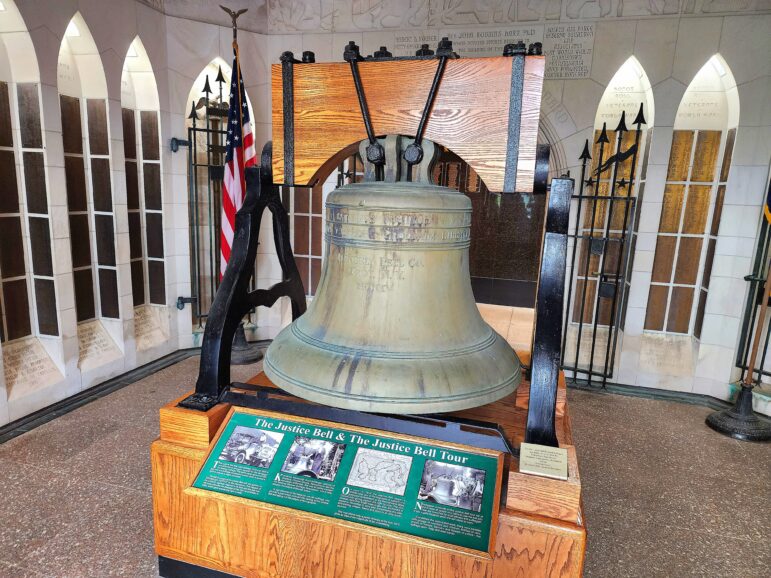
The Justice Bell [Photo by Karl E. H. Seigfried]
I recently returned from a little late-summer road trip into American history. Gas prices are insane, and there’s always work to be done, but it’s important to get away and get into it, once in a while.
At every stop, I was smacked in the face by our American myths and their divergence from historical reality.
Diversity in the Ranks: Valley Forge National Historical Park
Just this month, Secretary of War Pete Hegseth repeated the myth of George Washington kneeling in the snow at Valley Forge to pray for God’s help. Does it even matter that the tale was made up by the same Parson Weems who made up the “I cannot tell a lie” cherry tree story? Various artistic representations of the fictional scene were popular in 1866, 1976, and 2026. It’s an irresistible bit of hokum for those determined to portray this nation as fundamentally white, patriarchal, and Christian.
Just as hokey is the contemporary conservative touchstone of this nation being built by Christians on Christian faith and Christian principles. Contrary to today’s right-wing talking points disseminated by corporate shills and terminally online chuckleheads, the revolutionary army that actually fought to birth this nation and suffered through unimaginably harsh conditions at Valley Forge during the winter of 1777-1778 was as diverse as the United States are today and always have been. This is brilliantly documented by the Valley Forge museum and audio tour.
The historical encampment included nearly 20,000 soldiers plus women and children related to them and civilians who provided desperately needed assistance. Large enough to hold the status of the fourth largest city in the colonies, the camp included people of African, Austrian, Dutch, English, French, German, Irish, Italian, Native American, Polish, Portuguese, Prussian, Scottish, and Swedish descent. Religions represented included Catholicism, Protestantism, Judaism, and the Religious Society of Friends.
In addition to the religious diversity among those winter denizens of Valley Forge, there’s the historical presence of Freemasons among the Founding Fathers during a time when the organization embraced Enlightenment concepts of a deity who acted as Grand Architect, as opposed to standard Christian beliefs regarding God and Christ.
Washington himself had been a Mason for 25 years by the time the encampment at Valley Forge began. He participated in Masonic rites throughout the revolutionary period, supported Masonic lodges of active soldiers, was sworn in as president on a Masonic Bible, and was buried with Masonic honors. There’s an enormous Masonic arch honoring Washington at Valley Forge that was dedicated in 1917, complete with prominent figurations of pagan deities Athena and Nike. None of this really screams “Christian values.”
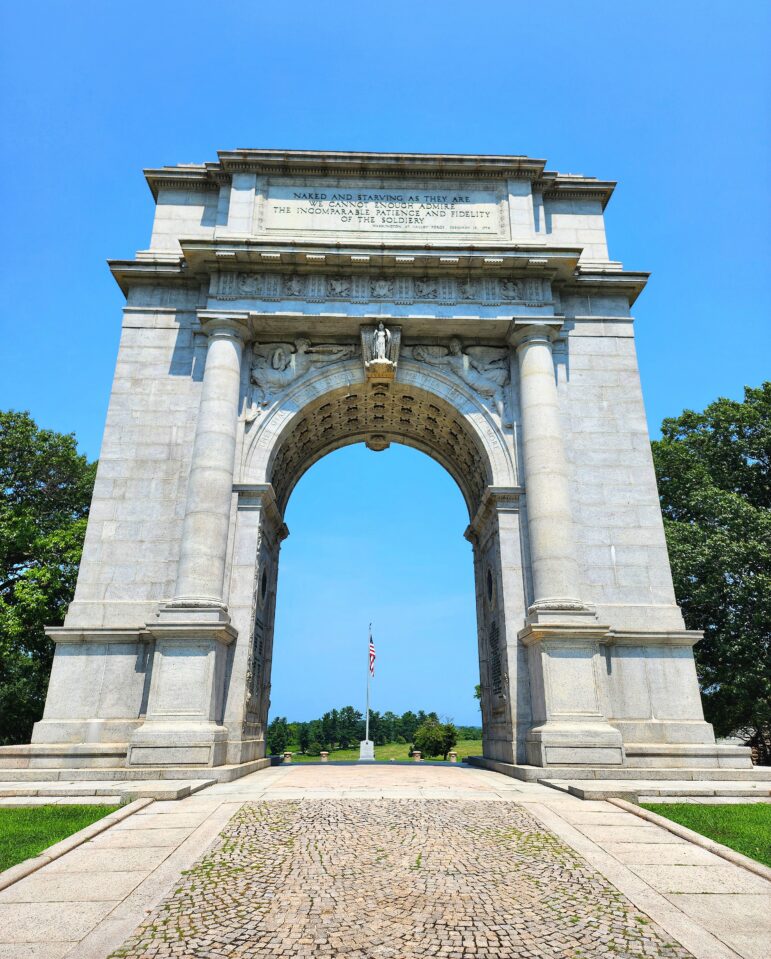
National Memorial Arch at Valley Forge [Photo by Karl E. H. Seigfried]
Awkwardly for those who natter on about white pride and white nationalism, over 700 soldiers at Valley Forge had African ancestry and/or a mix of African and Native American. Even worse for our contemporary nonsense-spewers, it took an immigrant to get the job done; the army was a disorderly mess until the Prussian Baron Friedrich Wilhelm August Heinrich Ferdinand Freiherr von Steuben arrived from abroad and taught the troops how to do things the proper German way. Whoops!
Our nation won its freedom with the blood of many whom Secretary Hegseth would now deny promotion. The myth not only contradicts reality, it is used to erase reality.
Freedom and Slavery: Liberty Bell Center
There has been literal erasure outside the building that has housed the Liberty Bell in Philadelphia since 2003. One of the welcoming volunteer guides explained that we could see down below to the remains of the President’s House where George Washington and Vice President John Adams lived before the White House was built. Also living in the residence were Washington’s slaves.
The fact that a monument to American liberty was built on top of a slave residence may already be a bit too on the nose, but the guide also explained that our current president forced the National Park Service to remove all mention of slavery from all written materials outside the Liberty Bell Center. She determinedly shared a QR code linking to the original signage and text that had been removed on the orders of Master Donald. She wasn’t the only one openly defying the president’s racist erasures.
Inside the center, exhibits explain the complex history of the bell as a symbol of freedom. Commissioned by the Pennsylvania Provincial Assembly in 1752 and made in London, the bell was immediately cracked and recast. The claim that the bell rang out to announce the Declaration of Independence wasn’t made until 71 years later, when the last of the Founding Fathers had been dead for more than a decade. It was slavery abolitionists who first called it the Liberty Bell in the 1830s, pointing out the break between the bell’s inscription to “proclaim liberty throughout all the land unto all the inhabitants thereof” and the reality of continued slavery in the United States.
In 1915, members of the women’s suffrage movement commissioned the Justice Bell, which replicated the Liberty Bell but added the words “establish justice” to the inscription. For the next five years, the new bell was used to draw public attention to women’s disenfranchisement, including on a tour of Pennsylvania to promote a proposed state amendment giving women the right to vote. The clapper was chained to the bell, preventing its being rung, to symbolize the silenced voices of the women. It was finally unchained and rung in front of Independence Hall after the passing of the Nineteenth Amendment in 1920. The exhibit went on to show how the Liberty Bell was used as a symbol of freedom throughout the twentieth century, including by the American civil rights movement and the struggle to end South African Apartheid.
While I was taking photos of the Liberty Bell itself, a young National Park Service ranger stepped forward, walked through the gathered tourists, crossed the rope, stood by the bell, and addressed the crowd. He told of the history of the bell, and he addressed the contradiction of proclaiming liberty for all while denying it to so many. Everything he said was baldly factual, but our current federal administration is so determined to destroy the historical record that the ranger’s speech seemed revolutionary.
Here and at other National Park historic sites, the rangers seem to be the real heroes living out Odinnic values – preserving knowledge and speaking truth to power, despite the personal or professional consequences they may face. They seemed possessed by a calm rage and an unstoppable urge to boldly declaim everything that Trump has forbidden them to say about our history and our vexed relationship with freedom.
The ranger finished his talk by directly addressing the little gathering of very young and wide-eyed white boys who had gathered right in front of him. “And what will YOU do,” he asked, “to further the cause of freedom?”
They Knew: Benjamin Franklin Museum
Ben Franklin has been my favorite founding father since I read his autobiography at a very young age. As an adult, I fell in love with him again when I realized what an Odinnic figure he was. A resolute wanderer and gatherer of wisdom, he endlessly created aphorisms that could fit right into Hávamál (“Sayings of the High One”), the Old Norse poem in which Odin himself shares nuggets of knowledge. Some of Franklin’s sayings seem like actual paraphrases of the Allfather’s advice.
Franklin was also an outspoken abolitionist and defender of democracy, or so the story goes. Very late in life, in his final five years, after his return from Paris, a decade after the Declaration of Independence, he did indeed join the Abolition Society founded by Friends (more on them below) and wrote essays supporting the end of slavery. Yet he had long bolstered his personal income as a publisher by advertising slave sales and running notices of runaway slaves.
His printed work made him wealthy enough to retire at age 42, yet he purchased at least seven slaves rather than hire servants. Despite his conversion to the cause of abolition, he only amended his will to free his own slaves after his own death. This awkward fact is often elided by the fact that they died while enslaved to him during his lifetime. To say that he owned no slaves at the time of his death is technically true but spiritually dishonest.
The Benjamin Franklin Museum in Philadelphia includes an interactive display where visitors can parse out Franklin’s actions related to slavery on a pair of scales and decide for themselves whether he was mostly pro- or anti-slavery. As someone who has long admired him, and as someone who read every factoid in the most forgiving light, it was painful to see that the scales came down resolutely on the pro-slavery side. Late-in-life conversions are great, but they don’t negate decades of action. I’ve long said the same thing about neo-Nazi Heathens who decide they’re “not racist” after lifetimes dedicated to hate. Sure, I suppose that it’s nice, but declarations don’t erase deeds.
Thomas Jefferson may have been referring to Franklin when he explained in his own later years why his 168-word passage denouncing slavery as an “assemblage of horrors” was removed from the Declaration of Independence. He directly blamed Georgia and South Carolina as the chief opponents of the statement, before writing this:
Our Northern brethren also I believe felt a little tender under these censures; for tho’ their people have very few slaves themselves, yet they had been pretty considerable carriers of them to others.
Franklin had been on the committee that edited the draft of the Declaration, years before his final change of heart regarding slavery. He was an owner of “very few slaves” – especially compared to Jefferson himself, who owned over 600 (including his own children with his slave Sally Hemings) – and he definitely profited from slave sales and the carrying of escaped slaves to their masters.
As a kid learning about the Declaration, I remember being bothered by the most famous line:
We hold these truths to be self-evident, that all men are created equal, that they are endowed by their Creator with certain unalienable Rights, that among these are Life, Liberty and the pursuit of Happiness.
We already knew as children that slavery was the common practice and that women couldn’t vote. Even way back in the 1970s, just after the celebration of the United States Bicentennial in 1976, we understood that the Declaration was forwarding a myth that flew in face of the reality. To say that Benjamin Franklin was of his time and shouldn’t be judged by today’s standards denies the truth: the Founding Fathers knew that slavery was wrong and chose to support it, anyway.
The Public Universal Friend: Arch Street Meeting House
I found a much more inspiring evolution at the Philadelphia meeting house of the Religious Society of Friends, commonly known to the rest of us as Quakers. Twenty years after Friend William Penn founded Pennsylvania in 1681 as a refuge for members of his faith and of other persecuted religious groups, he deeded a parcel of land to the Society to be used as a burial ground. During the yellow fever epidemic of 1793, the Friends made their cemetery available for the dead of all religions, races, and nationalities. In 1805, they finished building the main portion of their meetinghouse on the site, which now includes a large and detailed exhibit about the Friends and their interesting history.
Similar to the rites of Ásatrú and Heathenry – reimaginings of ancient Norse and Germanic polytheisms in the modern world – the religious meetings of the Friends give everyone who has something to say a chance to speak before the participants. The gathering of equals includes elders who, according to materials in the museum, are simply “more likely to share their reflections during meeting.” This sounds much closer to the blóts of Ásatrú than to the services of American Christianity. Likewise, the Friends’ concept of the Light Within or the Inner Light doesn’t seem so different from our concepts of Odinnic inspiration or divine megin.
I’ve long found that we have more in common with other so-called minority religions than we do with the frankly unwelcoming mainstream Christian traditions, and I do believe that any efforts at interfaith communication should be focused there. Not very far from the Meeting House, I was happy to see the amazing sculpture titled Religious Liberty, commissioned by the B’nai B’rith from Jewish sculptor Moses Jacob Ezekiel and dedicated to “the people of the United States” on the occasion of the 1876 American Centennial. The Goddess of Liberty it portrays is definitely a deity I can get behind.
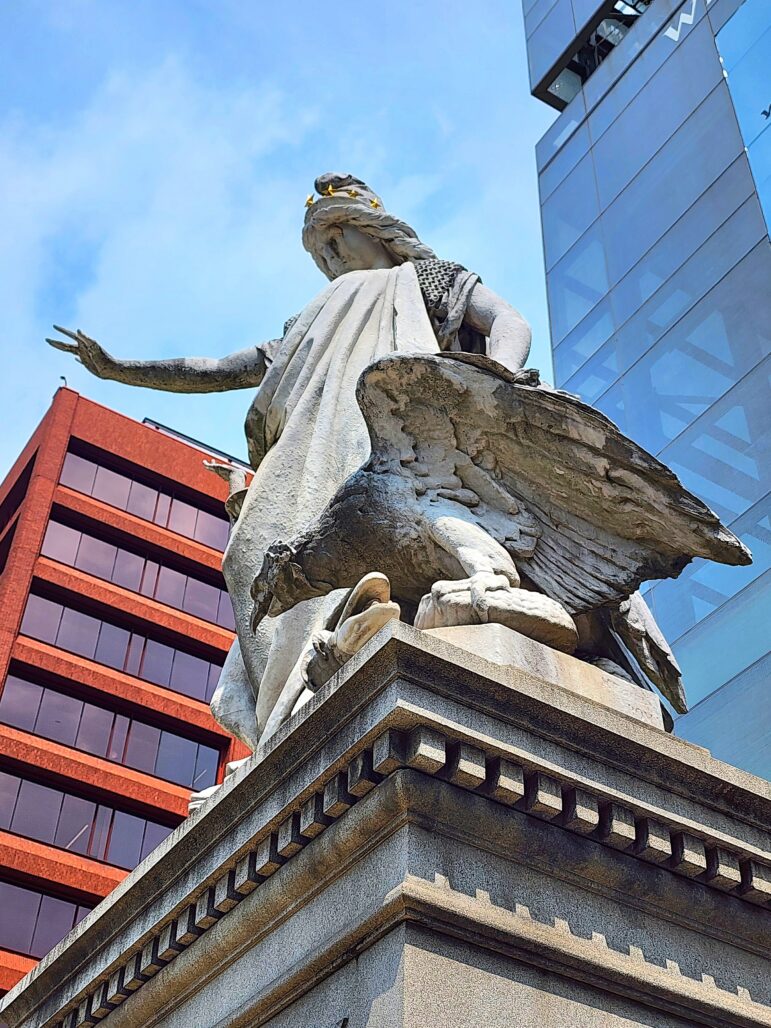
Religious Liberty by Moses Jacob Ezekiel [Photo by Karl E. H. Seigfried]
The story of the evolution of the Friends on the slavery issue was more heartening than that of Ben Franklin. Although there were both pro- and anti-slavery factions among the Friends in the early 1700s, the tide turned over the course of the century. In 1776, the year of the Declaration, the Friends officially forbade enslaving people (decidedly unlike Franklin and the other Founding Fathers). By the 1780s, most groups of Friends required their members to release any slaves they still owned. By the end of the 1700s, Friends were deeply involved in the abolition movement and helping former slaves. In the early 1800s, Friends gave anti-slavery lectures, produced pamphlets, participated in the Underground Railroad, and led a boycott of goods produced by slave labor.
There’s a popular myth that dedicated pacifists like the Friends are avoiders of conflict, that they completely remove themselves from politics. This couldn’t be further from the truth. As one display in the museum put it,
Quakers are guided by their beliefs, or “testimonies,” such as peace, equality, and sustainability.
Throughout history, they have pushed for social, political, and environmental justice both in the United Sates and around the world. Injustice is the result of a series of political and social choices – choices that can be changed. How will YOU make change?
I have often written about the need for today’s Heathens to put their beliefs into action outside of ritual settings. There’s nothing inherently wrong with obsessing over Old Icelandic poetry or debating the ultimate fate of the soul, but these things can drift away from our lived lives when we construct a fence between our theology and our lives. A world-affirming religion should engage with the world. The Friends provide us with an inspirational model for how religious beliefs can lead to direct and meaningful action.
Their actions were not only in opposition to slavery. Friends were at the forefront of the fight for women’s suffrage, served in non-military capacities during World War II (including volunteering in mental health facilities, educational initiatives, forestry, and firefighting), supported and worked for the release of Japanese-Americans interred by the U.S. government, and worked to ban nuclear weapons, chemical weapons, and landmines. They have worked tirelessly to address human rights, climate change, sustainability, economic justice, and the root causes of violence.
I’m old enough to remember the brief life of the Susan B. Anthony dollar, but the famous suffragist wasn’t the only Friend with an amazing life. In the 1950s and 1960s, many Friends were deeply involved in the civil rights movement, but perhaps none as much as Bayard Rustin, a gay black Friend who was one of Dr. Martin Luther King Jr.’s closest advisors, a key promoter of nonviolent tactics, and the lead organizer of the 1963 March on Washington. The 1979 National March on Washington for Lesbian and Gay Rights was also planned at the Arch Street Meeting House.
But the most fascinating Friend story at the museum was this one:
The Public Universal Friend, born in 1752 as Jemima Wilkinson… After a prolonged illness in 1776, presumably typhus, The Friend claimed to have died and been reborn as a genderless prophet named The Public Universal Friend. The Friend refused gendered pronouns and wore androgenous clothing. The Friend preached throughout the northeastern United Sates, attracting many followers for their new religion, the Society of Universal Friends. The most committed followers were a group of unmarried women known as the Sister Friends.
The next time some conservative Christian or right-wing Heathen gets all snippy about transgender folk being some new phenomenon or not “real Americans” or some other bullshit, tell them to go screw, then raise a glass to The Public Universal Friend.
Movies as Myths: Rocky and Romero
After all that heavy learning about American myths and United States history, I followed three side quests that felt more like pilgrimages. All were visits to filming locations for movies that I truly love.
The first was the Rocky Balboa statue atop the steps that lead to the Philadelphia Museum of Art. Like everyone else, I replicated Rocky’s run up the steps from the original 1976 movie, and I’m proud to say that I did not suffer a heart attack. It’s a bit surreal to stand next to the statue from Rocky III (1982) right there where the Clubber Lang confrontation scene was filmed, even if it’s a duplicate that was made as a backup for filming. The view of the city is pretty awesome.
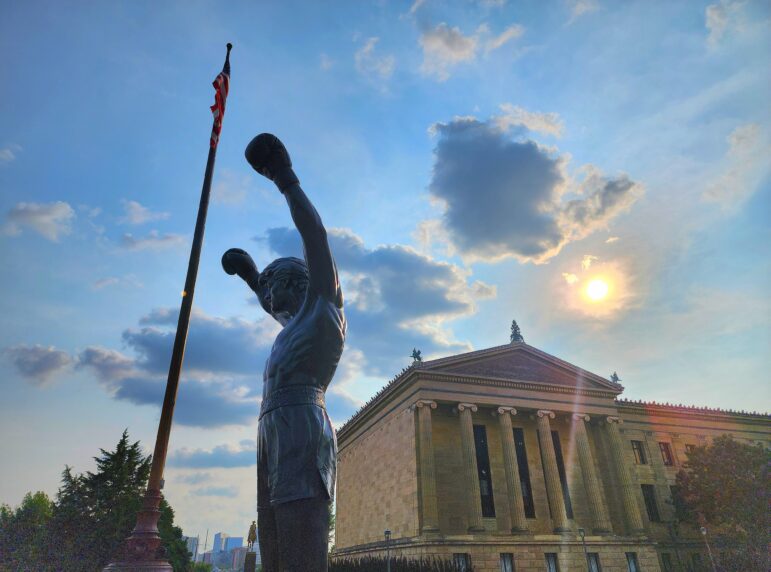
Rocky Balboa statue in Philadelphia [Photo by Karl E. H. Seigfried]
I’ve written about my long love for boxing here at The Wild Hunt. Before I started as a TWH columnist, I wrote ringside reports and analysis for East Side Boxing. I love all the Rocky movies, despite the cheesiness they sometimes wallow in. But I love real boxing more. And the myth of Rocky is belied by the reality of real boxers, including right there at the museum.
Down below the bottom of the steps, far from the Rocky statue, somewhere among the trees, fenced off from public touch, surrounded by trashy sheets of wood thrown on the ground, and partially obscured by a little Japanese tractor, there stands a neglected statue of Joe Frazier. If you know about Rocky but not about Joe, well… that just makes me sad. Smokin’ Joe was one of the greatest heavyweights of all time and was half of several of the greatest fights of all time. He’s one of the real ones, one of the masters, one of the most inspirational figures in African-American history. Look him up.
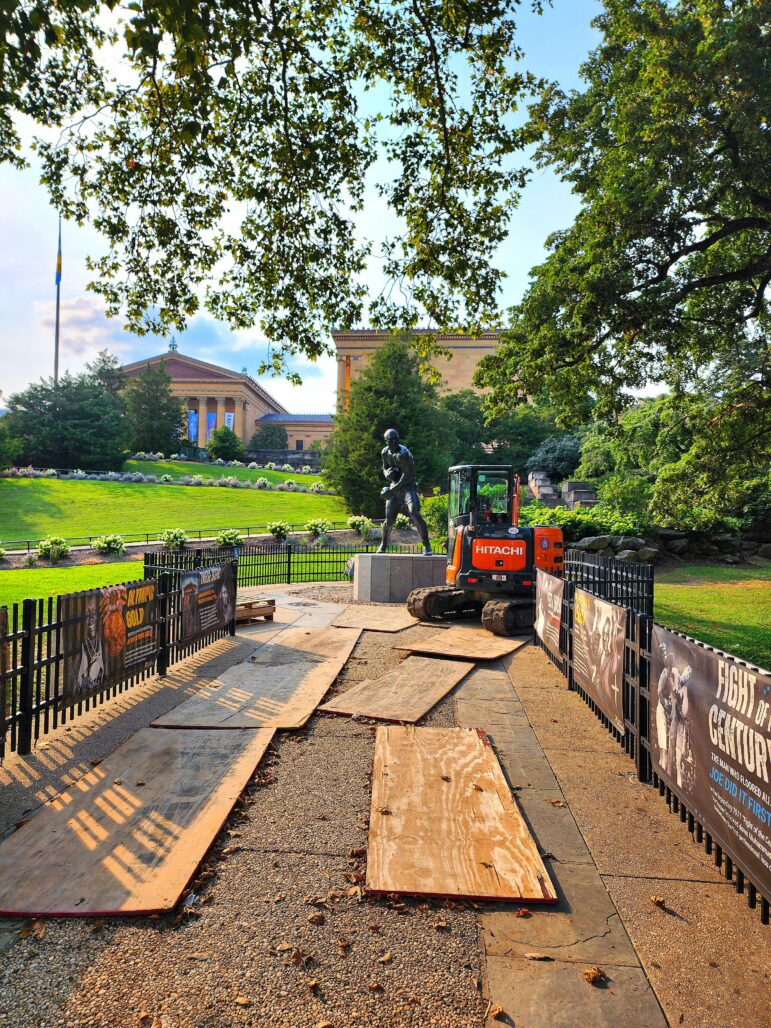
Joe Frazier statue in Philadelphia [Photo by Karl E. H. Seigfried]
In 2008, three years before his death at age 67, Frazier told The Guardian that the famous scenes of Rocky training in the slaughterhouse and running up the museum steps were based on his own training in Philadelphia. “But he never paid me for none of my past,” Frazier lamented. “Rocky is a sad story for me.” When there was a push to get a bronze statue of Frazier erected, the city instead went with the one of Rocky. The actual black Philly champion didn’t get his own monument until 2015, a third of a century after the fictional white boxer got his in Rocky III. All of this really underscored the disparity between myth and reality here in this nation of ours, and what we choose to believe and teach to our children.
After Philadelphia, I hit the road to Monroeville, ten miles east of Pittsburgh. I was determined to see the 1969 shopping mall that was the site of the classic 1978 Dawn of the Dead by George A. Romero. I’ve written here about my love of Romero’s films, and this is probably my second favorite (after his 1977 vampire film [or is it?] Martin). Wal-Mart, cursèd be its name, recently purchased the mall and announced their plans to demolish it, so this was my last chance to walk where Peter, Roger, Stephen, and Francine made their doomed stand against the living dead.
Driving through the neighborhood above the mall, I surprised myself by getting all queasy in the stomach. The closer I got, the stronger the feeling got that I was entering a dangerous place, a place where the dead walk and feast on living flesh. Yes, I know it was just a movie. Yes, I know it was made nearly 50 years ago. But when I realized I was driving down the road that Peter and Roger drove the trucks down, and when I saw that parking lot and the mall behind it, hoo boy! Walking through the mall and finding various spots where key scenes were filmed, and especially given that the mall – like so many malls nationwide – had very few visitors and several empty storefronts, I had a pervasive sense of the weird and of being displaced in time to that horrifying locale in the Me Decade.
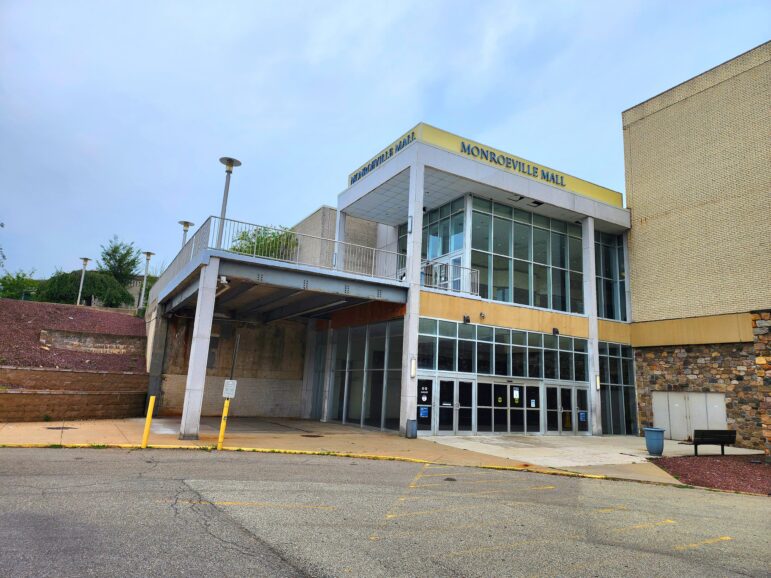
Monroeville Mall [Photo by Karl E. H. Seigfried]
The last stop on my itinerary was the Evans City Cemetery, up to the north of Pittsburgh, the site of the opening scenes of the original 1968 Night of the Living Dead. Again, I got that weird feeling in my stomach. As I neared the cemetery, I started to feel that I was driving into the opening credits of the film, which show Johnny and Barbara driving to visit their father’s grave. When I got to the actual side road up to the cemetery, the surreality really kicked in. There was the place where Barbara crashes the car while trying to escape the first ghoul. There was the little chapel. And finally, there were the gravestones where the Johnny said, “They’re coming to get you, Barbara.” The weirdness was broken when I noticed that there was a small group of black metal dudes taking selfies by the grave markers, because of course there was. This was a place of pilgrimage.
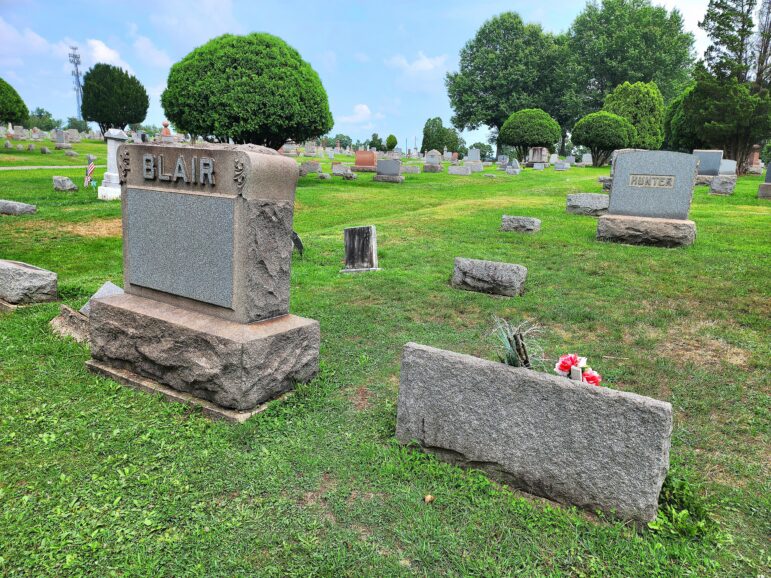
Evans City Cemetery [Photo by Karl E. H. Seigfried]
I’ve made the trip to Iceland that so many American Heathens make. I’ve been to Thingvellir, stood where the Althing was, walked in the field where Egill played the fatal game, all of that. It was brilliant and exciting and somehow magical. This was like that, but different. It was purely American. Films are our sagas, and horror is our truest genre. They’re what future scholars will study as they attempt to understand us. After all the confrontation between myth and reality in and around Philadelphia, I had veered to the side and driven straight into the heart of our mythology. The overwhelming sense of weirdness I got underscored the power our native myths have over our imaginations.
Later, back home for the 10th anniversary midsummer blót of Thor’s Oak Kindred, honoring the thunder-rider as we do each year at this time, I hailed Romero as an aspirational and inspirational ancestor. The fact that he created the modern mythology of the zombie wasn’t the reason. It was because he, the son of Spanish and Lithuanian parents, was able to use tales of the walking dead to confront our national diseases of racism, sexism, militarism, jingoism, isolationism, separatism, consumerism, classism, and so many other -isms far grosser than extras in pancake makeup pretending to eat a butcher’s donated offal. If he was able to use the benighted genre of low-budget horror to forward progressive sociological and theological critiques of the United States, the rest of us can surely use our own talents to confront, denounce, battle, and heal all the hateful damage that is being done around us on the daily.
Somewhere between myth and truth, there is action.
Postscript: That little ending line just popped into my head, fully formed. I felt very clever, but then I googled “movie tagline somewhere between * and * there is *” – and, of course, I’m just paraphrasing the promotion for The Exorcist. Don’t judge me for being a 1970s horror movie nerd. It’s my native mythology, after all.
The Wild Hunt is not responsible for links to external content.
To join a conversation on this post:
Visit our The Wild Hunt subreddit! Point your favorite browser to https://www.reddit.com/r/The_Wild_Hunt_News/, then click “JOIN”. Make sure to click the bell, too, to be notified of new articles posted to our subreddit.