

I suppose I’ve always been a combination of envious and suspicious of modern practitioners of Ásatrú and Heathenry who tell tales of having personal visions of the deities we know from Norse mythology.
As Thomas Jefferson, the Founding Father who proposed including legendary Germanic pagan leaders Hengist and Horsa on the reverse of the Great Seal of the United States, might have sung, “It must be nice to have Allfather on your side.”
Over the past two decades, I’ve seen so many testimonials online and in books by contemporary Heathens who claim to have had visitations from Norse deities who bathe with them, have sex with them, reveal their favorite colors to them, and tell them Snorri Sturluson was fake news, but you can trust me to tell you what really happened in Asgard.
It must be nice.
Where things go pear-shaped for me is in that moment after the person visited decides to share their personal mystical experience with the wider world, when other practitioners join the vision train and accept the information provided by the visionary (sexual maneuvers, favorite colors, true tales of Asgard) as of even greater truthiness than what we know from actual historical, literary, and archaeological sources.
Of course, those ancient sources can be said to be based on visions had by pagans of the long-ago time. So why aren’t the visions of today’s practitioners just as valid?
For me, personally, the answer arises from my own visionary visitation from Thor.
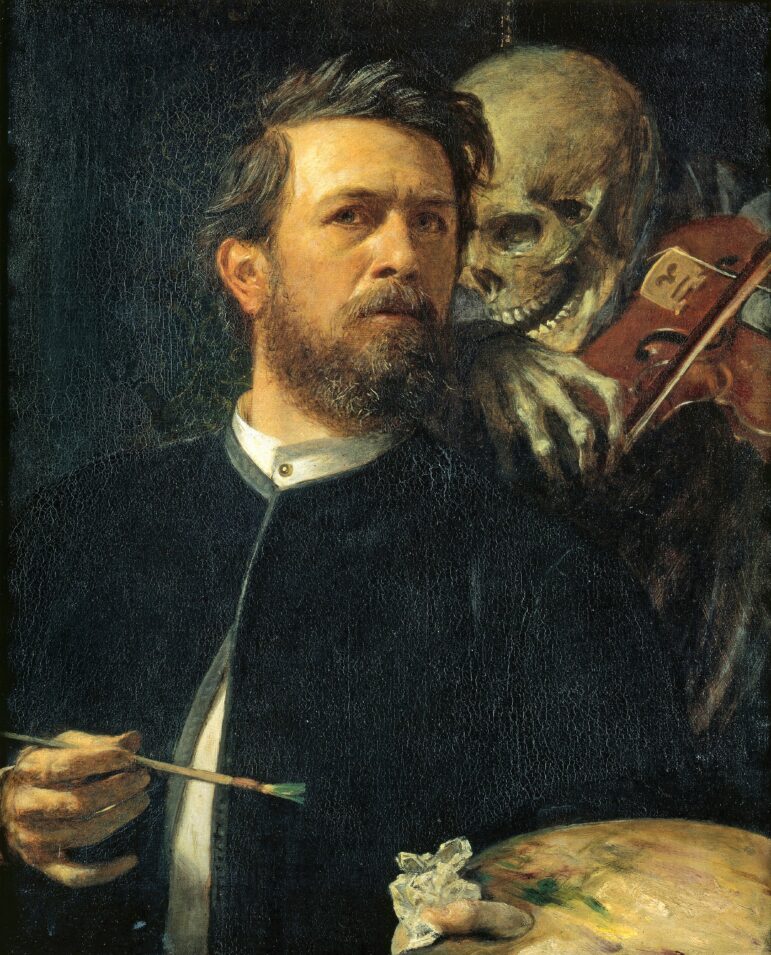
Self-Portrait with Death Playing the Fiddle (1872) by Arnold Böcklin [Public Domain]
Before I tell that story, I need to explain something about my relationship with sleeping and dreaming.
My issues began when I first found out about death – a key childhood moment that I still vividly remember with extreme clarity.
Before I tell that story, I need to explain something about my parents’ relationship with religion.
Monk and the Nun
My father was born in 1933 and grew up in a German farm settlement in Karavukovo (“place of the black wolf”), now within the borders of Serbia. The village kept old folkways mixed in with their Catholicism, including a tradition of second sight among the women of our family. My dad was an altar boy and told me stories about accompanying the priest when last rites were administered to the dying in their beds. Death was simply part of life.
When World War II exploded across Europe, the village was raided and exploited in various ways by both German and Russian soldiers. Eventually, Marshall Tito’s Yugoslavian Partisans arrived, shot the combat-age men that were left and led the children, women, and elderly to extermination camps.
As a young child, my father repeatedly snuck other prisoners out of the camp and led them across Yugoslavia and Hungary to the British zone of Ally-occupied Austria, where they were welcomed as refugees. Then he would retrace the many miles and sneak back into the camp with whatever trinkets he had been given by those he guided. When he was fully confident of the path, he led his own family to freedom.
In Austria, he eventually joined a monastery to find some way to understand how supposedly good Christian people could commit the gruesome horrors that he had seen done to other good Christian people. While on the inside, he studied church history, then literature, then philosophy, then lost what remained of his faith, then left the Church and eventually became a philosophy professor focused on genocide and human rights.
My mother was born in 1943 in San Diego, California, the second oldest in a Catholic family of seven children. Her mother was such a prolific baby-maker that she was featured in Maryknoll Magazine or some similar Catholic publication as a mother to be emulated by the devout.
When my mom graduated high school in 1960, all her girlfriends were engaged or actually married within weeks. She took a different path, worked to afford college, and attended school in Los Angeles. Eventually, she decided to finish her studies by joining a convent in Orange County.
While she was a nun, second-wave feminism burst out into the public consciousness. In short order, nun’s habits and headgear were discarded, the patriarchal structure of the Catholic Church was openly challenged, and her entire class left the nunnery (except for one poor thing with emotional and mental challenges who had nowhere else to go).
After leaving the convent, my mom went to Chicago for graduate school in philosophy just as the so-called race riots were hitting their hottest point. Like my father, she eventually became a philosophy professor, but with a focus on American studies and women’s studies.
When you have two parents who left the monastery and nunnery to study philosophy, and you ask them what death is, it doesn’t matter that you’re four years old. You get a straight answer.
I remember sitting on my bed, asking my mom what death was, and listening to her calm and rational explanation with mounting terror.
What hit me hardest was the idea that someday my parents simply wouldn’t be there anymore. They would just be gone, forever.
The roots of my sleep issues are in that frozen moment.
Beyond the Realms of Death
For many, many years, I would stare at the ceiling at night and struggle to push down that same childhood panic as I sought to avoid thinking about the eternal void of nothingness, the absolute un-being for all eternity that dwarfs the insignificant thimbleful of time we have of life. These thoughts are not conducive to restful sleep.
Things got even worse when, in the dark depths of my 1990s Star Trek fandom, I read a paperback that explored philosophical issues in the TV show and its associated films. The bit that got to me was about the transporter.
According to the author whose name I can’t even remember, the transporter machine scanned the person being transported, stored the data in the computer, absolutely vaporized the person, then re-formed them from material on the planet surface using the data.
Horrifying.
I don’t know if this was actually lore on the show, but the concept laid out in the book was disturbing. I was really bothered by the idea that the newly formed being on the planet surface would have all the memories of the original person, would to all intents and purpose be that person, but the actual original person would be dead and gone forever.
I can’t remember if the author made the connection to sleep, or if I made that connection myself. The 1990s were a long time ago.
But I did begin to obsess over the break in consciousness that occurs in sleep. We lay there and think, we drift behind the wall of sleep, we slip into the weirdness of the sleep experience, and we awake back into thinking.
I’ve tried and tried to connect the two moments – the end of thinking and the return to thinking – but the sleep experience between makes it impossible. Like the person transported by the Enterprise, I wondered, am I really the same person when I awake as I was when I fell asleep?
I read Frank Herbert’s Dune series way too young, and I’ve long misremembered the lines about fear to instead be “Sleep is the mind-killer. Sleep is the little-death that brings total obliteration.” Again, these thoughts are not conducive to restful sleep.
So when I first read the Old Norse poem Hávamál (“Sayings of the High One”), there was one gnomic proclamation from Odin that particularly hit me.
The stupid man stays awake all night
and worries about everything;
he’s tired out when the morning comes
and all’s just as bad as it was.(Carolyne Larrington translation)
Ouch. That one hit home.
It was also an important first step into Ásatrú, since I immediately felt a deep spiritual kinship with the poet who composed these words a thousand and more years ago. There was something profoundly comforting in knowing that someone in those ancient times had the same sleep issues I did.
My nightly existential dread continued, however, exacerbated by my feelings about dreaming.
Welcome to My Nightmare
I’ve always had extremely vivid dreams, from preschool through today.
They distort time, sometimes seeming to last for hours. I remember one dream of walking along a desert road that – according to my own inner experience – lasted a full day. I remember another that lasted years, through a host of life changes and experiences. What a strange thing the mind is.
Possibly due to my chronic lack of sleep, my dreams often intrude into my waking hours. I don’t mean that I’m dreaming with my eyes open. I mean that my dreams are not forgotten, and waking experiences trigger memories of them that are as strong as those of actual events.
In addition to my hang-up regarding the break in the continuity of consciousness, I’ve long dreaded sleeping because of the experience of dreaming. Not because the dreams are necessarily bad but because they last so long and are so exhausting. They just go on and on and on.
Actually, sometimes they are bad.
As a kid, I was horrified of horror movies. I wasn’t allowed to watch them, so, as often happens, I was fascinated with finding out about them.
I remember grade school recesses where my little boy gang sat in a circle, removed a bit from the other kids on the playground, while one among us recounted in gory detail some R-rated horror film he’d seen on cable (then still a new and rare thing) or by sneaking into a movie theater. I can still picture some of the scenes they described, as if I’d seen the films myself.
I also peeked at horror magazines at the now-defunct White Hen Pantry and horror books at dearly departed bookstores Waldenbooks or Kroch’s and Brentano’s. This habit had disastrous consequences.
After seeing photos from the 1983 film Xtro, I had a phobia about closed shower curtains for years. The TV ads for Jaws made me scared of sharks even in swimming pools and bathtubs. After looking at a big coffee-table book about the original Alien film, I had dreams about its creatures for years.
Whether or not this horror peeping was the cause, I had what I later learned to be a form of night terrors – nightmares that continued for that extra moment after waking up, with the horror of the dream manifesting in my bedroom for a second or two before vanishing with full wakefulness and turning on a light.
But for that brief moment, the horror seemed really, really real. The creepy child in the doorway, the shadowy being by the wall, and the witchy creature leaning over me all appeared as substantial as anything else in the room.
Then I found a cure.
Thanks to the miracle that is Tubi, I started watching all the 1970s and 1980s horror movies that I was terrified of as a child, without ever having actually seen them. It turns out they’re generally extremely slow-moving compared to modern films and are mostly not at all terrifying.
Jaws had actually laughable shark attacks mixed in with wonderfully cynical portrayals of craven politicians. The Amityville Horror didn’t really have much horror at all (but did have Margot Kidder, the Lois Lane of 1970s and 1980s cinema). Night of the Living Dead turned out to be a Twilight Zone type of social commentary that led to an obsession with George Romero, which led to one with Dario Argento, which led to one with Lucio Fulci, and on and on.
Watching these films in the middle of the night every night helped me get to sleep better. They’re so slow-paced that they’re actually a bit hypnotic, and the patently fake physical horror distracts from and overwhelms late-night ruminations on the actual horrors of life and death in this violent world of ours.
Watching them also got rid of the night terrors. Facing the ghouls and goblins while sipping a protein shake and eating tortilla chips immediately before bed somehow deactivated the creature-generating feature of my brain. There’s probably some deep psychological thing there about facing our fears, but I’m too tired to game it out.
My vision of Thor occurred many years ago, before I found this miracle cure.
The Coming of Thor
I was a newbie Heathen living in a tiny little coach house in an alley. One night, I suddenly awoke with the feeling that I was being watched. Indeed, I was.
The god Thor was right there in my tiny little coach house bedroom.
He sat on a throne, leaning slightly forward, with his heavily bearded chin resting on the fist of an arm that itself rested on a knee as he thoughtfully gazed at me.
Then he was gone. The vision simply disappeared.
Oh, I was high on this experience for quite a while. I didn’t post about it online or write about it in a book or claim that Thor had anointed me his spokesperson on Midgard or anything like that. But I did feel that Thor approved of me turning to the Old Way, that he liked the idea of the irreligious son of philosophers becoming his devotee, that he freely welcomed me into the Heathen life.
It really felt good to have been visited by the mighty Thor. Then, quite a while later, a horrible thing happened.
My subconscious must have been bothered by something, by a feeling that there was something familiar about the figure in the vision. Not the familiarity of the Thor I knew from the poems and myths. Something else entirely.
One day, it hit me. I knew where I had seen that vision before.
It was Arnold Schwarzenegger as the older King Conan in the final shot of the 1982 Conan the Barbarian movie, the epilogue in which the wizard narrator intones, “In time, he became a king by his own hand. This story shall also be told.”
That was it, exactly. The throne, the pose, the beard, the fist, the arm, the knee, the gaze.
Damn it.
Knowing what I know now from experience about sleep issues, intense dreams, night terrors, and my obsessions with R-rated movies of the 1970s and 1980s, I fully understand and accept that this wasn’t a divine vision or a magical stamp of Asgardian approval.
The same mental mechanism that produced intense dreams about xenomorphs and nightmares about shadow people that lingered into night-terror wakefulness also produced the momentary image of Arnold-as-Thor sitting in my midnight bedroom.
I think it’s hilarious. I love Arnold. I love Conan. I love Thor. I’d be happy to hang out with any one of them, but there’s just about an equal chance of me meeting Arnold as meeting Conan or Thor.
In the end, this is where I land regarding Heathens who very seriously tell others about their personal visitations from the divine realms and about the others who then very seriously treat their visions as direct communications from the gods themselves: do what thou wilt, but I’m going to stick with the poems and myths.
Going Through the Motions
As amazing and as powerful as dreams are, I think that – for some among us – the lure of adoration from the Heathen community (especially in online spaces) hits like a drug of an entirely higher strength. People chase that dopamine rush, and it can be a truly intense thing, especially when people whose opinions you court start citing you as a divine seer and/or pay you to run workshops at Pagan gatherings.
Maybe that’s why I view the old poetry and mythology differently. It’s all anonymous. There aren’t personalities attached. All we have is the lore, without knowing anything specific about the individual authors. I think it’s a wonderful situation in which we find ourselves, because it means we can concentrate on the ideas instead of the content creators.
That’s a very different state of things than watching someone you know post on Facebook about getting humped by a divinity in between status updates about their cookie jar collection and requests that people buy their new self-published eBook on sacred rites of wood elves or whatever.
It’s especially strange to me when someone who has publicly declared these very serious, literal, actual, real-world interactions with honest-to-goodness gods of the old mythology then moves on through the subcultural milieu and announces himself to be an acolyte of a totally different religion a few months later. But, as has been documented by historians and sociologists, this sort of lateral movement within subcultures is fairly common.
If I was absolutely convinced of the reality of my meeting with an actual Norse god or goddess, the idea of giving them the kiss-off and blithely moving on to Wicca or Scientology or what-have-you shortly thereafter would seem absolutely bonkers. How can someone have that powerful of a theophanic experience, the sort of life-altering event that starts new religions, then simply shrug and move on to Druidry or Kemetism?
The fact that this sort of thing is generally accepted within the wider Pagan communities doesn’t do anything to convince me of the veracity of these modern visions or the honesty of those who declare them. It just seems crazy to me that these intense manifestations of divinity are seen as simultaneously worthy of wondrous respect and really not that big a deal.
As always, your mileage may vary. To thine own self be true, whatever gets you through the night, etc.
I’ll be watching Fulci films on Tubi and trying to think sleepy thoughts.
I’m back on my feet
Getting no sleep
Making it all mineGive me a chance
To follow the bands
Waiting for the sunshine“Dreamer” (1973) by Uriah Heep
The Wild Hunt is not responsible for links to external content.
To join a conversation on this post:
Visit our The Wild Hunt subreddit! Point your favorite browser to https://www.reddit.com/r/The_Wild_Hunt_News/, then click “JOIN”. Make sure to click the bell, too, to be notified of new articles posted to our subreddit.