

DENIZLI, Turkey – Archeologists have uncovered a statue of the goddess Athena in western Turkey, according to a statement from Mehmet Nuri Ersoy, the minister of culture and tourism.
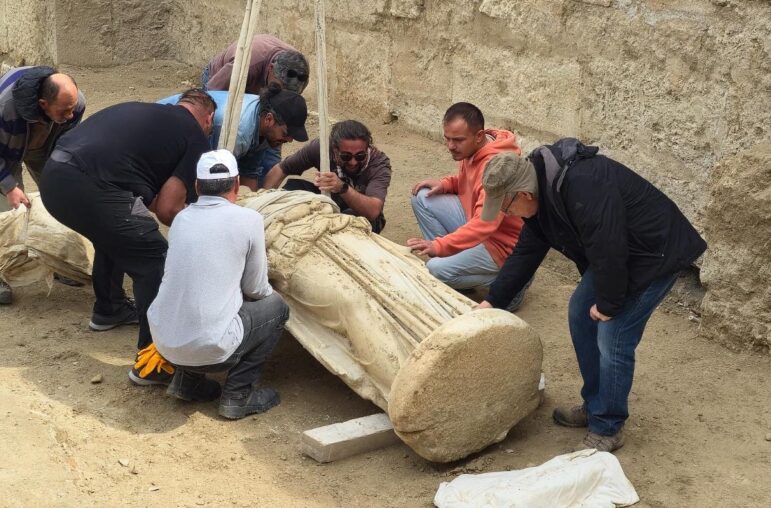
Archeologists excavating a two meter tall statue of the goddess Athena at Laodikeia, Turkey [Turkish Ministry of Culture and Tourism]
The discovery was made during excavations of the ancient Greek city of Laodikeia, located on the Lycus River near the modern city of Denizli. The city was founded by King Antiochus II Theos in the 3rd century B.C.E. and continued under the rule of Pergamon, Rome, and Constantinople until it was sacked by the Seljuks in 1161 and eventually destroyed during Mongol invasions. The city has been excavated since 2002 by Pamukkale University, and has been considered a prospective UNESCO World Heritage Site since 2013.
Laodikeia has several notable ruins from the classical period, including multiple temples and two theatres. The Western Theatre, where the statue of Athena was found, has been largely restored, including banks of stone seats; it once could have held some 8000 spectators for performances of Homeric epics and other theatrical works.
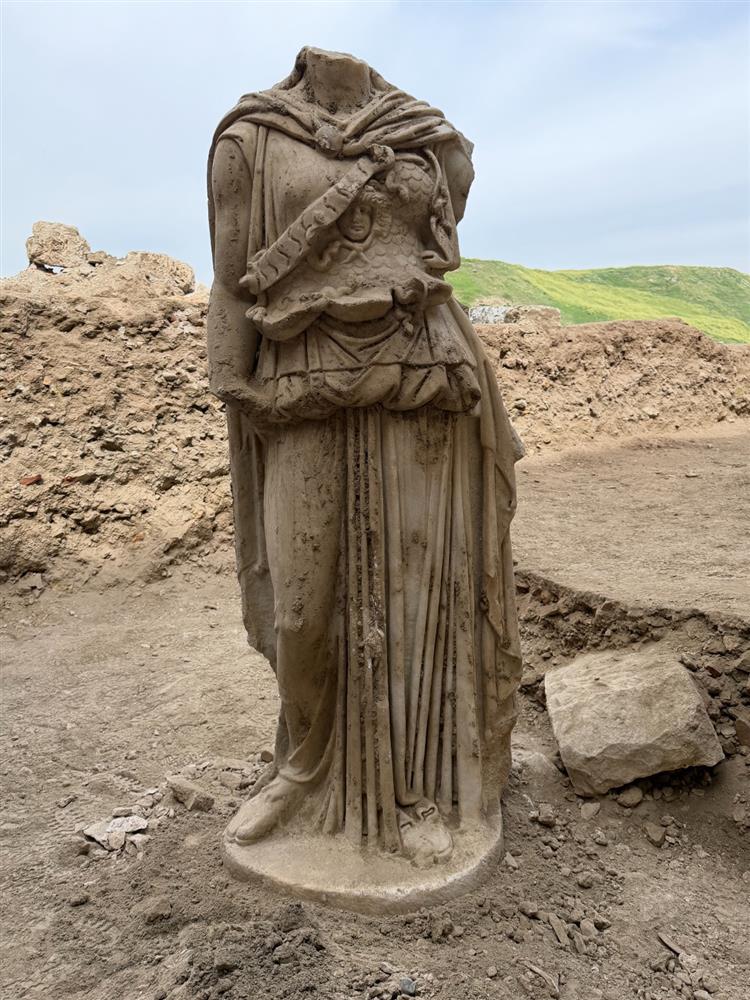
The newly excavated statue of Athena from Laodikeia, Turkey [Turkish Ministry of Culture and Tourism]
The statue was discovered in the Western Theatre’s stage building, a three-story structure with 16 columns on each floor. Statues of deities, along with figures from the Iliad and the Odyssey,were placed between these columns. The Athena statue appears to have been one of these. The statue is nearly two meters (six and a half feet) tall, with a rougher backside that suggests its purpose was to face forward with others in the stage building. The statue was found lying face down in the rubble of the stage building’s outer wall, known as the postskene. The statue’s head has not yet been found.
The Athena statue is thought to be from the Augustinian period, between 27 B.C.E. and 14 C.E. It is made of white marble and has highly detailed clothing sculpting on its sleeveless garment, called a peplos, and cape, a hylamis. The statue is easily identified as Athena by her famous aegis motif breastplate, featuring the head of Medusa.
The Ministry of Culture and Tourism’s statement notes that weaving was an important part of ancient Laodikeia’s economy, and that Athena’s role as goddess of weaving was more important there than her more famous role as a goddess of strategy in war. That identification might explain the high quality of detail put into the statue’s clothing.
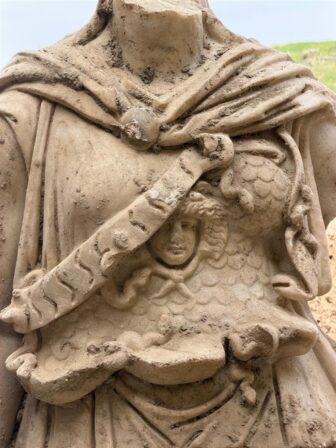
Detail of the Medusa head on Athena’s aegis breastplate [Turkish Ministry of Culture and Tourism]
Athena was one of the most important and widely venerated deities in the classical world. Though most famously identified with the city of Athens, to which she lent her name, Athena was worshiped throughout the Greco-Roman world. She was the patron of the Homeric hero Odysseus and his son Telemachus, protecting them throughout their travails during the Odyssey. To modern audiences, Athena is most often known as a goddess of wisdom and warfare, but in the classical world she held many epithets beyond these, especially pertaining to crafts and invention. In various places, Athena was hailed as goddess of weaving, of horse-bridling, and of ship-building, among others.
In the modern Pagan movement, Athena has consistently been one of the most popular goddesses worshiped, finding her way onto many altars across both eclectic and Hellenic reconstructionist paths.
The statement from the Ministry of Culture and Tourism notes that excavation is set the continue uninterrupted as the year continues.
The Wild Hunt is not responsible for links to external content.
To join a conversation on this post:
Visit our The Wild Hunt subreddit! Point your favorite browser to https://www.reddit.com/r/The_Wild_Hunt_News/, then click “JOIN”. Make sure to click the bell, too, to be notified of new articles posted to our subreddit.