

Today’s offering is from Beatrix Kondo. Kondo is a Brazilian journalist and cultural critic with over 20 years of covering pop culture and sociocultural analysis for international outlets. She focuses on feminist readings of genre fiction, trauma-coded narratives, and how beauty, danger, and survival keep rewriting each other in contemporary media. Visit her at beatrixkondo.com.
The Vanissen family has one single and unquestionable rule: girls are witches, boys are shapeshifters. Why? This should never need to be explained, debated, or questioned by anyone who benefits from it.
That silence is the first spell the book casts.
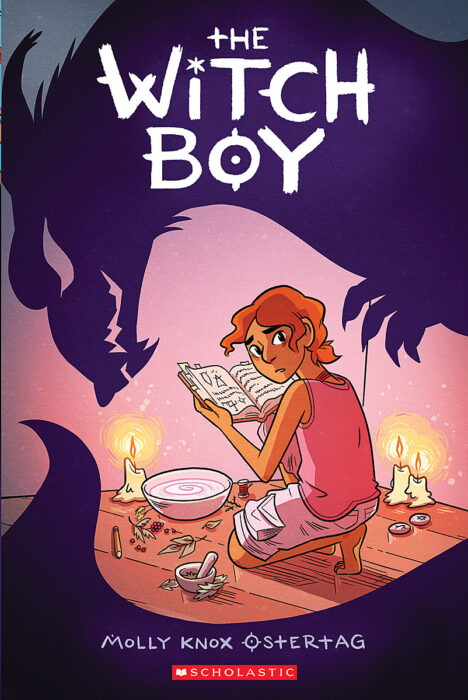
Cover to The Witch Boy (2017) by Lee Knox Ostertag [Scholastic]
Lee Knox Ostertag’s1 debut graphic novel The Witch Boy (2017) is middle-grade fiction: bright panels, warm colors, a 13-year-old protagonist navigating family expectations and a mysterious threat in the woods. It is also, for any genre and age, one of the most precise depictions of how a community enforces its logic without ever questioning it — and tries to impose silence on those who do. Ostertag works almost entirely in the space between panels, trusting his reader to feel the weight of what he declines to fully explain. The result is a book that functions beautifully as a children’s story and devastatingly as a document of what systems do to the people who were never consulted when those systems were built.
Aster is the boy who wants to be a witch, and whose cousins shapeshift into animals, as all boys in his family are expected to do at that age when they are to become men. He feels no animal spirit calling him. What he feels, instead, is the pull of the spells the girls have been learning in lessons he is forbidden from attending. He watches from the edges. He takes notes. He practices in secret, in the suburban neighborhood where nobody from the outside knows what he is or what he is supposed to be.
The Vanissen family worries about Aster. His parents, his aunts, his grandmother—they watch him with the careful attention of people who love someone and cannot afford to let that love override the rules. What they offer him, when he presses, is a warning: the story of Mikasi.
Mikasi is Aster’s great-uncle, his grandmother’s twin brother, and the book’s most devastating and tragic figure. As a boy, he knew he couldn’t shapeshift. He begged to be taught witchcraft; however, the family refused, closed the door, and called it protection. What happened next? Mikasi stole a magical artifact and fled, trying to teach himself what nobody would, trying to use witchcraft to do what it was never meant to do—force himself into the shapeshifter his family needed him to be. The attempt mutated him. By the time the first book closes, he is barely recognizable as the child in the black-and-white flashback panels, a boy rendered in color only in Ostertag’s memory sequences, warm and red and already separate from the grey world that wouldn’t hold him.
The family tells Aster this story as a cautionary tale, with a clear intended moral: see what happens when you go against the rules. As though a similar tragic future would be inevitable. The lesson Witch Boy actually delivers is something else entirely. It is Aster’s grandmother who says it, finally, near the end: it was not Mikasi’s magic that was wrong but what the family had denied him.
bell hooks, writing in The Will to Change, argues that patriarchal systems damage men precisely by refusing them the emotional and relational vocabulary to understand themselves. The damage arrives dressed as protection, as tradition, as love. Mikasi was not destroyed by desire. He was destroyed by isolation—by the withdrawal of knowledge, community, and recognition at the moment he needed them the most. What turned him into a monster was the family’s refusal to see what he was and transmit what he needed to become it safely. Ostertag never cites hooks. He draws Mikasi in black and white and lets the color speak.
This is the book’s great formal achievement: it trusts us readers to make the connection. When middle-grade fiction frequently explains its allegory—pausing the story to confirm we understood the metaphor—The Witch Boy practices a radical confidence in its audience. The space between lines and images carries as much argument as the dialogue. A child reading this book will feel Mikasi’s tragedy before she can articulate why, and that feeling is the point.
The question the story declines to ask—and this is where its ideological limits become visible, which is a legitimate observation about a middle-grade graphic novel and not a condemnation of one—is who built the rule in the first place. The Vanissen family distributes power by gender and seals itself off from the non-magical world. Nobody inside the system asks why, or is supposed to. The separation from human society is presented as simply how things are, as natural as the shapeshifting and witchcraft themselves. Power, in the Vanissen world, functions like inheritance: it flows along predetermined lines, and the lines are never examined by those who move along them without friction.
Charlie is the figure who makes this visible by being outside it entirely. She is Aster’s friend from the suburban neighborhood, a girl with two dads who chafes at her own world’s gender divisions and has no stake in the Vanissen hierarchy. She is the first person to see Aster perform magic and respond with admiration rather than correction. This matters enormously: the validation Aster needs does not come from within the system but from someone the system has decided is irrelevant. Charlie cannot inherit the Vanissens’ powers. The access she gains to the magical world is personal, built through friendship, and entirely contingent on Aster’s willingness to cross the border the family tries so hard to maintain.
Aster transgresses in two directions at once. He pursues the magic his gender prohibits, and he builds a genuine relationship across the boundary his community maintains against the non-magical world. The book treats both transgressions as parts of the same act of becoming, which they are. Both require him to trust what he knows about himself over what the system tells him he should be, and both require the presence of someone willing to see him without the overlay of what he’s supposed to be.
And then there is the figure of the grandmother.
She appears throughout the book as the family’s authority, the one whose word carries weight, the keeper of the knowledge Aster is forbidden. In the final pages of the first volume, almost in passing, it is revealed that she has always had both powers—witchcraft and shapeshifting—and has moved through her community as a witch, only a witch, for the entirety of her life. She survived by being illegible to a system that assumed it already knew what she was. She never had to fight for recognition because the recognition she received, though incomplete, was enough to keep her safe. The shapeshifting stayed hidden because shapeshifting, unlike witchcraft, leaves no visible trace when it goes unused.
This is passing—the experience of moving through a world that reads you as something adjacent to, rather than exactly, what you are. In contemporary conversations about gender identity, passing carries a specific and complicated weight: it can mean safety, invisibility, exhaustion, a self divided between what is expressed and what is known. The grandmother’s revelation sits in gentle but unmistakable conversation with genderfluid and trans experiences—not as allegory requiring decoding, but as a structural recognition of what it costs to remain whole inside a system that only has room for part of you. She held both powers and showed one. The other waited.
Ostertag never editorializes this. The reveal comes and the story moves on, trusting the readers to sit with it.
For Pagan communities reading this book with their children, that trust is a gift. The Vanissen world—its relationship with nature, its inherited practice, its community of knowledge passed through families across generations—will feel familiar in ways that secular middle-grade fiction rarely achieves. The magic here is ecological, embodied, relational. It is not a superpower; it is achieved through practice, it is something cultivated, something that requires transmission. The denial of that practice to Mikasi reads, in a Pagan context, with a particular sharpness: to be told you cannot have the knowledge your community holds is to be told you cannot have yourself.
The conversation this book opens, between parent and child, between elder and young practitioner, between a community and the gender structures it may have absorbed without examination, is one worth having slowly and more than once. What rules do we maintain because they serve us? Who built them? Who has always moved through them safely, and who has always paid the price?
The Witch Boy is the first volume in a trilogy. The Hidden Witch and The Midwinter Witch expand the world, deepen the cast, and continue Ostertag’s patient, confident examination of what communities owe the people they shape. Read them under the same lens. The images will keep delivering what the words don’t say.
1. Editor’s note: Ostertag originally published The Witch Boy under the name Molly Knox Ostertag.↩
The Wild Hunt is not responsible for links to external content.
To join a conversation on this post:
Visit our The Wild Hunt subreddit! Point your favorite browser to https://www.reddit.com/r/The_Wild_Hunt_News/, then click “JOIN”. Make sure to click the bell, too, to be notified of new articles posted to our subreddit.