

“Welcome to the greatest rock ‘n’ roll show not on Earth!” reads the promo for Loki: The End of the World Tour, a world premiere rock musical at Chicago’s Lifeline Theatre, with music and lyrics by George Howe, book by Christina Calvit, and directed by Heather Currie. “In an us vs. them world, can we envision a new mythology?”
If you prefer surprises and just want to know if it’s any good, or if I think the musical has a recognizably Pagan heart: it is, and it does.
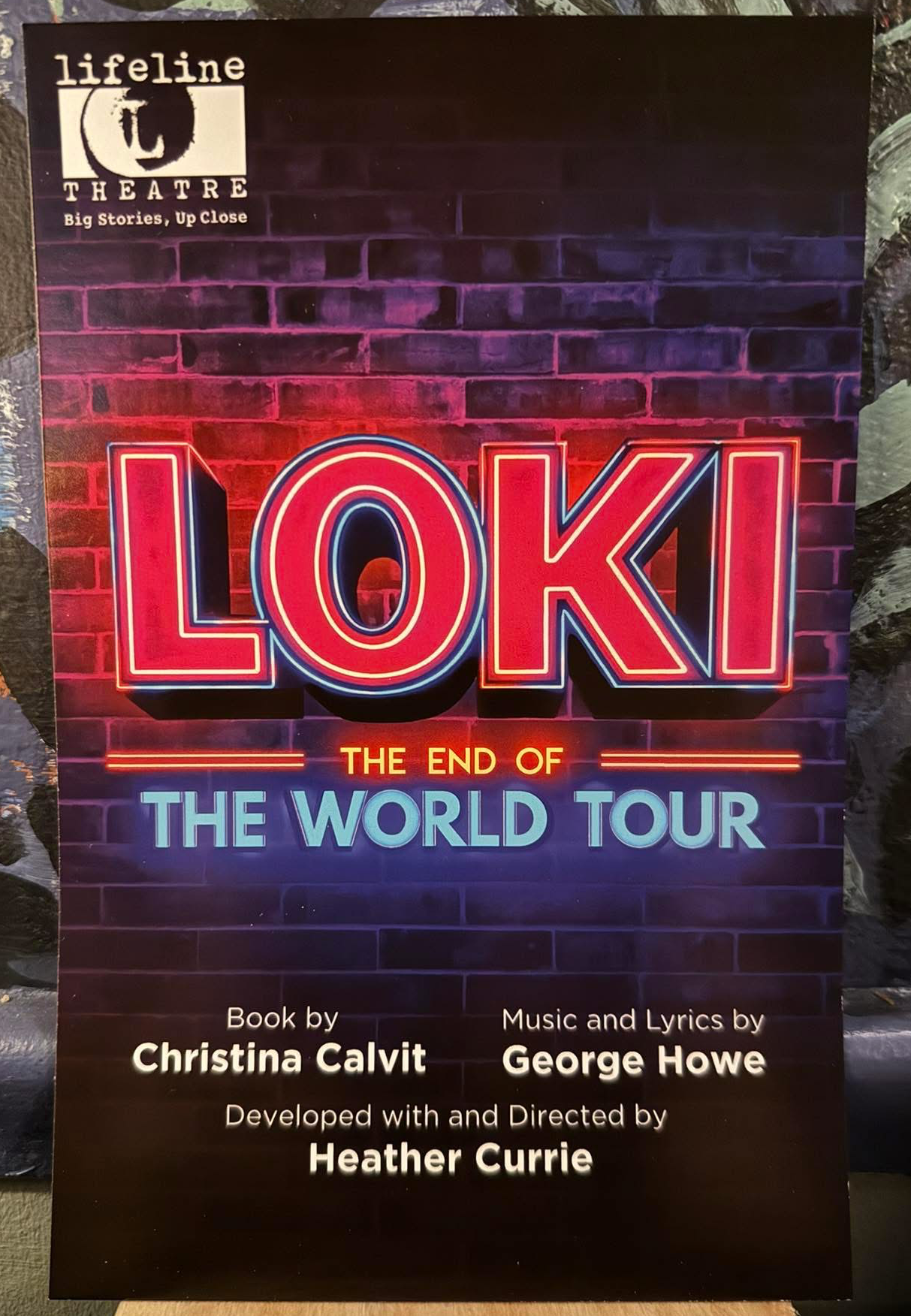
Poster for “Loki: The End of the World Tour” at Chicago’s Lifeline Theatre
Loki borrows from an ambitiously large sampling of specific Old Norse poems and stories. The writing weaves these together with modern moments into a cohesive plotline, emcee’d by a three-person rock band called the Norns. According to other attendees, zero mythological knowledge is required to understand and enjoy the show. That said, if you’re delighted by the idea of Norns who are responsible for creating the backing music guiding each singer—Norns sometimes willing to change their tune and other times immovable—you’ll see why I think this show is even better the more you know.
As the punny title suggests, Loki: The End of the World Tour depicts events leading up to the apocalyptic Ragnarok. The eldest Norn (Kelan Smith, who pairs deadpan certainty with a wise, secret smile) insists that Ragnarok is the clear-cut battle of good gods versus evil monsters. Of course it is.
Or is it?
Obviously not. Leaning into nuance too early on would ruin the storytelling fun. But we as audience members eventually discover that this openly queer Loki’s “monstrous” children are just that: children, with a need to be treated with kindness and understanding, who face abuse from powerful rulers instead. The story suggests parallels to current attacks on trans and migrant children, among many others, and aligns with Lifeline Theatre’s stated vision: “To contribute to a society guided by compassion, empathy, and a willingness to change.”
This message repeats in many forms of media and literature and reminds us that objectifying Othered people into things to exploit or destroy is the real evil, harming everyone—even, ironically, the most powerful. I never get sick of a story like this. (In July, I have my own forthcoming short story, “Apocalypse Later,” in a speculative fiction anthology by Lonely Cryptid Media, featuring a trans Loki who knows herself to be evil, just like everybody always says. Of course she is. Or is she?)
This kind of question-who-the-monsters-are theme is less accepted in some modern Heathen religious spaces than it seems to be in pop culture. Telling the story of Ragnarok with compassion for Loki and Loki’s children is not new in Heathenry: even the 1982 text much-admired by old-school Asatruar, The Well and the Tree by Paul Bauschatz, argues this. Nonetheless, tolerating or even amicably disagreeing with friendliness toward Loki and family is new within large, mainstream US-based Heathen organizations. In 2023, a mere three years ago, I, as someone oathed to Loki, and Eric Kenron, now one of my dearest friends and a devotee of Heimdall (a god some see as an eternal enemy of Loki), crafted revised bylaws with several others in the Troth, removing a ban on openly praying to some of Loki’s family within Troth-sponsored events and publications. I’m glad things are different now, in some spaces. But it still feels surreal that it was ever a debate, and my gods! Was it ever!
It’s important to note that I don’t think any of the real Norse gods are evil, just deliciously complicated. I believe that the actual Odin often participates in stories—modern or ancient—in an educational role. “Watch me fail in exciting ways” makes for a great lesson, and sometimes that means playing the villain. I don’t worship fascists, and these gods aren’t that. But sometimes they play them on TV – or on stage, as it were.
Anyway, Loki: The End of the World Tour loves Loki and the kiddos. It’s a very funny musical (at times funnier for me because I knew what was coming, while much of the audience sat blissfully unaware that Loki, played by Jack Chylinski, was about to seduce a horse). The story turns shocking and painful at times, but like Voluspa or any regenerative Pagan myth, is never permanently bleak.
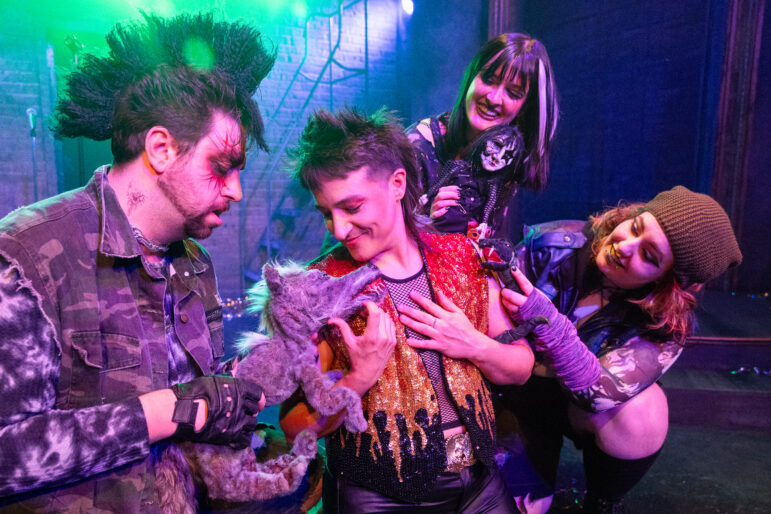
Anthony Kayer, Jack Chylinski, Grace Reidenauer, and Avery Thompson as Loki and their children in “Loki: The End of the World Tour” [Photo credit: Josh Bernaski]
I want to give a shout-out to props designer Saskia Bakker for crafting puppets of Loki’s babies in their infancy: a fluffy snake, a decrepit wolf, and a doll somewhere between Annabelle and a Kiss concert. I thought they were beautiful. Lighting designer G. “Max” Maxin IV and scenic designer Lindsay Mummert also prove that impactful imagery on stage need not require a huge budget nor digital projections: the imprisonment of Loki’s three children is visually stunning and aided by skilled gesture from Grace Reidenauer (Hel), Anthony Kayer (Fenris), and Avery Thompson (Middy the Midgard Serpent).
Reidenauer as Hel is extraordinarily close in appearance to how I visualize this goddess. Her acting is striking: an outspoken, empathetic teen retreating silently inward while her parent falls in love with someone who hurt her. It is compelling and heartbreaking to watch Hel ascend to Her high seat, leaving behind her childhood distress for apotheosis and otherworldly stoicism as Death Herself, compounded by Loki’s grief that he arrives too late. Actually, all of the kids are so well-acted that although I am certain the actors are full-grown adults, I felt an extreme parental urge to intervene, cuddle, and adopt all three.
I didn’t buy the writing’s Hillary Clinton girlboss-style motivations for Freya (Janelle Sanabria, a vocal powerhouse who fittingly sends love to her cat in her bio). An obsession with leading the charge at Ragnarok, and Odin doesn’t think she can because she’s a woman? Nah. Freya’s wiser than that, even here, and it feels anachronistic, much more so than modern setting: Old Norse female warriors are well-documented and Odin traditionally defers to Freya in battle, not the other way around. But I do appreciate her bitter arc as Gullveig, thrice burned by the Aesir, her personhood and pain dismissed because she wouldn’t die, so what did it matter—that kind of misogyny feels real. I also like the juiciness of her conflation with Frigg here, since she deliberately and spitefully gives Loki the information needed to kill her own innocent son (step-son?) Baldur (Peter Gertas).
Gertas makes a wise choice to commit with no hesitation or irony to Baldur’s earnest optimism. He’s a sweetie and I dreaded his death. Thor (Keenan Odenkirk), as in most pop culture depictions, is the violent enforcer and dumb jock comic relief, but also has a heart: Odenkirk plays Thor as panicked in a failing quest for attention and affection. Thor even has a sexuality crisis and a bewildered kiss on the lips with Loki, all of which adds warmth.
Odin (Scott Danielson) is the real bully of the musical, but Danielson presents Odin’s pathos and paranoia in such a way that he also stays three-dimensional. Specifically, Danielson’s highly physical acting during Baldur’s funeral was disturbing and stole my attention: I felt like I was watching a real father living out his worst nightmares with a dead son. He did not look well. Loki and Odin’s lore-accurate, homoerotically-tinged blood brotherhood is also a welcome correction to the Marvel Zeitgeist of Loki as Odin’s adopted son. Not so!
The musical references the Narfi/Vali myth in the form of Sigyn’s unnamed newborn. Intriguingly, Chylinski’s Loki expresses a vicious, bitter, and fourth-wall-bending awareness that their infant’s abdomen will be torn open, but the show evades revealing that Loki’s bindings are Narfi’s intestines. It deceptively seems like Loki is the violent one in that moment, going insane and threatening his own child: another example that not everything is as it seems. I suspect keeping this vague (and confusing to many audience members) is because, by that point, the other gods already look unsympathetic, and brutally murdering an infant to punish Loki would probably be a step too far.
Speaking of Sigyn… oh boy, Sigyn. India Renteria does a good job making her hateable, and I mean that as a compliment!
Musical theatre tends to adhere to certain storytelling conventions, and it is admittedly difficult to depict “quirky antihero (Loki) loses everything at the end of act one and enters a villain arc in the start of act two” if said antihero maintains an unconditionally loving marriage of equals with a goddess who would die to protect her step-children. That’s the Sigyn I know.
To be fair, there is so little written down about Sigyn historically that she could be anybody. I’m just going to ask you to take my word for it. Or go talk to her yourself: you’ll see. She has a beautiful heart. Instead, this production makes Sigyn’s fidelity ironic: she engages in “why can’t you be normal, look at everything I do for you” narcissistic abuse, instead of being a loyal goddess of compassion taking a willful underworld descent. This Sigyn appears to take satisfaction from hurting other people. Renteria wanders around the stage holding the bowl to “help” the bound and tortured Loki, and for the majority of her woe-is-me, victim-blaming ballad, she neglects to hold the bowl anywhere near Loki, defeating the entire purpose. I think this is intentional. I have held the bowl for Loki ritually every month for nearly a decade, so it drives me nuts to see. But it’s interesting! Why can’t Sigyn roleplay a villain sometimes like the other gods do? Sure. I support women’s wrongs. (But go watch Mara und der Feuerbringer for the Sigyn I recognize.)
As for Chylinski, I have no complaints about their capable handling of Loki’s charisma, cleverness, sexiness, and comedy, and was pleased to see both tenderness and grief. I especially appreciate that both the script and the actor take risks as Loki spirals toward an apocalyptic crisis. Where Chylinski really impresses me, however, is at their most understated. There is a portion of the Loki musical where lines blur between actors and characters, costumes become plainer, the fourth wall breaks permanently, and fiction disappears to uncover literal fears about the end of our actual lives and world.
In this moment, I felt the Loki I know most vividly, and some of the other gods who were cruel earlier could also be spiritually present as their loving selves. This is Chylinski’s strongest scene, one with the great responsibility of stepping on stage and holding the non-fictional expectations, anxieties, and pain of an audience in a quiet and honest way. In this moment, they perform the powerful magical act of delivering genuine hope, free from purity or naivete. Very Loki.
I and others exited the theatre feeling loved and less afraid, with a reminder to be bold and seek the beauty of authenticity even and especially in the face of violence. Throughout the musical, from a Pagan perspective, I heard statements from artists embodying the gods and spirits that those beings are still here (even within a goofy-sexy Thor song about his hammer returning again and again and again) and that they are available to humans for connection: the catharsis of rage and grief, hard lessons, loud music, and plenty of humor, comfort, and queer joy.
I’m an easy sell for any media that depicts Loki as the abundantly loving deity he is, but even among attendees with no prior knowledge, plenty of people appeared thoughtful and visibly moved. I have no idea what the individual spiritual beliefs are of the writers, directors, cast, and crew, but I’ll go ahead and say from my perspective, the musical felt inspired. Literally.
Loki: The End of the World Tour runs until June 27, 2026 at Lifeline Theatre, 6912 North Glenwood Avenue, Chicago, IL, 60626. More info and tickets are available here.
(And if you are sensitive to loud sounds, like I am, wear ear plugs!)
The Wild Hunt is not responsible for links to external content.
To join a conversation on this post:
Visit our The Wild Hunt subreddit! Point your favorite browser to https://www.reddit.com/r/The_Wild_Hunt_News/, then click “JOIN”. Make sure to click the bell, too, to be notified of new articles posted to our subreddit.