

I won’t say that I’m any authority on David Bowie’s work, but I wrote a book about him anyway.
In 2020 I was driving through the desert and spending a lot of time with 1976’s Station to Station, and one of the final characters of Bowie’s archetypal channelings, the haunting Thin White Duke. I didn’t even know if I liked the album; I just couldn’t shake it. I was enchanted – I heard so much ceremony and ritual in the songs. I had mainlined Blackstar when it came out in 2016, and the two albums mirrored each other in their sense of bewitchment – with, admittedly, Station being the more theatrical of the two.

The Thin White Duke. David Bowie at the O’Keefe Centre, Toronto, Ontario Canada on 28 February 1976. [Jean-Luc Ourlin, Wikimedia Commons, CC 2.0]
Where Station to Station is flashy and naked occultism, the parroting of words to achieve an end, Blackstar has the grief of transformation. I don’t think I can truly understand either album without the other. They are so deeply in conversation, to the point where I feel like I’m overhearing them in another room. Blackstar’s title track is its first track, just like Station; it’s the longest song; and it’s is 9:58 to Station to Station’s 10:16. (Sorry, no angel numbers.)
Where Station to Station is a notebook of a man approaching 30, a charlatan performing parlor tricks and amusing himself with stimulants, Blackstar is a grimoire. The record of what it is to hold all of your magic, and then to grapple with the sensation of losing it.
During Station’s creation, Bowie was a shell of himself. He had starred as Thomas Jerome Newton in The Man Who Fell to Earth, a long, rambling film based on the novel by Walter Tevis. He was rail thin and brittle, and dressing in the 1970’s reimagining of the 1950’s. It was crisp collars, suspenders, and a fedora, the formerly colorful character of Halloween Jack stripped back to noir. Occultism saturates the album, from the title track being a map of the spheres of the Tree of Life in Jewish mysticism’s Qabalah, to every little Easter egg of Crowley’s poems.
Here are we, one magical movement
From Kether to Malkuth
There are you, drive like a demon
From station to station
– “Station to Station”
Station to Station is chaotic, at times funky. The tracks, in my opinion, do not flow together but rather crash into one another. There’s something sweeping and overwhelming and antagonistic about it, despite being a fairly short album at only six songs. The songs are intentionally alienating. If I were to suggest a Bowie album to someone who had never heard him, this would not be the one I would start with.
It wasn’t Bowie’s best time. He was so high that he didn’t recall most of the album’s creation, and in the throes of his addiction he did some, putting it delicately, bad shit. There was the Hitler praise, the fascism admiration. The thing with the Nazi salute.
He always spoke of the Duke afterwards with deep mortification. Like at any moment the Duke would emerge from the fog of a street once more and he’d have to fight him. He called him a nasty character, a physical symbol of his amphetamine use.
Run for the shadows
Run for the shadows
– “Golden Years “
I became fixated with Station to Station just as I left my Saturn return. I had done just enough magic to consider myself a fried and exasperated magician – no longer a novice but still with no real idea of what I was doing. In the darkness of tedium lived the Thin White Duke. I spent the writing process yelling at him. I spent it reflecting on the ways I felt like I was becoming more and more mortal the older I got, and then there was Saturn, reminding me that childhood ends and time is finite.
As I experienced Arizona at 83 miles per hour, there was this reminder of how small I was in the vastness of the desert, and I found it confrontational. I think that’s what I felt that Station to Station was articulating within me, and that’s where Dark Way Down emerged. I wasn’t young anymore. It felt like I should have more figured out. Fewer grudges. Less resentment. But I was angry. I was angry and felt the darkness of fascism stretch out in front of me in great long shadows. Now, I’m writing inside it.
Heart wrecker, heart wrecker, make me delight
Life is so vague when it brings someone new
This time tomorrow I’ll know what to do
I know it’s happened to you
-“Stay”
Station to Station’s lyrics only feature the title phrase once – specifically in the Malkuth and Keter verse, evoking clumsily the stations of the Tree of Life, or more likely, the Stations of the Cross, as I’ve never heard a mystic or occultist call the Tree of Life spheres “stations.” A young man’s occultism gets messy and imprecise, but he tosses it out so confidently.
Where Station to Station is the Magician card, full of candles, enough sense to know a ritual, Blackstar is Judgement, the stubs of everything Bowie created, a collection of his past spellwork, all melted down for his funeral pyre. The drum beats from Low, the echoes of Heroes, and the final track, his lament of how there could have been more magic, more ritual, more candles, but he can’t give everything away. There was more of him that he had to retain because time was up. Station to Station is reckless and distant, Blackstar is present and still.
Comparing Station to Blackstar feels like comparing the toddler dressed for a wedding to the man suited for his funeral.

A memorial outside of Bowie’s New York home the day after his death, January 2016. (Bowie claimed that during the recording of Station to Station he subsisted primarily on milk, peppers, and cocaine.) [David Shankbone, Wikimedia Commons, CC 3.0]
Blackstar’s looseness is not the fury of cocaine or inexperience, but the long notes of cancer treatment. Bowie in the writing and recording process was back on drugs, this time to try to save his life, and when not that, his comfort. Where Station allowed him to hide in the Duke, in Blackstar, the magician is Bowie. No pretense. The album is reflective, passive. Instead of the dissociation of Station to Station, it’s a focus on the emotional reality of death.
In the villa of Ormen, in the villa of Ormen
Stands a solitary candle, ah-ah, ah-ah
In the centre of it all, in the centre of it all
– “Blackstar “
Blackstar repeats the line “I’m a Blackstar” like a chant. Most lines in the song have it as the call and response: “I’m the Great I Am (I’m a Blackstar).” It not only calls back to his first major hit, Space Oddity, but his time reading Aleister Crowley in Bel Air: “Every man and every woman is a star.”
Blackstar is another name for Saturn, and Saturn is a planet of time. It’s an archetype of control, and losing it. Or empire and decay. The god Saturn is the god of time, generation, dissolution. It’s astrologically considered a marker of rigidity and structure. Saturn is in Station to Station too, released in Bowie’s first Saturn return and marking his achievement of wealth and fame, all while he crumbled apart in his personal and professional reputation. But in Blackstar, an old man must die. He has reached the end of his long reign. The king is humbled.
How many times does an angel fall?
-“Blackstar”
I tend to prefer Bowie once he comes down from the stars and learns how to be a human. After Station to Station, he fled Los Angeles, got sober, and became his last Bowie. Bowie the human. I like him best this way, as the alien who is no longer drinking himself to death, but who has married Iman, developed solidarity with Black artists and music, and is dapper but himself. It makes the impact of Blackstar so much more tragic. The alien came to Earth. He learned to be one of us. He learned to love his human life. And then he was tragically ripped from it. Blackstar reverberates with that tragedy. The hero’s journey ends the ways all our journeys end.
Blackstar’s last song, “I Can’t Give Everything Away,” has the same repetition of “Blackstar,” pressing the title of the song as the message. The petition is more direct than Station to Station, the anguish more realized. It’s his Prospero’s lament, his head full of memories of past magic that he’ll have to accept losing in the exile of death.
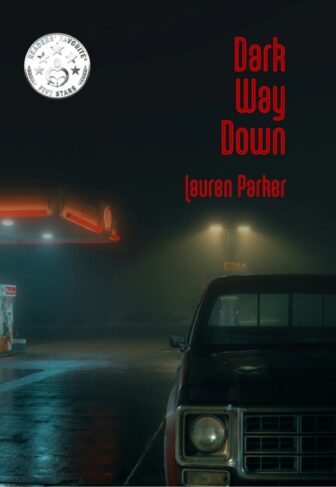
Cover to “Dark Way Down” by our own Lauren Parker [Animal Heart Press]
I don’t know what truly happens with all the songs that we won’t hear. Maybe they become stars too.
With your kiss my life begins
You’re spring to me, all things to me
Don’t you know you’re life itself?
– “Wild is the Wind”
The Wild Hunt is not responsible for links to external content.
To join a conversation on this post:
Visit our The Wild Hunt subreddit! Point your favorite browser to https://www.reddit.com/r/The_Wild_Hunt_News/, then click “JOIN”. Make sure to click the bell, too, to be notified of new articles posted to our subreddit.