

Just inside the entrance to Ancient Splendor: Roman Art in the Age of Trajan, the exhibition which opened at the St. Louis Art Museum yesterday, stands a monumental statue of Trajan, who ruled the Roman Empire between 98 and 117 of the Common Era. The statue’s gravity is undeniable, nearly seven feet tall and weighing more than 2,500 pounds, a figure carved from marble and clad in the military dress that signified the emperor’s dominance over the greatest territorial claim in Roman history. Standing in the middle of an uncluttered hall dressed in cream, lavender, and wood, this portrait of Trajan casts the very image of classical sculpture: austere, timeless, awe-inspiring.
But we know that portrait of the Roman past is somewhere between a mistake and a fabrication. In Trajan’s own time, his sculpture would have been colorful, painted in ways we might think of as gaudy today. It’s only because we are looking at it now, after the millennia have had their chance to strip away all that color, that we are left with the pale marble before us. And yet, despite the best efforts of art historians and classicists, this severe image of the past retains its hold on the Western psyche – especially on a certain class of reactionaries who wield a shocking amount of influence in the current American administration.
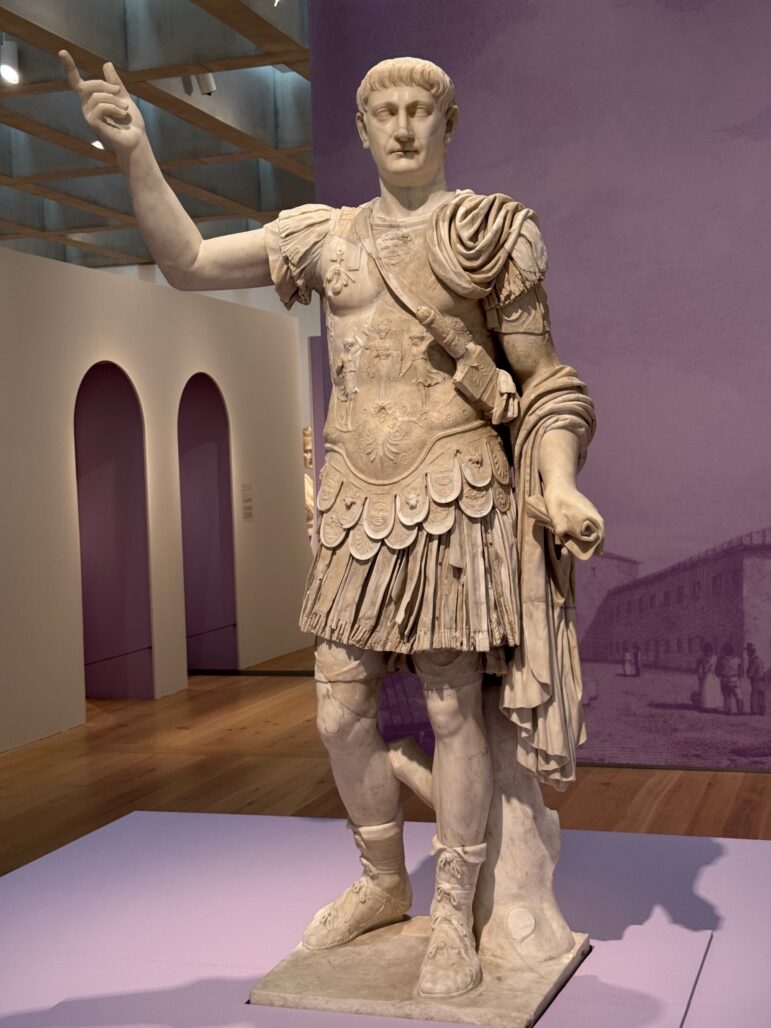
Statue of Trajan, end of 1st to beginning of 2nd century CE, marble, from Minturno, Italy. National Archeological Museum of Naples. [E. Scott]
This was a conundrum I found myself coming back to again and again as I toured Ancient Splendor. This is an exhibit that, as a Pagan, I had been looking forward to for months. I am always looking forward to a chance to see new artifacts from the ancient pagan era, and indeed, my visits to certain exhibitions have been major parts of my religious development. But even as I took in this wonderful collection of items from the height of the Roman Empire – many of which are appearing for the first time outside of Italy – I felt that much about the ways we apprehend and make use of the past was being left unsaid.
This is an old-fashioned exhibition, not just in the sense that it focuses on the classical era, but in its approach to history. Ancient Splendor is explicitly about Trajan and his family (including his imperial successor Hadrian) and how their successful military campaigns led to their sponsorship of art and architecture as a means to cement legitimacy and political power. There are some objects that speak to the lives of the lower classes, the enslaved, and the “barbarians” who made up the vast majority of humanity in the Roman Empire, but for the most part the exhibit is concerned with the lives of the era’s powerful men and women. It’s the “Great Man” theory on display – for the most part items are displayed to tell us something about Trajan or his associates as individuals, and the movements of broader social classes are described in terms of their relationship to the emperor.
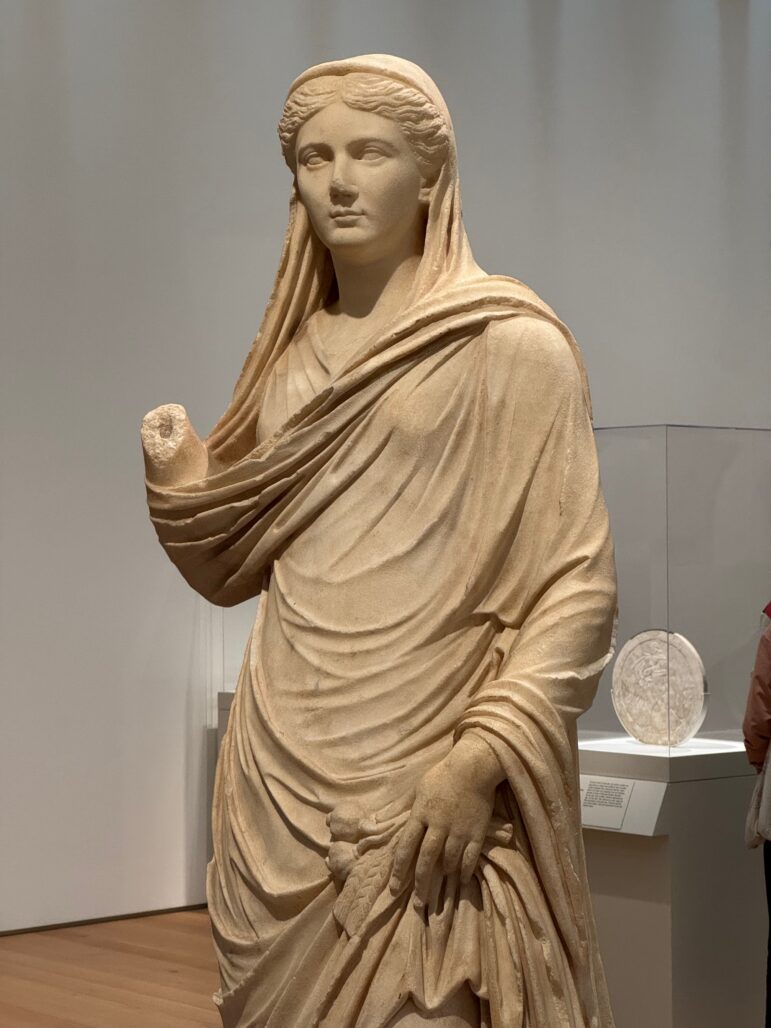
Sabine as Ceres, 137-8 CE, marble, from the Baths of Neptune, Ostia, Italy. Archeological Park of Ostia Antica, Rome. [E. Scott]
This is true even with regards to the mythological and religious material on display, which has a dedicated room of its own. The centerpiece there is a statue from Ostia’s Baths of Neptune depicting Sabina, grand-niece to Trajan and wife to Hadrian, as Ceres, the Roman equivalent of the Greek goddess Demeter. It is a magnificent statue, and a fascinating look into how the imperial family wove itself into the iconography of Roman religion. But it did not inspire the same kind of religious reverence I might have felt for a statue of Ceres that were not so clearly a piece of political propaganda. Perhaps that is unfair of me; most of the ancient pagan art that has survived to us was, in some way, a tool to legitimate power. But it’s rarely presented so obviously.
That said, there are plenty of religious objects surrounding Sabina that are a delight for a modern Pagan visitor. I especially liked a cabinet of tiny bronze figurines and portraits of deities like Mercury, Hercules, and Jupiter Serapis, along with the household deities, the lares. These intimate figures, small enough to be held in the hand, remind us of the genuine devotion these gods inspired in the pagans of the ancient world. So too does a marble disc, called an oscillium, from Pompeii, that depicts Dionysus on one side and Pan on the other; the display notes that these discs come from festivals in the countryside, where votive gifts to Dionysus (or his Roman equivalent, Bacchus) would be hung from tree branches. Pan makes several appearances throughout the exhibition. My favorite is a marble figure of Cupid, depicted, as he often is today, as a chubby nude child, holding a theatrical mask of Pan that wears a devious grin.
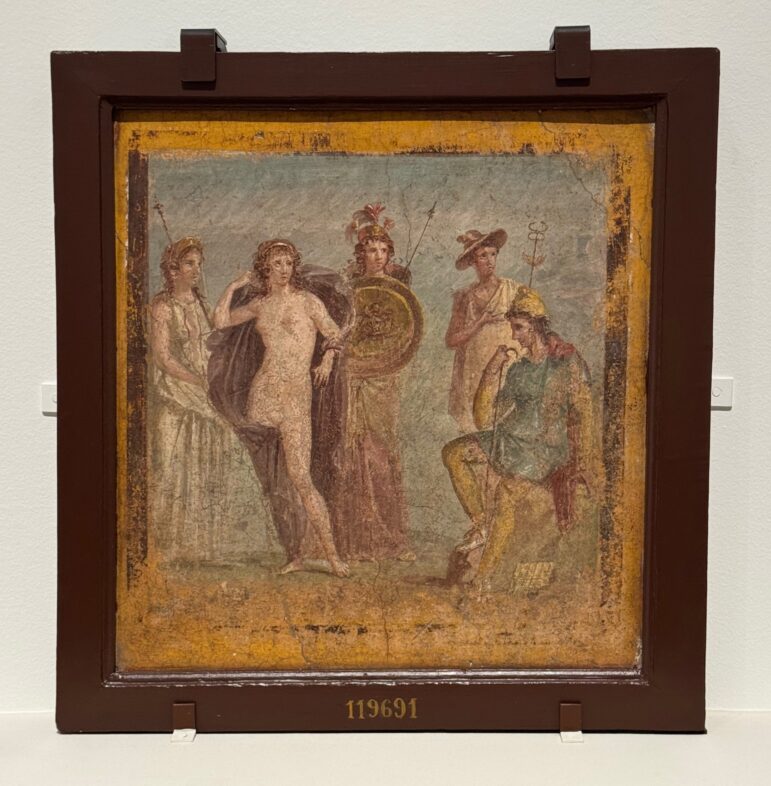
The Judgment of Paris, 1st century CE, fresco on plaster, from Pompeii, Italy. The National Archeological Museum of Naples. [E. Scott]
There is more to the exhibit than just statuary. Some of Rome’s more colorful depictions are on display in the form of frescoes, many from Pompeii, displaying mythological scenes like the Judgment of Paris, Narcissus and Echo, or the moon goddess Selene visiting the sleeping Endymion. Mosaics, too, offer a glimpse of Roman life that feels genuinely lived-in, whether in detailed pictures of theatrical masks or fish or in utilitarian patterns laid into a threshold.
It is, however, monumental statuary that is the focus of this exhibition. Larger-than-life portraits of Trajan greet visitors at the beginning and bid them farewell at the end. The finale of the exhibition is a reconstruction of a section of Trajan’s Column, the most visible monument to the emperor’s deeds and reputation. (Note: The column had not yet been installed on the day I visited.) Visitors are meant to enter into a conversation with the past that centers around Trajan, Hadrian, and their powerful family members and associates; this is the frame of reference we are meant to apply to all of the objects in Ancient Splendor.
This is not, in and of itself, a bad thing. Certainly the Romans centered much of their culture around the figure of the emperor, and found their reigns a significant way of dating events in their culture. The individual character of emperors had significant impacts on the daily lives of their subjects; Trajan’s reputation as one of the “Five Good Emperors” proceeded from the material conditions of his rule. And, being honest: the lives of the emperors is how most of the public knows about ancient Roman history, if they know about it at all.
I think what’s left me feeling unsatisfied about this exhibit isn’t this framing, but that the process of arriving at that framing doesn’t come up for discussion. Some other recent historical exhibits at the St. Louis Art Museum – I’m thinking here of the fantastic Nubia from 2021 – put a great deal of effort into explaining the historiography of their material, describing not only what we know about the objects on display but how we came to know it. I feel that Ancient Splendor could use more of that framing. The objects themselves are fascinating, but are presented in a way that tells the audience little about how archeologists, art historians, and classicists develop their interpretations of these artifacts.
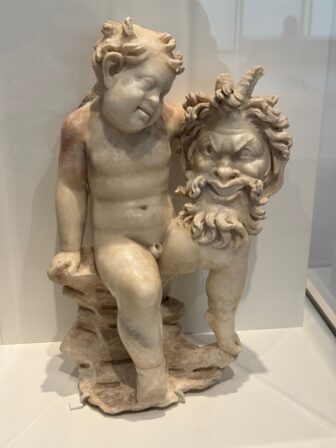
Cupid with a mask of Pan, 1st century CE, marble, from Pompeii, Italy. The National Archeological Museum of Naples. [E. Scott]
All that said, Ancient Splendor is more than worth a visit for any Pagan with a connection to the Roman deities. Rarely do we get such an opportunity to visit with the same incarnation of Apollo, or Hercules, or even Ceres in the guise of an empress. But as we encounter these mementos of the pagan past, it is worth keeping a critical eye on how they are presented, and to what uses they are being put today.
The Wild Hunt is not responsible for links to external content.
To join a conversation on this post:
Visit our The Wild Hunt subreddit! Point your favorite browser to https://www.reddit.com/r/The_Wild_Hunt_News/, then click “JOIN”. Make sure to click the bell, too, to be notified of new articles posted to our subreddit.