

Before my parents moved, I took a jar of earth from their garden. This was the garden that had taken my father’s wedding ring and given back old blue bottles and square-headed nails and chunks of brick throughout my childhood. It took a little blood as I waded into it – it was always given to flooding – and came back with a mason jar worth of earth. I added a leaf from the apple tree on the corner of the property, and one of the thin dry husks from the catalpa tree that stank up the yard every summer. The swing we had hung from that tree was old enough that the rope was almost gone, grey remnants hanging from the branch grown too tall to fetch them down. Those are my memories of the place – the rusted out burn barrel, and the chicken coop with the patched-together fence, and the plastic patio furniture that had started to crack with age.
My memories of my childhood aren’t all good ones, but I miss that house. I miss the carpenter bees that dug into the ceiling of the front porch and the way the yard slowly ate up the brick sidewalk. I miss the old cellar out back with its thriving cave cricket population and the smokehouse above it with its golden stillness within and green ivy without. I miss the way the maple tree turned gold every year as the colors on the swingset beneath it washed out, and the speed a bike could go down the gravel alleyway behind the garage, and the brooder my dad and I built one summer that was used for a new flock of chicks every year until it couldn’t hold together anymore.
I took the jar of dirt for a magical task that never manifested, given by a channeler I no longer trust, from a god I no longer follow. At the time, it was one of several – one more way to feel connected to the lands where my roots had been planted. It was never intended to be the last thing I had of the place.
Now that I cannot go back, that jar means something different.
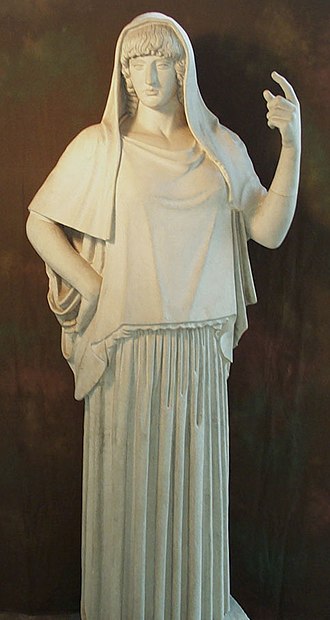
Giustiniani Hestia (Museo Torlonia copy). Roman, second century CE. Original; c.460 BCE. [public domain]
Her power extends over altars and hearths, and therefore all prayers and all sacrifices end with this goddess, because she is the guardian of the innermost things.
– Cicero, De Natura Deorum
I have never kidded myself about Kansas. There are parts of it I love, sure, in the way any kid loves the home where they grew up. It has a quiet beauty to it that people from more urban states often miss, and it is filled with tenacious, kind, generous people. But I was not yet out of high school before I knew that I was never going to come back.
It was instinctive, a holistic push against everything about the place that distanced the good right along with the bad. I hit college and kept going, visited seldom, turned my full attention to getting far enough away and then further than that. When my friends talked about moving home and putting their resources into the institutions that had given us the inspiration to build ourselves bigger, I listened with a disbelief that bordered on terror. We had gotten out despite the odds, I thought. What could be worth risking that?
It took me years to be able to articulate any more of that, for distance to lend the perspective needed for the big picture. While I can tell stories of museums, and concerts, and teachers that shaped me and gave me the fire I needed to keep going, growing up in Kansas in the 90s was growing up in an atmosphere of racism and homophobia so pervasive it didn’t even register. When every field trip required walking past the slurs and bigotry of the Westboro Baptist Church, the daily hazing of my queer peers was just background noise. When I could count the non-white families in town on one hand, I didn’t have the context for why there were so few. I knew that the people around me were decent, hard working, kind folks who took care of their families. I couldn’t figure out why I wanted to be so far away from them.
As an adult, with a full state and 20 years between us, I can find these contradictions illuminating. Thinking about how people can be essentially decent with one breath and repeating a litany of hate with the next has shaped a lot of my paradigm for how the world works. But understanding more about “why” doesn’t change the “what”. Since I’ve left, the state that birthed me has rolled out law after law that makes it not just unpleasant but unsafe for me to return. For the last 20 years, my home has turned subtext into text to make it clear I’m not welcome. The most recent of these has stripped rights from my community, put a bounty on my head, and driven more people like me from their homes.
Contrarian that I am, of course I’m going back now.
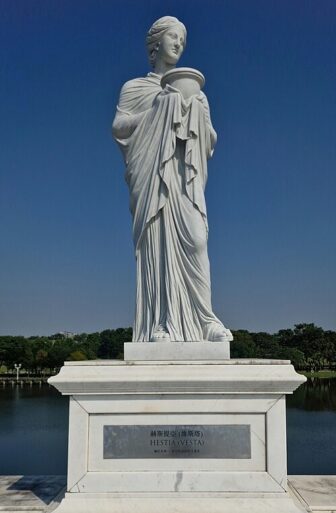
Hestia, from Olympus Bridge, Chimei Museum, Taiwan [public domain]
Of these, they say, Hestia discovered how to build houses, and because of this benefaction of hers practically all men have established her shrine in every home, according her honours and sacrifices.
– Diodorus Siculus, Library of History
I cannot do better to sum up the effects of the law stripping transgender Kansans of their legal documentation than my friend Sylvie Althoff did in her brilliant article. Unlike me, Sylvie still lives in Kansas. Unlike me, she’s gone through the considerable legal hassle of changing her gender marker on her driver’s license and birth certificate. Unlike me, she is impacted every day by the possibility of not being able to get to work, or vote, or use a restroom outside of her house.
These days, I’m just a visitor. I am coming home for a funeral and to see my parents’ new house and to visit a few of the haunts that my young self loved as much as the asparagus that grew wild and untended at the end of the road. Then, it’s quite possible I will never come back.
My family doesn’t understand that. They feel as unsafe in my city as I do in their small town, and I am sure each of us finds the other’s concerns a bit overstated. I cannot explain to them how much I dread the place, or how much work it is to cross the state line and believe that I’ll be able to leave again, back to the places and people that have let me spread my roots and grow, and change, and become more expansive.
I miss my home. I loved it once. But when I have to plan my trip by each bathroom break, ration my drinks, strategize with my friends where to get gas and who’ll speak first if we get pulled over?
Home doesn’t love me.
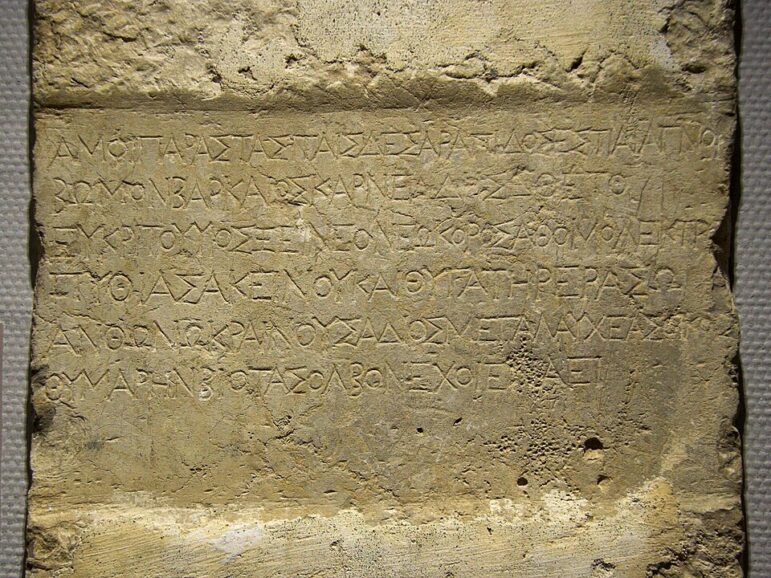
Metric dedication of an altar to Hestia from Karneades of Barke, his wife Pythias and their daughter Eraso beside the Temple of Serapis (IG XIV 433). Lapidary and epigraphic collection of the Greek Theatre of Taormina. Found in Taormina. Inscriptionː “Beside these walls of Serapis the warden of the temple Karneades of Barke, son of Eukritos, o foreigner, and his spouse Pythias and his daughter Eraso placed to Hestia a pure altar, as a reward for this, o you that governs the marvellous dwellings of Zeus, grant to them a lovely auspiciousness of life.” [Zde, Wikimedia Commons, CC 4.0]
Sing, Muses, of the goddess of the hearth, the keeper of the sacred flame. Sing of Hestia, who gave up her Olympian throne and is still honored first and last of all the gods.
Hestia, eldest sister of Zeus, you are the pilot light of the stove and the furnace, the warmth that welcomes and protects. Keep us safe.
You are the patient one, who waits for us unchanging at the end of journeys. Help us find you.
You are the unchanging, yourself whole and entire, around whom your family orbits. Help us know ourselves.
When we have no home, help us build one. When the fires of our hearth grow too hot, let us not be burned. When we are unrecognized in our divinity, show us to places where we may belong.
Eternal, ever florid queen, laughing and blessed, I will sing of you again and of another also.
The Wild Hunt is not responsible for links to external content.
To join a conversation on this post:
Visit our The Wild Hunt subreddit! Point your favorite browser to https://www.reddit.com/r/The_Wild_Hunt_News/, then click “JOIN”. Make sure to click the bell, too, to be notified of new articles posted to our subreddit.