

TWH – The Torah in the Tarot by Stav Appel is an unusual and ambitious project: part historical reproduction, part theological investigation, and part intellectual provocation. The boxed set, published by Ayin Press, includes a reproduction of the Jean Noblet Tarot de Marseille—often considered the oldest surviving Marseille-pattern deck, dating to around 1650. It also contains a substantial companion booklet in which Appel advances a striking thesis: that the Noblet deck imagery is built on an obscured set of Jewish symbols.
Appel, trained as a data scientist and deeply immersed in Torah study, recounts that his project began with a chance encounter. While examining an old Tarot deck, he began noticing biblical resonances embedded within the imagery. That curiosity evolved into sustained research. His central claim is not that Tarot as a whole is Jewish in origin, nor that its creators were openly Jewish. Instead, he argues that the specific iconography preserved in the Noblet deck contains concealed Jewish symbolism—encoded references to Hebrew letters, ritual objects, and theological concepts—crafted in a historical moment when Judaism faced persecution in Western Europe.
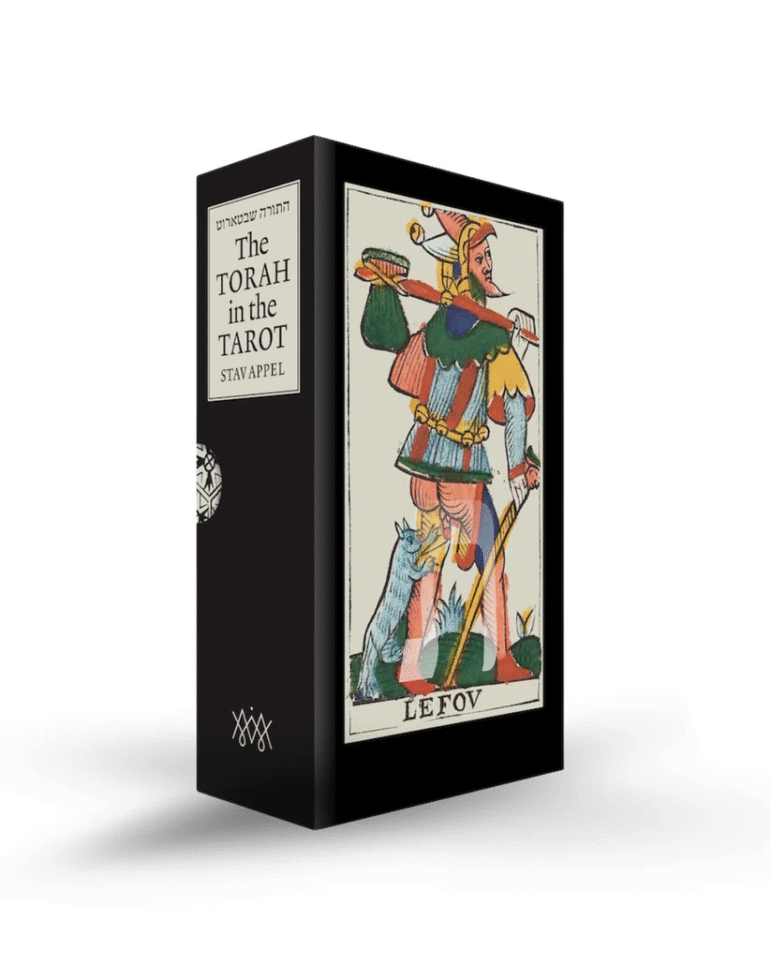
Tarot Deck: 78 cards | 2.5 x 4 in. | 0.46 kg
Booklet: Paperback | 300 pages | 3.5 x 5.75 in.
ISBN: 9781961814301 | e-ISBN: 9781961814349
Publication date: October 28th, 2025
Box cover designed by Cem Eskinazi and Tom Haviv
Book cover and interior designed by Michael Russem
Historians date the Noblet deck to 17th century France, a period shaped by the long shadow of the Inquisition and by crypto-Jewish – that is, relating to people of Jewish origin who outwardly practiced Catholicism but secretly maintained their traditions – survival strategies in Spain, Portugal, and parts of France. Appel situates the Tarot’s design within this broader culture of hidden transmission. Jewish communities forced into outward conformity often developed clandestine methods for preserving religious knowledge. The Society for Crypto-Jewish Studies, quoted in the volume, affirms that secret gatherings for worship or study were sometimes disguised as ordinary social events, including card-playing. While this does not prove Appel’s thesis, it establishes that the historical conditions for such concealment certainly existed.
Appel’s method is a close visual analysis paired with textual interpretation drawn from rabbinic and mystical traditions. For example, he reads the Magician (Le Bateleur) in the Noblet deck as visually echoing the Hebrew letter alef (א), with its diagonal axis implied and arms extended. He further suggests that the tools laid upon the Magician’s table resemble implements associated with circumcision ritual, proposing that the figure may symbolize a mohel rather than a stage conjurer.
Whether or not readers accept this identification, Appel’s detailed attention to gesture, color, and compositional structure demonstrates the seriousness of his inquiry.
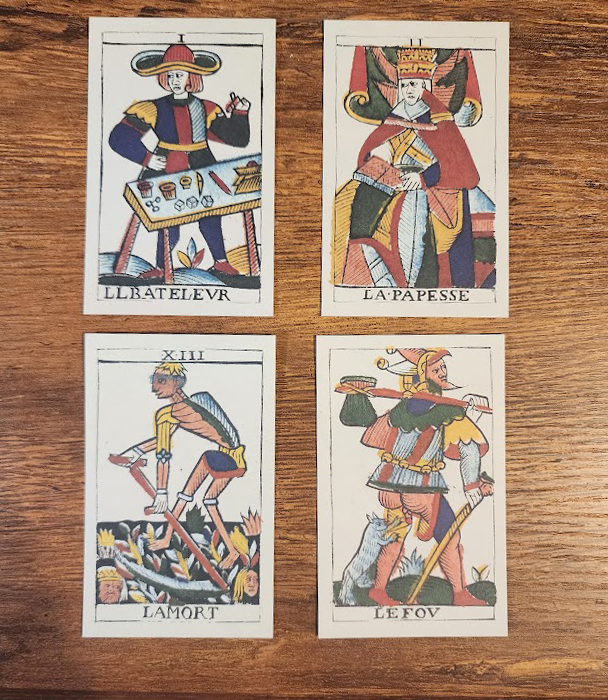
The High Priestess offers an even more provocative case. In the later Rider-Waite-Smith Tarot, the card explicitly depicts a Torah scroll labeled “Tora,” along with Temple pillars marked B and J (for “Boaz” and “Jachin,” pillars which stood at the First Temple in Jerusalem.) Appel asks whether this represents an independent reinvention of Jewish symbolism or whether Waite’s design drew, directly or indirectly, from earlier concealed content embedded in the Marseille tradition. The question remains speculative, but it highlights the broader issue: how symbols migrate, transform, and become recontextualized over time.
Importantly, Appel does not claim that Jean Noblet himself was Jewish, nor does he offer documentary proof of crypto-Jewish authorship. Instead, he proposes that the Noblet deck likely preserved visual motifs that predated its printing—motifs later reproduced by artisans who may not have understood their origins. Over successive iterations of the Marseille pattern, Appel argues, the clarity of Hebrew letters and ritual references deteriorated, suggesting copying without comprehension.
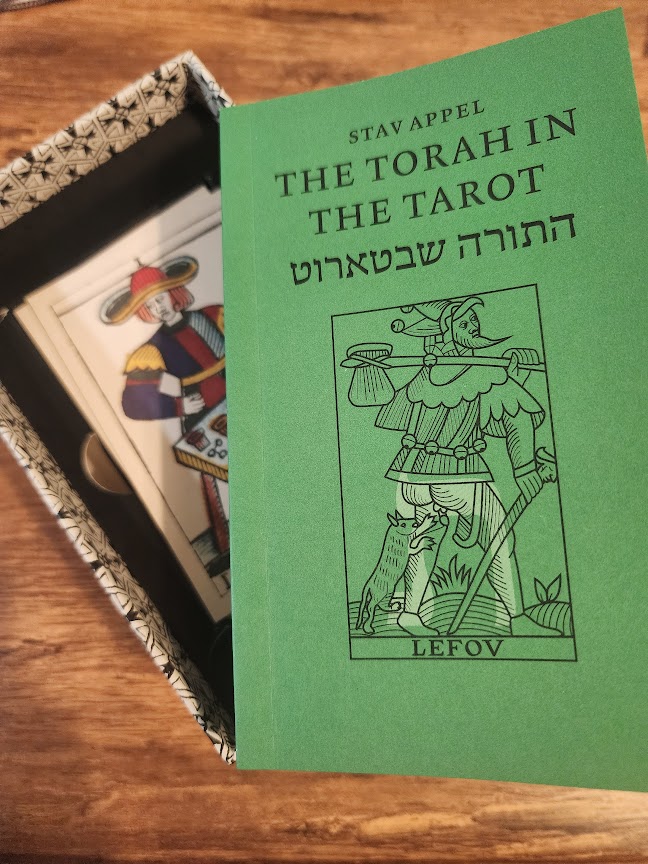
The companion booklet, with a foreword by poet Ariana Reines, is the intellectual heart of the project. Written in a style that occasionally echoes rabbinic discourse—layered, interpretive, dialogical—it reads less like a conventional art history monograph and more like a sustained midrash on Tarot imagery. Appel moves card by card through the 22 Major Arcana, proposing a Hebrew letter and corresponding Jewish concept for each. Even readers who remain unconvinced by the totality of his argument will find the methodological boldness refreshing. He models how interdisciplinary work—combining historical context, textual tradition, and visual literacy—can open new interpretive possibilities.
The physical deck itself is a faithful reproduction of the Tarot de Marseille. The cards are uncoated, sharply cut, and visually raw. They lack the gloss and polish of many contemporary decks, instead conveying a sense of archival authenticity. Some practitioners may question their durability for frequent divinatory use. Yet this very material quality reinforces the set’s scholarly orientation: the cards feel like artifacts for contemplation as much as tools for cartomancy.
For students of Tarot history, Appel’s work represents a bold reframing. For those engaged in Jewish mysticism or the study of crypto-Jewish resilience, it offers an imaginative hypothesis grounded in genuine historical pressures. And for practicing readers, it introduces an additional interpretive layer—one that neither replaces nor negates other esoteric systems, but invites reconsideration of the Tarot’s symbolic depth.
Ultimately, The Torah in the Tarot is less a definitive conclusion than an invitation. Appel asks readers to look again at images long familiar, to entertain the possibility that layers of meaning were hidden in plain sight. Whether one embraces his thesis fully, partially, or skeptically, the project succeeds in what serious scholarship often aims to do: unsettle assumptions, provoke dialogue, and expand the field of inquiry.

Editorial Note: A review copy of The Torah in the Tarot was supplied by Ayin Press.
The Wild Hunt is not responsible for links to external content.
To join a conversation on this post:
Visit our The Wild Hunt subreddit! Point your favorite browser to https://www.reddit.com/r/The_Wild_Hunt_News/, then click “JOIN”. Make sure to click the bell, too, to be notified of new articles posted to our subreddit.