
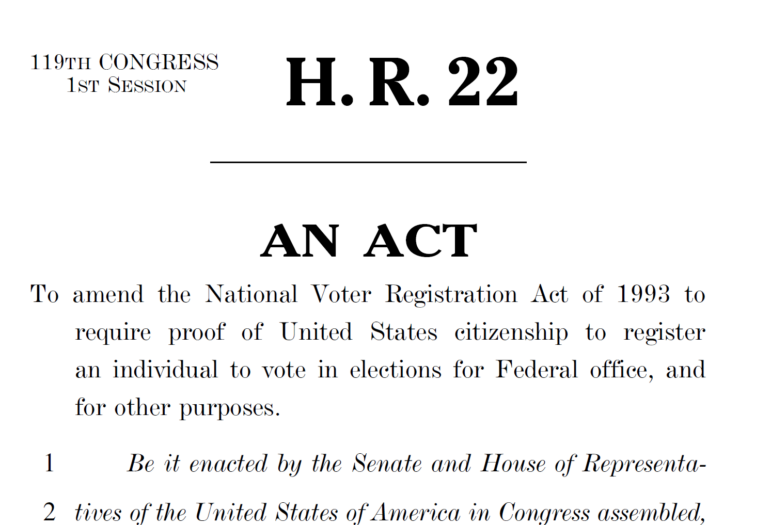
WASHINGTON— The Safeguard American Voter Eligibility (SAVE) Act is federal legislation that would require individuals to provide documentary proof of U.S. citizenship when registering to vote in federal elections. The bill amends the National Voter Registration Act of 1993 and passed the U.S. House of Representatives on April 10, 2025, as part of a broader effort by Republicans to strengthen election security requirements. It was received in the Senate the same day and referred to the Committee on Rules and Administration. The Senate could consider the bill as early as this week.
As debate over the legislation intensifies, election administrators and civil rights advocates are examining how the proposed documentation requirements could affect various communities, including women, transgender voters, Indigenous peoples, and some minority faith groups, including some modern Paganisms.
The bill has become a flashpoint in Washington in recent days. Several House Republicans have announced that they will oppose Senate legislation until the upper chamber takes up the SAVE Act. Rep. Brandon Gill (R-Texas) wrote on the social media platform X that he would vote “no” on Senate bills, except those funding the Department of Homeland Security, until the Senate advances the measure. Rep. Anna Paulina Luna (R-Florida) issued a similar statement, saying House Republicans intend to block Senate-passed legislation until the bill reaches the president’s desk.
Other lawmakers have echoed the pressure campaign. Reps. Randy Fine (R-Florida), Keith Self (R-Texas), and Mark Harris (R-North Carolina) wrote in a recent opinion piece that they are prepared to oppose Senate legislation until the chamber considers the bill. President Donald Trump, speaking at a House Republican retreat in Doral, Florida, last week, also urged the Senate to pass the legislation, saying he would not sign other bills until it is approved.

United States Capitol Building [public domain
Senate leadership has not committed to bringing the bill to a vote. Speaking on the Senate floor Thursday, Senate Republican Leader John Thune said he could not guarantee the measure’s outcome but indicated that the issue would be debated.
As the political standoff unfolds, the SAVE Act has also drawn scrutiny from election administrators, civil rights organizations, and voting-access advocates who are examining how the proposed documentation requirements could affect voters and election systems across the country.
So what is the SAVE Act, and could it affect Pagan communities? The answer is somewhat complicated.
Supporters of the legislation argue that it would ensure that only U.S. citizens are registered to vote, reinforcing a rule that already exists in federal law. Since the Illegal Immigration Reform and Immigrant Responsibility Act of 1996, noncitizens have been prohibited from voting in federal elections. Advocates say requiring documentary proof of citizenship would provide an additional safeguard against unlawful registration.
Critics, however, argue that the measure addresses a problem that appears to be rare while potentially creating new hurdles for eligible voters. Investigations by state election officials have consistently found very few cases of noncitizen registration or voting. For example, according to the Salt Lake Tribune, a review of more than two million voter records in Utah between 2025 and 2026 identified only one confirmed instance of noncitizen registration and no cases of noncitizen voting.
Another concern raised by election administrators and voting-access advocates is that not all eligible citizens have immediate access to documentary proof of citizenship, such as a birth certificate, passport, or naturalization record. Millions of Americans either lack these documents or do not have them readily available. Documents may also fail to match a voter’s current legal name because of marriage, divorce, court-ordered name changes, or other life events.
The requirement may therefore disproportionately affect certain groups whose legal documents are more likely to contain name changes or identity discrepancies.
Women who have changed their last names through marriage, divorce, or remarriage may find that their birth certificates, the most common form of proof of citizenship, do not match their current legal identification. In such cases, additional documents such as marriage certificates, divorce decrees, or court orders may be required to link the citizenship record to the individual’s present name.
Transgender individuals may encounter similar challenges. Many transgender people update their legal names and gender markers over time, but not all citizenship documents, such as birth certificates or naturalization records, may have been amended to reflect those changes. In some states, updating a birth certificate can require court orders, medical documentation, or lengthy administrative processes. As a result, transgender voters whose legal identity documents are not fully synchronized may face additional administrative steps to reconcile records before successfully registering, even when they are fully eligible U.S. citizens.
Some Indigenous communities may also face practical barriers under the SAVE Act. While the legislation explicitly recognizes certain federal tribal identification documents as proof of citizenship, many commonly used tribal IDs issued by Native nations do not list a person’s birthplace or explicitly confirm citizenship. Members of Native American and Alaska Native communities may therefore be required to provide additional documentation such as a certified birth certificate. In some rural tribal communities and reservation areas, births, particularly among older generations, were historically recorded outside hospital systems or through local tribal authorities rather than state vital records offices. This can make retrieving or replacing official birth certificates more difficult. Geographic factors can further complicate the process, as many Native American reservations and Alaska Native villages are located far from government offices where replacement documents are issued.
The SAVE Act does not place any explicit burden on Pagans, Wiccans, or other religious minorities. The bill does not include a religious test, collect information about religion, or regulate religious organizations. Its requirements apply uniformly to all voters.
However, there may be some indirect considerations relevant to some religious communities. In certain Pagan traditions, as well as in branches of Buddhism, Hinduism, and Abrahamic monastic traditions, individuals may adopt new spiritual names after conversion, initiation, or entry into religious vocation. These names are typically used within religious contexts and do not constitute legal name changes unless formalized through court proceedings. Civil records such as birth certificates, passports, and voter registration documents rely on a person’s legal name.
For Pagans, the issue also intersects with a longer history of religious privacy. During the 1970s through the 1990s, many Wiccans practiced discreetly due to employment discrimination, custody disputes, and social stigma. U.S. courts have since affirmed that Wicca is a religion protected under the First Amendment, including in the appellate decision Dettmer v. Landon and the broader religious-freedom ruling Cutter v. Wilkinson.
For most Pagans, Craft names remain spiritual or ritual identities rather than legal names. As a result, documentation laws, including voter registration rules, generally rely on a person’s legal identity rather than their religious one. Still, as debates over voter identification and citizenship verification continue, communities that value privacy or maintain multiple forms of identity may find themselves paying closer attention to how such laws are implemented.
The Wild Hunt is not responsible for links to external content.
To join a conversation on this post:
Visit our The Wild Hunt subreddit! Point your favorite browser to https://www.reddit.com/r/The_Wild_Hunt_News/, then click “JOIN”. Make sure to click the bell, too, to be notified of new articles posted to our subreddit.