
MADRID — When Christopher Columbus first encountered the Indigenous peoples of the Caribbean in 1492, his earliest descriptions conveyed both admiration and calculation. Writing about the Taíno and Lucayan peoples in journals later transcribed by Bartolomé de las Casas, Columbus described communities he perceived as generous, peaceful, and physically striking.
Columbus noted that they were “very handsome” and that they shared what they possessed freely, remarking that if asked for something, “they never say no; rather they invite the person to share it.”Yet embedded in these early observations was the mindset of conquest. Columbus quickly reframed the Indigenous people he encountered as potential subjects for conversion and labor. He repeatedly described the Taíno and Lucayan peoples as physically “very well-built” and “handsome,” then pivoted immediately to their perceived usefulness to Spain.
In an entry dated October 12, 1492, Columbus wrote: “They are very well made, with very handsome bodies and very good countenances… they should be good servants and of quick intelligence.” Two days later, on October 14, his tone shifted even further toward domination: “These people are very simple as regards the use of arms… with fifty men they can all be subjugated and made to do what is required of them.”
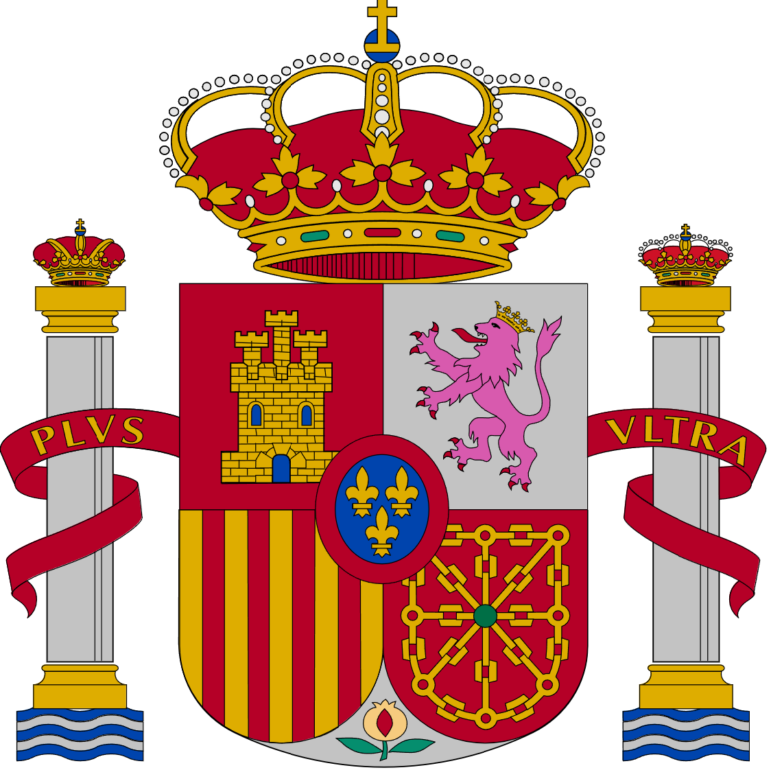
Spain Coat of Arms [public domain
Columbus also distinguished between Indigenous communities he described as peaceful and others he labeled “Caribs,” whom he characterized as violent and cannibalistic. Historians continue to debate the accuracy of such claims, but these descriptions soon served as justification for military campaigns and the enslavement of Indigenous people. By the time of his later voyages, Columbus was already transporting Indigenous captives back to Spain as enslaved laborers.
These writings reveal how rapidly early curiosity and admiration gave way to the colonial logic that would shape centuries of European expansion in the Americas, and the catastrophe that followed for Indigenous peoples.
Historians often refer to the period that followed as the “Great Dying.” Across the Americas, Indigenous populations suffered catastrophic losses, in some regions reaching as high as 90 percent within a century of contact. Epidemic diseases, particularly smallpox, measles, influenza, and typhus, spread through communities that had no prior exposure to Afro-Eurasian pathogens. Violence and warfare further intensified the devastation as Spanish conquistadors launched military campaigns across the Americas.
Colonial labor systems compounded the suffering. The Spanish encomienda system, and later the mita, forced Indigenous people into coerced labor into mining, agricultural, and infrastructure projects under brutal conditions. Exhaustion, malnutrition, and disease dramatically increased mortality rates.
Colonization also reshaped land ownership and governance throughout the hemisphere. Indigenous peoples were displaced from ancestral territories as European settlements expanded. Mission systems and colonial towns, often called reducciones, concentrated Indigenous populations under tighter administrative and religious control.
Spain’s King Addresses the Legacy of Conquest
More than five centuries after Columbus’s voyages, the legacy of colonization continues to shape diplomatic and cultural debates. On March 16, 2026, Felipe VI publicly acknowledged that the Spanish conquest of the Americas involved “much abuse” and raised enduring ethical questions about the exercise of power.
The remarks were made during a visit to the exhibition Women in Indigenous Mexico at the National Archaeological Museum, where the monarch spoke with officials, including Mexico’s ambassador to Spain, Quirino Ordaz Coppel.
According to a video released by the Spanish royal household, Felipe noted that historical events examined through contemporary values “obviously cannot make us feel proud.” At the same time, he emphasized that such events must be understood within their historical context.
The king also referenced policies issued under the Catholic Monarchs, including directives associated with Isabella I of Castile and the colonial legal framework known as the Laws of the Indies, which were intended, at least in theory, to regulate the treatment of Indigenous populations.
“There was a clear intent to protect,” Felipe said. “Yet, in reality, these measures were not implemented as intended, and much abuse occurred.”
The comments come amid ongoing diplomatic tensions between Spain and Mexico over demands for a formal apology for colonial-era abuses. In recent years, both former Mexican president Andrés Manuel López Obrador and current president Claudia Sheinbaum have urged Spain to acknowledge the violence and injustices of the conquest.
López Obrador previously sent a letter to the Spanish king requesting recognition of what he described as massacres and forced conversions carried out “with the sword and the cross.” Spain declined to issue a formal apology, straining relations between the two governments.
Sheinbaum has continued to press the issue, recently expressing hope that Spain will eventually “consider asking for forgiveness” for what she described as the “great atrocities” committed during the conquest.
Felipe’s remarks do not constitute a formal apology. However, observers note that they represent a rare acknowledgment, though one of the clearest messages by a Spanish monarch that abuses occurred during the colonial expansion of Spain’s empire in the Americas.
A Continuing Historical Reckoning
The debate surrounding Spain’s colonial legacy reflects a broader global conversation about how nations confront the darker chapters of their past. For Indigenous communities across the Americas, the consequences of conquest, demographic collapse, cultural disruption, and land loss, remain part of living history.
At the same time, Indigenous resilience and cultural reclamation movements have ensured that the peoples and cultures Columbus first encountered did not disappear. In recent years, a renewed Taíno cultural resurgence has gained visibility as individuals from Cuba, Hispaniola, and Puerto Rico reconnect with Indigenous heritage and revive ancestral cultural and spiritual traditions.
Felipe’s remarks may not amount to a formal apology, but they could represent a tentative step toward historical acknowledgment and a broader process of truth and reconciliation. As debates over memory, responsibility, and reconciliation continue, the legacies of colonization—and the resistance to it—remain deeply woven into the cultural, spiritual, and political landscapes of the modern Americas.
The Wild Hunt is not responsible for links to external content.
To join a conversation on this post:
Visit our The Wild Hunt subreddit! Point your favorite browser to https://www.reddit.com/r/The_Wild_Hunt_News/, then click “JOIN”. Make sure to click the bell, too, to be notified of new articles posted to our subreddit.