
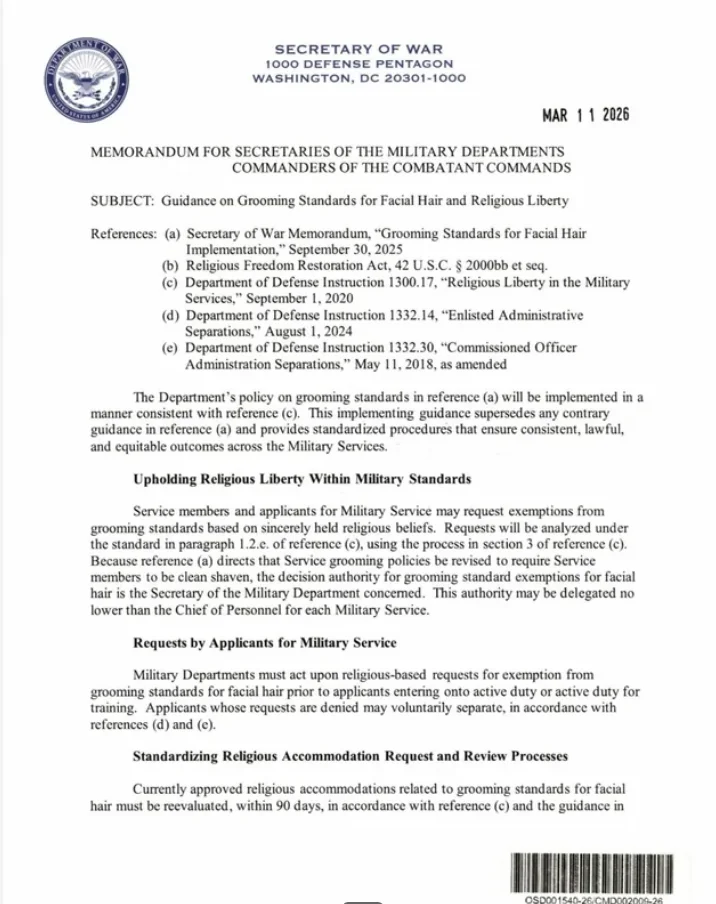
WASHINGTON—An image of a Department of Defense memorandum that began circulating online this week has now been confirmed as authentic by a Pentagon official. The Wild Hunt obtained verification from a Pentagon official speaking on background, confirming the March 11, 2026, document. No additional details were provided at the time of publication.
This article has been edited to reflect the veracity of the memo.
WASHINGTON— A Department of Defense memorandum began circulating online this week, appearing consistent with the Pentagon’s broader 2025 crackdown on facial hair and religious accommodations. The Wild Hunt has not independently verified that the March 11, 2026, document has been officially issued or published. The Wild Hunt contacted Pentagon Press Operations for confirmation, and the Department had not yet replied in time for publication.
The emergence of the memo follows a series of highly visible policy and cultural shifts within the military that came into focus in September 2025. At that time, President Donald Trump and Defense Secretary Pete Hegseth addressed hundreds of senior military leaders at Marine Corps Base Quantico in a 90-minute event that some observers described as resembling a political rally. The gathering, which brought together top generals and admirals in a single venue, raised concerns among defense analysts not only about optics but also about the concentration of senior leadership and the tone of the messaging.
During the address, Trump emphasized the potential use of military force in domestic contexts, referencing unrest in major American cities and describing what he called an “enemy within.” Hegseth, for his part, used the platform to outline a sweeping cultural realignment within the newly renamed “Department of War.” His remarks centered on eliminating what he characterized as “woke” influences, including diversity, equity, and inclusion (DEI) initiatives, identity-based observances, and what he described as “politically correct” policies. In their place, he promoted a return to a “warrior ethos,” emphasizing discipline, uniformity, and combat readiness.
Hegseth’s comments were then accompanied by a shift in policy directions. Hegseth called for stricter fitness enforcement, sharply criticizing what he described as declining physical standards across the ranks. He also directed that combat roles be governed by the “highest male standard,” framing the policy as gender-neutral while acknowledging it could significantly limit women’s participation in combat positions. Outside observers warned that such changes could reshape the composition of the force and raise questions about equity and effectiveness.
Grooming standards became another focal point of the address. Hegseth announced a renewed emphasis on uniform appearance, calling for an end to beard exemptions and other forms of what he described as “superficial individual expression.” In a remark that drew particular attention, he stated that the military would not become “a military full of Nordic pagans.” While some interpreted the comment as a rhetorical flourish, others saw it as invoking language historically associated with exclusionary or ethnonationalist interpretations of Norse spirituality.
In subsequent reporting, The Wild Hunt spoke with Heathen service members and community voices who emphasized that contemporary Heathenry is religiously diverse and widely rejects racialized ideologies. Several service members described a tension between their commitment to military service and their awareness that public statements by senior officials can shape how their beliefs are perceived within institutional settings. Even when not intended as policy, such remarks can influence how commanders evaluate religious accommodation requests or assess the legitimacy of minority faith practices.
It is within this context that the March 11, 2026, memorandum—titled “Guidance on Grooming Standards for Facial Hair and Religious Liberty”— draws attention. The document appears to formalize a standardized process for evaluating religious accommodation requests related to grooming policies. Addressed to the Secretaries of the Military Departments and Combatant Commanders, it frames itself as implementing guidance tied to earlier directives requiring service members to be clean-shaven.
The memorandum outlines a multi-step review process that places significant emphasis on documentation and evaluation. Service members and applicants seeking exemptions must submit a sworn attestation affirming the sincerity of their belief, a detailed explanation of the religious basis for the request, and supporting evidence demonstrating that the belief is both religious in nature and sincerely held. Examples of such evidence could include participation in religious observances, written materials, or corroborating statements from religious leaders or community members.
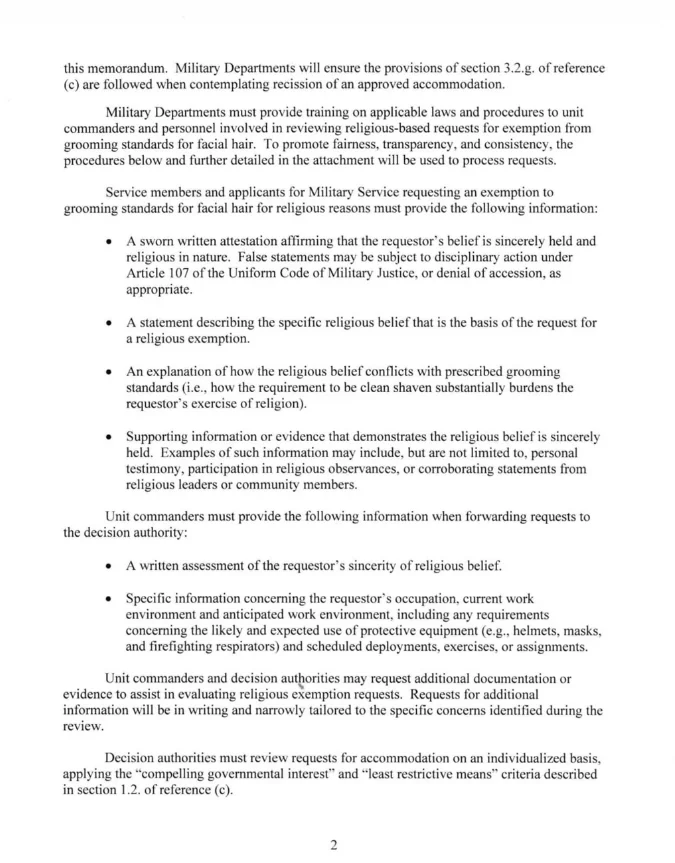
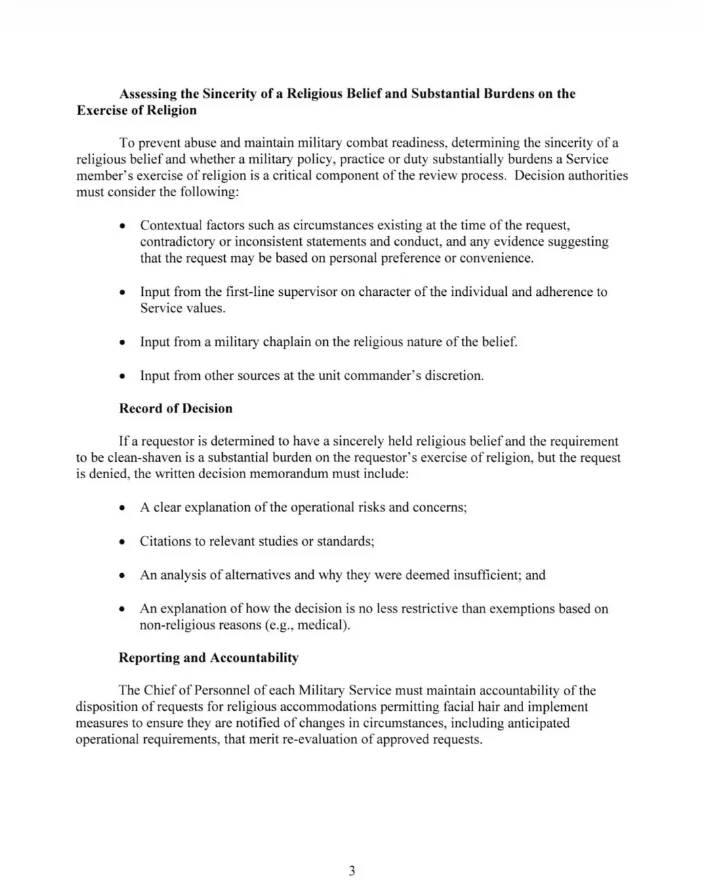
Commanders would play a central role in the process, tasked with assessing both the sincerity of the belief and the operational implications of granting an accommodation. This includes evaluating potential impacts on mission readiness, safety equipment such as gas masks or respirators, and the demands of specific roles or deployments. Additional input may be sought from first-line supervisors, military chaplains, and other sources at the commander’s discretion. Final decision authority would rest with senior leadership within each military branch, and any denial would require a written justification addressing operational risks, alternatives considered, and consistency with non-religious exemptions, such as those granted for medical reasons.
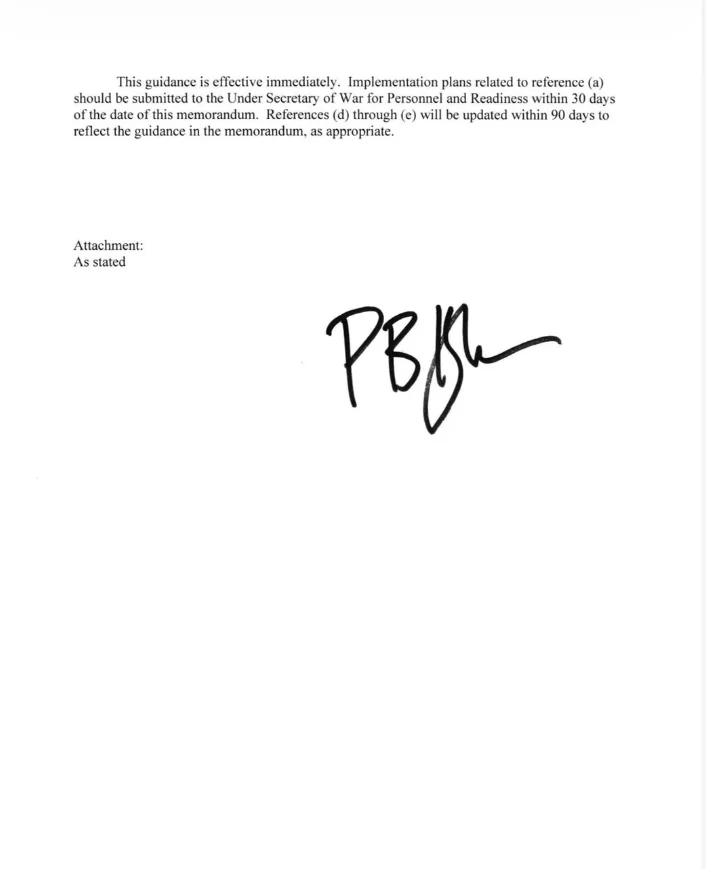
The memorandum also calls for the reevaluation of previously approved religious accommodations within a specified timeframe and introduces reporting requirements to ensure oversight and consistency across the services. These provisions suggest a broader effort to standardize how religious exemptions are granted and monitored across the military.
If the memo is confirmed, the guidance would further institutionalize tensions previously identified in The Wild Hunt’s reporting. Heathen and Pagan service members have already expressed concern that their beliefs may be subject to heightened scrutiny, particularly when institutional language emphasizes the need to evaluate “sincerely held” religious claims. Those concerns are echoed in the memorandum’s detailed evidentiary requirements and its focus on assessing both sincerity and burden.
The structure and language of the memorandum closely align with the Religious Freedom Restoration Act (RFRA), which governs religious accommodation claims in federal contexts, including the military. RFRA requires that any government action that substantially burdens an individual’s exercise of religion must further a compelling governmental interest and represent the least restrictive means of achieving that interest. The memorandum incorporates this framework by directing decision-makers to evaluate whether grooming requirements impose a “substantial burden” and to justify any denial based on operational necessity.
At the same time, the memo highlights an enduring tension in the application of RFRA. While courts have consistently held that sincerity, not theological correctness, is the appropriate standard, the process of evaluating sincerity will undoubtedly be complex. The memorandum’s reliance on documentation, corroboration, and command-level assessment introduces layers of scrutiny that may disproportionately affect minority religions, particularly those without centralized authority structures or widely recognized institutional markers.
For Pagan, Heathen, and other decentralized traditions, demonstrating sincerity within a bureaucratic framework can present unique challenges. Practices may be highly individualized, community-based, or transmitted outside formal institutions, making them less legible to evaluators accustomed to more hierarchical religious structures. As a result, the very processes designed to protect religious freedom can, in practice, become sites of negotiation and potential constraint.
Whether or not the March 2026 memorandum is ultimately authenticated, its circulation reflects a broader reality already documented by service members: that religious identity, especially for minority faiths, remains subject to institutional interpretation, negotiation, and, at times, skepticism within military structures. Given the current climate in which Christian expression is often more institutionally recognized, questions regarding grooming standards and religious accommodation in military culture are unlikely to fade.
The Wild Hunt will continue to follow this story and provide updates as additional details emerge.
The Wild Hunt is not responsible for links to external content.
To join a conversation on this post:
Visit our The Wild Hunt subreddit! Point your favorite browser to https://www.reddit.com/r/The_Wild_Hunt_News/, then click “JOIN”. Make sure to click the bell, too, to be notified of new articles posted to our subreddit.