

Today’s offering comes to us from Cosette Paneque. Cosette is a long-time Pagan, a Georgian Wiccan Priestess, and a daughter of Ogun. She works in spiritual care and end-of-life education, and supports heart-centred organisations through web and community management. Her work centres on community, meaning-seeking, and social justice. Born in Havana, raised in Miami, she lives in Melbourne, Australia. Visit her at cosettepaneque.com.
Irene Solà’s I Gave You Eyes and You Looked Toward Darkness is a haunted-house novel in which the Devil runs in the blood, and the boundary between the living and the dead is as porous as the veil at Samhain. It’s not the creaky, corridor-stalking kind of haunting. It’s closer to a feverish ancestral rite: a single day in a remote Catalonian farmhouse where generations of women — some alive, many dead — gather as one of their own lies dying, poised between worlds.
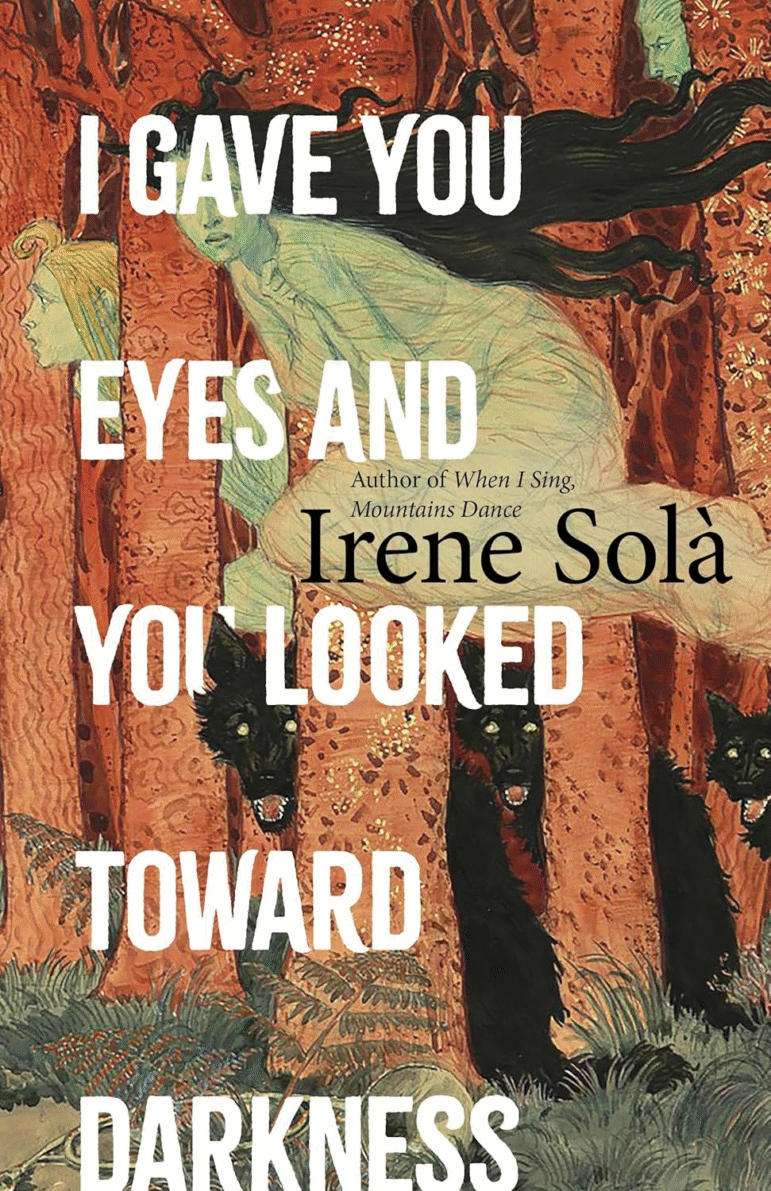
Cover to “I Gave You Eyes and You Looked Toward Darkness” by Irene Solà
The novel’s folkloric spine is a pact. When God doesn’t answer Joana’s prayers, the matriarch trades her soul to the Devil for “a full man.” When the husband arrives missing a toe, the cunning woman argues the contract on a technicality. The Devil doesn’t lose gracefully, cursing Joana and ensuring every descendant is born incomplete. Something is always missing — sometimes mildly, sometimes grotesquely, sometimes fatally — an ear, the tongue, the liver, eyelashes, or the ability to feel pain, to remember, or to love. Each body bears the cost of Joana’s defiance.
The story unfolds across a single day, from dawn to night, at Mas Clavell, the ancestral farmhouse in the Catalan mountains. The women gather as Bernadeta lies dying. While they skin animals, cook, and gossip — sharing jokes and folk tales drawn from local Catalonian folklore — the narrative jumps eras without warning. It spans centuries within hours, piecing together a family history that is fragmentary, contradictory, half-mythologised, and experienced all at once. This temporal compression mirrors the logic of dying, where past and present collapse together. Bernadeta’s clairvoyance and failing consciousness become the novel’s organising principle. Her death rattle reverberates across generations.
The house itself is more than a setting. Solà describes the farmhouse entrance as a throat, the walls as cheek-flesh, the ceiling as a palate, and the rock floor like “a tongue worn down by countless years of swallowing.” Solà not only blurs the lines between past and present and between the living and the dead, but also those between humans, animals, and objects. She creates what amounts to an animist theology where everything — stone, flesh, story — retains memory and will.
Solà doesn’t collapse the Devil into allegory. He remains a physical, shape-shifting presence at Mas Clavell — a docile kitten, a kind goat, a haughty bull, “a bald man with magnificent eyebrows, the toes of a rooster, and the breasts of a woman.” He goes by many names, including Fallen Star, Shadow King, Old Hornie, Lucifer, and Baphomet, and interacts with the women in various, sometimes intimate, ways as antagonist, punisher, lover, and strange companion. The relationship between the women and the Devil resists easy categorisation.
The title is God’s rebuke to Margarida, Joana’s child. Born with a quarter heart missing, she is self-righteous and pious. She prays for salvation, but God condemns her: “I sculpted you, and yet you have taken another master… I gave you eyes and you looked toward darkness.” The moral logic is inverted. Who steers the fate of these women: an absent God, a Devil who bargains, or human men whose violence is constant and ungoverned by divine or demonic law?
The women of Mas Clavell are repeatedly described as ugly — hairy, animalistic, hunchbacked, with buck teeth, warts, and twisted legs. Solà works with that iconography, centring “abject women” usually excluded from history. Does making the monstrous feminine literal give it power or just reinforce the curse? Sometimes, the focus on deformity and ugliness felt like reclamation—a refusal of beauty standards and an embrace of the witch’s body. Other times, it felt like fixation, even contempt, as if the characters were punished on the page for their inheritance.
The novel is also shockingly graphic. Childbirth is rendered as brutality, sex as domination, death as spectacle, and animal detail as stomach-turning. Some of this violence is grounded in historical trauma: the Spanish Civil War, Francoist repression, and World War II. Solà wanted the body — human, animal, landscape, house — to have “protagonism,” and she commits to that vision unflinchingly. The book’s violence isn’t primarily transformative. It’s often punitive, relentless, without the relief of ritual or meaning. This distinguishes it from folkloric horror that uses violence as a portal or an initiation. Here, violence is weather: persistent, indifferent, without lesson. Some readers may see this extremity as truthful, while others may find it excessive rather than enlightening.
This is not an easy book. The era-jumping, constant story shifts, the demand to hold contradictions without explanation, and unrelenting violence, body horror, and vivid animal details keep you at arm’s length, even as the novel’s strange magic draws the reader in. Some passages linger like incense smoke, blurring the line between witch and woman, house and body, curse and inheritance until the distinctions dissolve. Solà takes folklore seriously. She understands place-spirits, ancestral memory, and the strange intelligence of houses.
If you’re drawn to folkloric density, ancestral memory, visceral horror that rejects comfort, or animist logic where houses and bodies blur, this has power. But know what you’re walking into. Solà doesn’t flinch from grotesque violence or the relentless brutality of these women’s lives. Yet beneath that extremity runs something else: community, continuity, the way the dead and living remain woven together. The novel rejects easy catharsis, but it’s not without warmth. If you prefer your folklore sanitised or your horror ultimately explicable, this novel may frustrate you. If you can sit with ugliness alongside tenderness, with a house that swallows but also holds, this book will stay with you.
For me, this novel was two experiences braided together: an inventive, haunted hymn to women-as-lineage and house-as-organism, and an immersion in grotesque violence that rarely softens. I didn’t always like it. I’m still unsure if I do. But I keep thinking about it. What if the extremity is the inheritance, and refusing silence in the face of it is what matters? What if Solà’s unrelenting style mirrors exactly what it means to carry a curse you didn’t choose, in a body that marks you as monstrous, and yet the dead still gather, the house still holds everyone, and the lineage endures? The novel’s refusal to offer an easy resolution might be its most honest gesture, but it doesn’t withhold everything. There’s something here about endurance, about remaining, about the strange comfort of being held by those who came before.
I Gave You Eyes and You Looked Toward Darkness by Irene Solà, translated by Mara Faye Lethem, is available now in hardback, paperback, on Kindle, and Audible.
The Wild Hunt is not responsible for links to external content.
To join a conversation on this post:
Visit our The Wild Hunt subreddit! Point your favorite browser to https://www.reddit.com/r/The_Wild_Hunt_News/, then click “JOIN”. Make sure to click the bell, too, to be notified of new articles posted to our subreddit.