

TWH – On January 23, 2026, more than 75,000 people took to the streets of Minneapolis in sub-zero temperatures with a single message: Immigration and Customs Enforcement should end its actions immediately and leave the metropolitan area. The protest—dubbed “ICE Out of Minnesota: Day of Truth and Freedom”—demanded that ICE and its thousands of masked agents, some carrying war-style weaponry, withdraw from the Twin Cities. Demonstrators also called for the prosecution of the agent who killed legal observer Renee Good, urged Congress to reject additional funding for ICE, and pressed Minnesota and national companies to refuse cooperation with ICE as a matter of Fourth Amendment principle.
Organizers urged Minnesotans statewide to stay home from work, school, and shopping in favor of “community, conscience, and collective action,” according to ICE Out of Minnesota. Ahead of the action, organizers issued a clergy call — an invitation for faith leaders to participate in nonviolent moral witness, reflection, and solidarity. That call drew clergy across traditions and regions, expanding the protest into a visibly interfaith event.
Stone Circle Wicca logo
Stone Circle Wicca (SCW) did not hesitate. Leaders within the tradition supported one of their members in traveling to Minneapolis, grounding the decision in a core tenet: “The individual Wiccan’s responsibility to seek their own humanization through fighting the dehumanization of others.”
In an interview with The Wild Hunt, SCW clergy and leaders described their participation not as a symbolic gesture, but as a religious obligation, an expression of their theology in action.
Jonathan White, a founding member of Stone Circle Wicca, boarded a flight and joined the convening on short notice. The point, he emphasized, was not to “parachute in to save anyone,” but to answer a direct request from a community under pressure. “A community that’s currently on the front lines… asked for help,” White said, describing the call as “specific” and “actionable,” aimed at faith leaders willing to travel, listen, learn, and stand with local organizers.
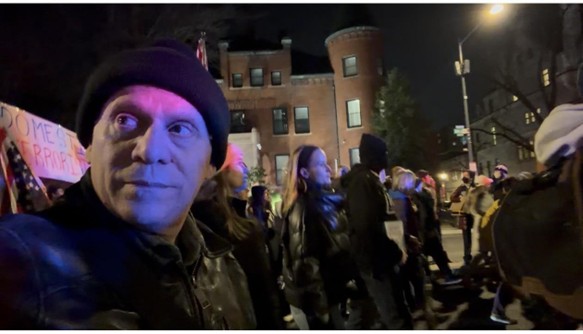
Jonathan White attending “ICE Out of Minnesota: Day of Truth and Freedom” [courtesy
For SCW, the request aligned with a spiritual ethic of intervention when people are being oppressed or reduced to categories rather than recognized as human beings. White framed it as a moral demand made practical: “The spiritual and moral duty to do what you can with what you have, where you are, to help people.”
That urgency also shaped the timeline. “We went on two days’ notice,” White said. For a small religious community without a denominational infrastructure or large operating budget, that mattered. “For us, even a plane ticket’s a big deal.” Still, the community made it work. White described the decision as part of SCW’s participatory leadership model—what he called “passing the wand” to whoever is best positioned for a task in a given moment. “It was my turn… just like it was Qira’s turn to draft the statement… and it was Eldritch’s turn to put together this conversation,” he said.
Once in Minneapolis, the realities were stark. “It was negative 16 degrees… and they were out for hours,” White recalled. With wind chill, the conditions were even harsher, yet tens of thousands stayed outside. He noted that the city itself felt transformed by the scale of participation: “The whole city was shut down,” he said, describing a boycott and work stoppage atmosphere that left people marching with no expectation of bathrooms, food, or the ordinary supports of daily life. The discomfort was not incidental; it was part of the sacrifice people willingly made to defend neighbors and resist fear.
White admitted he arrived unprepared for the extreme weather and had to buy new clothes suitable for hours outdoors. But he and his colleagues were unequivocal that the experience was worth it, because it made visible what they mean by “humanization.”
Seeing people as real, particular, and worthy—not as abstractions. “It’s not theoretical,” White said. “It’s deeply moral because it’s rooted in real feelings for real people.”
This is the core of SCW’s framing: resistance as a spiritual obligation rooted in humanization, and theology demonstrated through action—quickly, humbly, and in followership. “This wasn’t going in to save other people,” White said. “This was coming in followership, supporting people who are leading on the ground.”

Rev. Catharine “Qira” Clarenbach [courtesy]
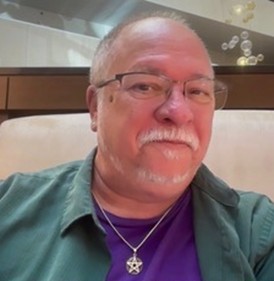
Rev. E. Eldritch [courtesy]
Other Stone Circle Wicca leaders, Rev. Catharine “Qira” Clarenbach and Rev. E. Eldritch, expanded on the decision to support White’s participation, the interfaith dimensions of the convening, and what sustained resistance looks like beyond a single day in the streets or a single protest.
Clarenbach explained that SCW’s language of “humanization” is not rhetorical but a spiritual value with teeth. “Humanization… and opposition to dehumanization come out of a worldview that is essentially in the service of life,” she said.
In her view, dehumanization is a consequence of oppression in many forms, and it thrives when people are treated as replaceable parts rather than living beings in relationship with Earth, with community, and with one another. Oppressive systems, she argued, demand that people be “treated as machines,” stripped of story and connection until harm becomes easier to justify.
Eldritch described the interfaith dimension in practical terms. When entering coalitions where Pagans may be unfamiliar to other participants, he said, the first task is not to lead with labels or theological explanation, but to meet the human need in front of you. “When you go to a community… the first thing you have to do is show up for humanity,” he said. The identity questions—who is Wiccan, who is Pagan, what anyone believes or how they practice —can come later, if they come at all. “What’s the need?… Talk about theology later,” he said, emphasizing that solidarity begins with presence.
That same approach shaped how SCW described resistance. They returned repeatedly to the idea that each person has a “work shift” in the struggle—an ethic of discernment rather than performance. “Resistance… can look lots of different ways,” Clarenbach said. “People have to discern their own role.” Some will march. Some will organize mutual aid. Some will train as legal observers or provide spiritual care. Some will build networks of communication and safety. The emphasis, for SCW, is not on a single “correct” form of resistance, but on showing up—consistently and in community—where your gifts and capacities fit.
Eldritch underscored that this includes honest boundaries. Not everyone can travel or physically march, and trying to force the wrong role can do more harm than good. But the work is still present. The call is still present. In SCW’s telling, the ethic is not heroism; it is responsibility.
The conversation also turned toward interfaith dialogue, especially in a moment when many Pagans are navigating heightened concern about Christian nationalism and the ways it appears to dominate public religious life. Stone Circle Wicca leaders cautioned against turning interfaith work into a theological battleground or assuming that the loudest expressions of Christianity represent all Christians.
White observed that Christian nationalism is better understood as a political-religious project with disproportionate influence rather than a full portrait of American Christianity. “Christian nationalism is a minority religion with disproportionate access to political power,” he said. “It tends to yell over so many Christians who have nothing in common with it.”
In Minneapolis, White said, the convening made that distinction tangible. He encountered a broad coalition, particularly Reform and Reconstructionist Jewish communities, Unitarian Universalists, and progressive Christian denominations, alongside representatives of other traditions, including Hindus and Buddhists. He recalled sitting near a woman who flew from New York on behalf of a Hindu group. He also described speakers from Christian traditions who explicitly named white Christian nationalism as a distortion of the faith, with one pastor, he noted, calling it a “heresy.”
White said, being openly Wiccan did not produce suspicion; it drew curiosity and welcome. When he registered and identified his faith tradition, he was greeted with enthusiasm because it “expanded the aperture” of what multi-faith solidarity could include.
From there, the interview moved to what comes next: how to describe “sustained resistance” in a way that doesn’t romanticize crisis or flatten the work into slogans. Clarenbach pointed to the neighborhood-scale relationship as foundational. She described how Minneapolis organizers emphasized hyper-local action—small gatherings, block-by-block visibility, practical mutual support—because community resilience is built in ordinary proximity. She shared a personal example from her own life: ICE detained someone in her apartment building. “I didn’t know them, and I wish that I did,” she said, naming the painful clarity that isolation can become vulnerability. In her view, a frayed web of relationships creates opportunities for oppression to take hold unnoticed; relationships become a form of protection.
White offered a three-part framework he saw reflected in Minneapolis and believes the Pagan community is well prepared to practice.
First: Do what you can do.
“Find what you can do… do what you can with what you have, where you are,” he said, warning against volunteering for roles that don’t match your abilities or circumstances.
Second: Get trained.
He described attending a legal observer training and noted that Minneapolis has invested heavily in building community skill—training thousands of people in concrete practices that make actions safer and more effective.
Third: Embrace decentralized leadership.
“You can’t name the leader of resistance in Minneapolis because there isn’t one—and that’s good,” he said, arguing that distributed leadership is both strategically resilient and culturally aligned with many Pagan communities.
Together, these points reflect SCW’s positive insistence that the work is neither abstract nor reserved for specialists. It is grounded in human relationships, disciplined by training, and sustained by shared responsibility. It is also, in their telling, fundamentally hopeful—not because the dangers are small, but because despair accomplishes nothing. What Minneapolis showed, White said, is that people will show up in fear and in cold and still choose each other.
“It’s not theoretical,” he said again, returning to the phrase like a refrain. “It’s deeply moral because it’s rooted in real feelings for real people.”
For Stone Circle Wicca, that is the heart of the matter: human beings are not abstractions, and faith is not confined to private belief. When communities ask for solidarity, SCW leaders say, Wiccan ethics demand response — one rooted in humility, followership, humanization, and the steady work of honoring community.
The Wild Hunt is not responsible for links to external content.
To join a conversation on this post:
Visit our The Wild Hunt subreddit! Point your favorite browser to https://www.reddit.com/r/The_Wild_Hunt_News/, then click “JOIN”. Make sure to click the bell, too, to be notified of new articles posted to our subreddit.