
WASHINGTON — The Becket Fund for Religious Liberty (commonly known simply as Becket) is a high-profile nonprofit public-interest law firm based in Washington, D.C. It is dedicated to protecting the free expression of religion across a wide range of traditions.
We should nevertheless note that while Becket is often associated with conservative legal causes, its client list is diverse. They reflect a focus on the legal principle of religious autonomy from government overreach rather than advocacy for any single faith. Its tagline, “Religious Freedom for All,” reflects what the organization describes as multi-faith, representing clients from many religious traditions rather than privileging one.
Supporters view Becket as a premier defender of the First Amendment, ensuring that religious individuals and institutions can participate in public life without being compelled to violate their convictions. Critics, however, have argued that the firm’s work, particularly in cases involving reproductive rights or LGBTQ+ anti-discrimination laws, deploys “religious liberty” in ways that undermine civil rights protections and broader social progress.

Nevertheless, Becket describes the Index as the nation’s only annual poll dedicated to measuring public attitudes on religious freedom in the United States. Now in its seventh year, the Religious Freedom Index was first launched in 2019, with the most recent findings released earlier this month. The latest Index assigns an overall score of 71 out of 100, which Becket characterizes as evidence that “Americans are increasingly unified in supporting religious liberty for people of all faiths.”
On its face, the findings suggest a nation growing more comfortable with religious expression beyond private worship, at work, in schools, and in civic life. A closer reading, however, raises important questions for religious minorities, including Pagans, Witches, and other non-Christian traditions, about which forms of religion are being affirmed and which remain vulnerable.
Faith Moves Into the Public Square
One of the Index’s headline findings is that “faith in the public square is on the rise.” Support for what the report calls Religious Sharing, that is, the freedom to express and promote one’s religious beliefs publicly, reached an all-time high score of 75. A majority of respondents (57%) now say religious freedom is inherently public, rather than confined to homes or houses of worship.
Younger Americans, particularly Gen Z, play a key role in this shift. Gen Z respondents scored highest on support for public religious expression and religious action. That support, however, comes with notable internal divides. These divides are especially along gender lines as well as growing skepticism about religion’s role in addressing social problems.
Broad Support but Narrow Applications
The Index also emphasizes that religious freedom “unifies Americans,” citing public support for recent Supreme Court decisions involving religious liberty claims. These include cases protecting parental opt-outs from public school curricula and allowing religious nonprofits to operate according to their doctrines without state interference.
Nearly three-quarters of Americans support parental opt-outs from school materials they find religiously objectionable, and a majority support public funds following students to religious schools. Becket frames these findings as evidence that religious liberty transcends partisan divisions.
Yet the cases highlighted in the Index overwhelmingly center on Christian claimants, and the survey’s framing reflects that emphasis. Scenarios involving religious freedom frequently reference Christian bakers, Christian counselors, or Christian parents—leaving open the question of whether comparable public support would extend to Pagan clergy, polytheist educators, or practitioners whose beliefs fall outside dominant cultural norms.
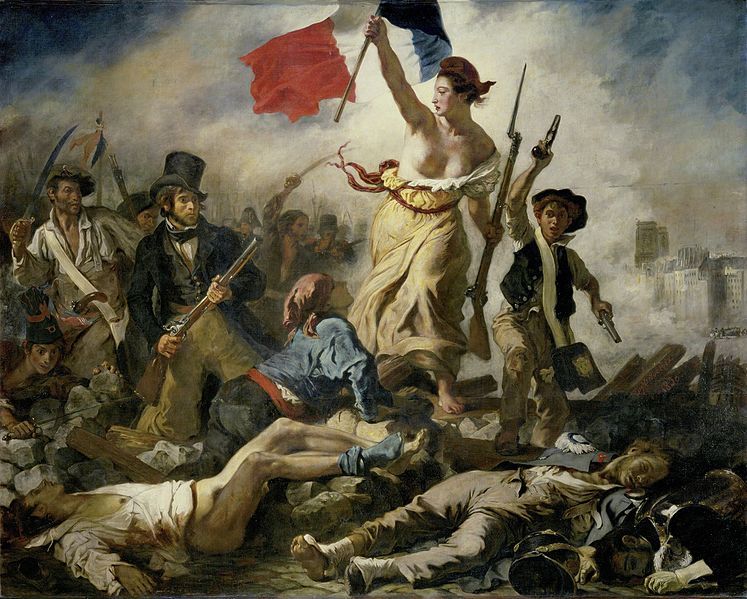
Liberty Leading the People by Eugène Delacroix [1830, public domain
Pluralism (In Theory)
The Index’s strongest-scoring dimension remains Religious Pluralism, holding steady at 86, suggesting broad agreement that people should be free to choose and practice religions, even less common ones, in the American social sphere, without fear of persecution.
For minority faith communities, this is encouraging in principle. In practice, though, lived experience often diverges from polling optimism. Pagan practitioners continue to report discrimination in workplaces, child-custody disputes, zoning decisions, and prisons, areas where religious freedom protections are inconsistently applied and frequently misunderstood.
The Index itself acknowledges that tension: while Americans broadly affirm pluralism, support declines when religious practices are perceived as burdensome or unfamiliar, a pattern that disproportionately affects minority religions.
Rising Intensity with Rising Risk
Another notable finding is that while overall religiosity remains relatively stable, the intensity of religious identity among believers is increasing. More Americans now describe religion as “very” or “extremely” important in their lives than in previous years.
Historically, periods of heightened religious intensity, particularly when aligned with political power, have increased pressure on minority faiths. The Index notes declining confidence, especially among Gen Z respondents, that religion is “part of the solution” to social problems, even as public religious expression expands. This contradiction points toward future cultural friction rather than consensus.
Again – Pagans Remain Absent
Despite its broad claims, the 2025 Religious Freedom Index does not explicitly reference Pagans, Wiccans, Heathens, polytheists, or other contemporary minority religions usually covered by The Wild Hunt. Instead, the Index relies almost exclusively on Christian-centered examples to illustrate religious liberty.
This omission invites skepticism about the inclusive nature of the religious liberty opinions expressed.
At the same time, Becket’s litigation history is more expansive than the Index itself suggests. In Town of Greece v. Galloway (2014), Becket defended the town’s practice of opening legislative meetings with prayer and has described diverse prayer-givers in its materials, including Wiccan leaders alongside Catholics, Protestants, Jews, and Bahá’ís. Beyond Wicca, Becket has represented or filed briefs supporting a Santería priest’s right to perform religious animal offerings in Texas (Merced v. City of Euless, 577 F.3d 578 (5th Cir. 2009)), defended the Apache Stronghold’s efforts to protect sacred land at Oak Flat, and advocated for the religious rights of Native American inmates.
Despite the promise of the findings, important methodological limitations remain. Becket provides a detailed description of its survey methodology, noting that the Index is based on a nationally representative annual poll conducted by an independent research firm. However, the survey design does not disaggregate attitudes toward specific minority religions.
Respondents were volunteers who agreed to participate in online surveys. While the sample was weighted to match U.S. Census benchmarks for age, gender, race and ethnicity, and region, it is not probability-based. The report explicitly states that strict sampling error cannot be calculated.
This limitation is particularly relevant for small religious populations, including Pagans, Wiccans, and polytheists. Because the Index does not oversample minority religions or report results by religious tradition, Pagan perspectives are statistically absorbed into the broader population. This does not invalidate the findings, but it does contextualize them, and likely amplifies dominant-faith assumptions about what religious freedom looks like in practice.
For our community, then, the 2025 Index presents a mixed picture. Broad public support for pluralism and conscience protections aligns with long-standing Pagan advocacy for equal treatment under the First Amendment. Yet the practical application of those protections remains uneven and often favors majority faith expressions.
As religious freedom becomes more publicly asserted, and more closely tied to high-profile court rulings, minority religions may find themselves increasingly subject to selective inclusion: protected in principle, contested in practice. The Index serves as a reminder that religious freedom is not a static achievement but an ongoing negotiation. For those whose traditions fall outside the cultural mainstream, vigilance remains essential, not only to defend the right to believe, but to ensure that religious freedom truly means freedom for all.
The Wild Hunt is not responsible for links to external content.
To join a conversation on this post:
Visit our The Wild Hunt subreddit! Point your favorite browser to https://www.reddit.com/r/The_Wild_Hunt_News/, then click “JOIN”. Make sure to click the bell, too, to be notified of new articles posted to our subreddit.