

Death has hounded me again this month, chasing me through moonlit woods and abandoned cities, across the sea and under it. I have felt its ghostly hand around my neck as I climbed sacred mountainsides and ran across hallowed fields. When I feel the breath leaving me, I cannot help but shout my grievances: oh, if I only had more life! Oh, if I only had more time!

Hades II, featuring Melinoë [Supergiant Games]
Yes, we’re back in the Underworld with Supergiant Games’s Hades II, the sequel to their 2020 hit. As with its predecessor, Hades II is a roguelike action game – instead of having a defined set of levels, the game has regions that are procedurally generated. A player will quickly learn what kinds of things to expect as they progress through the game, but each individual playthrough is unique. Add to that a huge variety of player choices – weaponry, special abilities, and extra challenges – and there seems to be no end to the game’s replayability.
But while that replayability is the main draw for most gamers, for Pagans, the best part of Hades II is the game’s rich mythological setting. Taking place some years after the original game, Hades II puts the player in the role of Melinoë, daughter of Persephone and Hades and sister to the first game’s protagonist, Zagreus. In ages past, the Greek gods, led by Zeus, slew their father, the titan of time Chronos, and consigned him to Tartarus. But Chronos has resurrected himself and imprisoned Hades and his family as punishment for their role in his downfall. Only Melinoë escaped, spirited to safety by the Witch-goddess Hecate, who then trained Melinoë in the arts of magick. Their goal is singular: battle from the surface realm of Erebus down through the Underworld to Tartarus and kill Time.
The tone in Hades II is noticeably darker than the first game, which often had a light-hearted, sitcom-style mood. Here, Melinoë and her associates are caught up in a divine war that spills over from the Underworld all the way to Mount Olympus, and their struggle to end Chronos once and for all gives the game a desperate edge that contrasts sharply with Zagreus’s goal of simply escaping from his father’s house. Melinoë, too, is a more serious character than her wise-cracking brother, her personality built on a combination of single-minded pursuit of the titan who stole her family and ingenue-like innocence about the world outside of her quest.
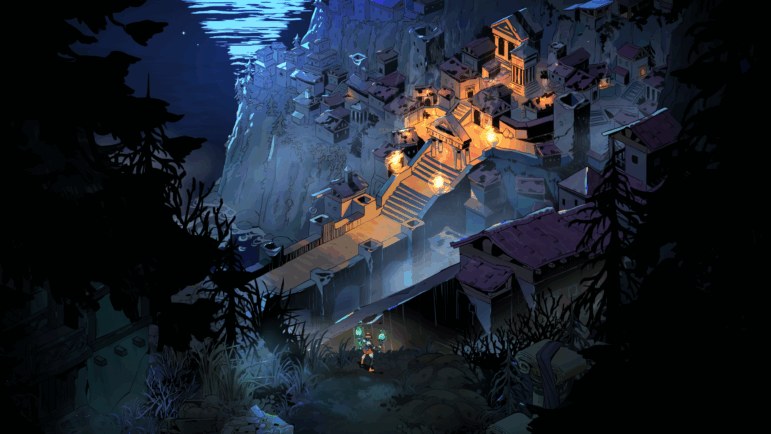
Melinoë looks over the haunted city of Ephyra in Hades II [Supergiant Games]
That’s not to say everything is grim. Between missions, Melinoë returns to her base of operations, the Crossroads, where she has a chance to interact with a wide cast of friends and accomplices, including deities like Moros, Nemesis, and Eris, and shades of the dead like Odysseus and Icarus. While the game tempts the player with plenty of mechanical incentives to keep playing, just as much encouragement comes from learning more about these characters and developing Melinoë’s relationships with them. And there are a few sidekicks who are outright comic relief, like Schelemeus, the (un-)living training dummy who exists sole to deliver one-liners while you try out your new weapons on him.
Another big addition to Hades II in comparison to the first game is the bigger role played by the Olympian gods. While those deities were part of Hades as the source of power-ups called “boons,” here they also appear in person. Sometime after progressing through the first quest in the Underworld, Melinoë unlocks an entire second path – the equivalent of an entire game the length of the first Hades – that takes her up from the Underworld to battle Typhon, the Father of All Monsters, who is besieging the gods’ home on Mount Olympus thanks to the machinations of Chronos. While Melinoë still spends the majority of her time battling alone, the path to Olympus feels less lonely than the route through the Underworld, and it’s a treat to have her meet figures like Hermes and Artemis as full-fledged characters rather than just as boon-dispensers.
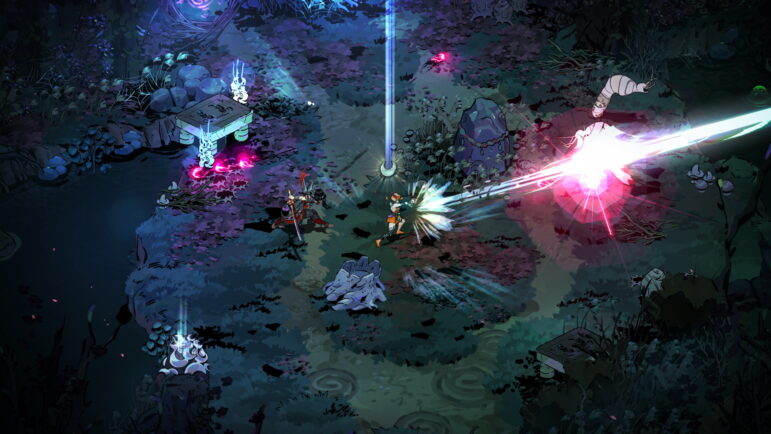
Melinoë’s powers have a strong Witch-theme in Hades II [Supergiant Games]
The gameplay is a tight refinement of the formula from Hades, trading some of the frenetic pinball-style dashing around from that game for a style based around controlling enemy movement and building momentary pauses in action to charge up powerful “omega” moves, which use up Melinoë’s magick meter. As with many things in this series, the simple choice to name the mechanic “magick” led to many further effects on the game’s flavor and lore.
While Zagreus was a rogueish warrior figure, Melinoë, thanks to Hecate’s instruction, is a powerful Witch, and her strength grows as she discovers new incantations, alchemical recipes, and Witch’s familiars. As a Wiccan, I couldn’t help but grin the first time I heard Melinoë finish a spell by chanting “so mote it be.” I reached out to Supergiant about how the team considered modern Pagan religions like Wicca while developing the game, and while we were unable to conduct an interview, they did note that “exploring the connection between Greek myth and the dawn of Witchcraft was at the heart of why we were excited to create Hades II.”
There are a few sour notes. Hades II’s movement to a more epic scope also has the effect of flattening out its conflicts. Chronos is portrayed as a far more evil figure than Hades was in the first game, and Typhon, while terrifying, is more or less a mindless monster; neither of them have the kind of depth Hades had as the antagonist (if not exactly the villain) in the first game. I think this is what has caused some players to feel dissatisfied with the game’s ending, which tries to bring the series’s themes of family conflict and forgiveness back to the forefront after so much time spent with such vicious antagonists. (Supergiant has announced a new patch that expands on the ending; so far the response from players who have played the beta version seems positive.) And sometimes it can be frustrating to figure out how to proceed with a certain quest line without consulting a wiki or a message board; I’ve played through about 150 nights and still can’t figure out how to get Icarus to kiss me.
But these are minor gripes, really. Nobody in video games right now has developed a more satisfying core gameplay loop than Supergiant, and for a Pagan and Witchy audience, nobody has created a setting more in tune with our interests and beliefs than the Hades series. If you, like me, have the Greek myths as a foundational part of your religious identity, you will find something new to smile about in every playthrough.
Which is good, because something has to keep us going when Prometheus blows us up for the sixth time in a row…
Hades II is available on Windows, MacOS, and Nintendo Switch. This review is based on the Nintendo Switch version.
The Wild Hunt is not responsible for links to external content.
To join a conversation on this post:
Visit our The Wild Hunt subreddit! Point your favorite browser to https://www.reddit.com/r/The_Wild_Hunt_News/, then click “JOIN”. Make sure to click the bell, too, to be notified of new articles posted to our subreddit.