
TWH – Evangelical pastor and Turning Point USA faith leader Lucas Miles appeared on Greg Kelly Reports last Friday to celebrate the success of his new book, Pagan Threat, which has climbed to No. 4 on The New York Times bestseller list. The book, which opens with an introduction by the late conservative activist Charlie Kirk in his final published words, warns of what Miles calls a “pagan uprising,” linking secularism, environmentalism, and progressive politics to the “replacement of God with the worship of man and Mother Earth.”
Miles’ book may have surged to the top of the charts. Still, its rhetoric and the quiet response from interfaith organizations pose a deeper question about who counts in America’s religious landscape.
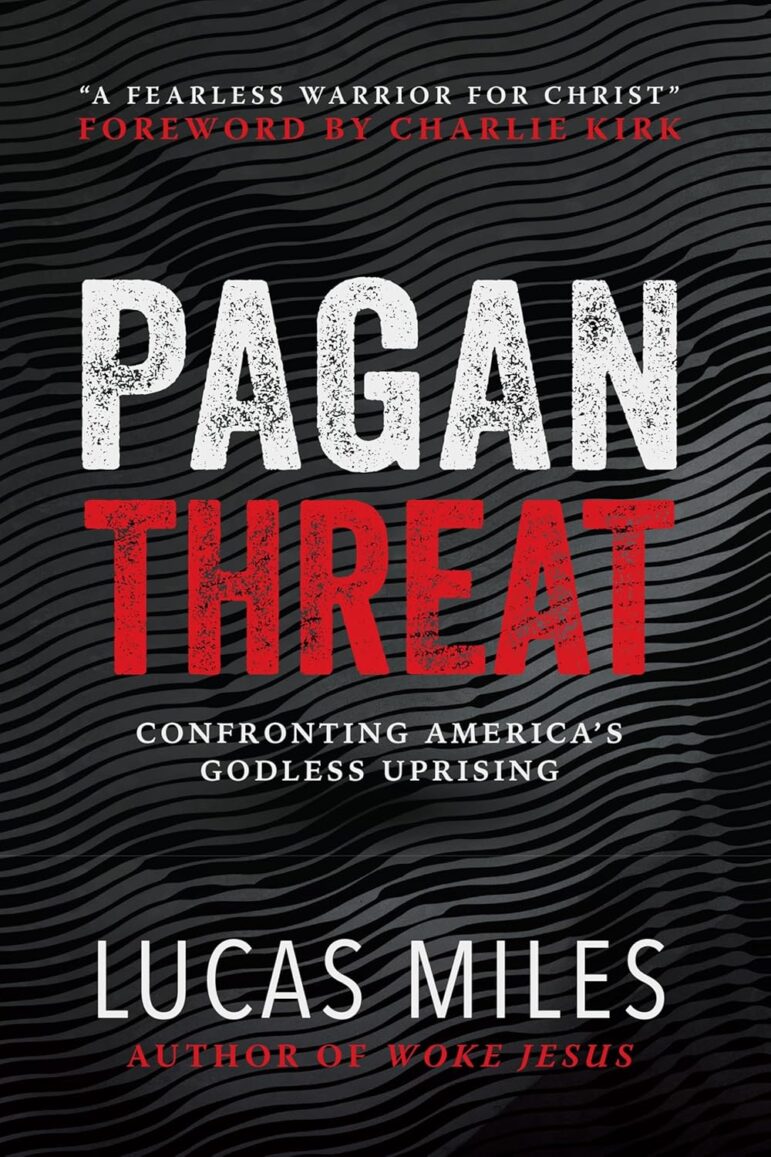
As a reminder, Miles’s book is unambiguous about who it refers to. The Wild Hunt covered the book just after its initial announcement in The Pagan Threat is talking about us. The book describes modern Pagan and Earth-based practices as part of a global spiritual danger, urging Christians to “refute and debunk” them. In the book, he defines Paganism as “a blanket term used to describe those who have abandoned mainstream forms of religion for esoteric practices,” listing Wicca, Druidry, Heathenry, Witchcraft, Shamanism, Thelema, and other polytheistic or nature-based traditions as examples. These are presented not as legitimate religions, but as moral and social threats, promoting national and spiritual disloyalty; in short, an existential, civilizational menace.
Still, many in the wider Pagan community have shrugged. As one colleague recently put it, “We’re on the list, but we’re not at the top of it.” Paganism is often seen as too small or too eccentric to be taken seriously as a target. Indeed, we should not paralyze ourselves with worry or fear.
But awareness still matters. The visibility The Pagan Threat has received, bolstered by sympathetic media platforms and large audiences, suggests otherwise. Books like this don’t emerge in isolation; they mirror and amplify larger cultural anxieties about pluralism, gender, ecology, and authority.
What is perhaps most concerning is not the book itself, but the silence that has followed. In the six weeks since its release, there has been little engagement from mainstream religious news outlets or interfaith organizations, communities that otherwise champion dialogue and mutual respect. One might have expected some public response, if only to reaffirm that America’s religious landscape includes Pagans, witches, and polytheists alongside more familiar faiths.

That silence raises uncomfortable questions: Are we still seen as too marginal to warrant solidarity? Too strange to defend? Or simply too small to matter? Whatever the reason, the absence of interfaith commentary leaves a vacuum in which rhetoric portraying any minority religion as inherently dangerous can grow unchecked.
The language in The Pagan Threat is familiar to students of history. Again and again, religious minorities have been accused of disloyalty, corruption, or moral contagion—framing difference as danger. From 19th-century anti-Jewish propaganda to the demonization of Yazidis by ISIS, such narratives have been used to justify exclusion, violence, and even annihilation.
Here is a quick reminder from the last 200 years.
Pre-Violence Rhetoric Toward Religious Groups
| Target Group | Period / Context | Core Rhetorical Themes |
|---|---|---|
| Armenian, Assyrian, and Greek Christians (Ottoman Empire) | 1890s–1910s | Labeled traitors and infidels undermining Islam; framed as enemies within. |
| European Jews | 19th–20th c. | Branded as conspirators or parasites, accused of corrupting culture and lacking loyalty to the nation. |
| Bosniak Muslims | 1990s Balkans | Depicted as “invaders” or extremists, portrayed as historic oppressors of Serbs. |
| Yazidis | 2014 (ISIS) | Declared “devil-worshippers”; denied status as a legitimate religion. |
| Rohingya Muslims | 2010s Myanmar | Cast as foreign infiltrators threatening Buddhism, accused of demographic and cultural subversion. |
Across time and geography, the pattern remains chillingly familiar. Minority faiths are cast as morally diseased, politically disloyal, or spiritually corrupt. Religious communities have been dehumanized—labeled vermin, parasites, or devil-worshippers—and accused of conspiring with outsiders, corrupting public morals, or threatening the nation’s very soul. Such language primes the public to see persecution as virtue. It transforms neighbors into enemies and turns religious difference into justification for exclusion, violence, and, far too often, annihilation.
At a moment when interfaith cooperation and respect for religious diversity are urgently needed, silence is not a neutral stance—it is complicity.
The phrase “Silence = Death,” born from the AIDS crisis of the 1980s, was more than a slogan; it was a moral reckoning. It called out a society whose apathy toward suffering became part of the violence itself, and it reminded those most at risk that inaction could be fatal. That message still matters.
It is difficult to imagine that a book targeting any other religious minority would be met with such quiet.
Leaders across faith traditions—Christian, Hindu, Jewish, Muslim, Sikh, Pagan, and secular alike—share a responsibility to speak when rhetoric defines any faith community as an enemy. To remain silent is to consent to the narrative that some faiths are unworthy of defense.
As Diana Helmuth observed in The Witching Year and reflected in her article this past weekend, “people don’t think we’re in danger because we’re cringe.” Again, there’s some truth in that. Bluntly, to much of the mainstream, modern Pagans appear as a kind of spiritual curiosity—part seekers, part Renaissance faire, part paranormal investigation—generally colorful but unserious, mostly eccentric, and perceived as misguided.
Their opinions are irrelevant. The litmus tests of legitimacy are not how the U.S. Constitution defines religious freedom. The First Amendment’s protections do not hinge on public approval, respectability, or opinion. Every faith tradition holds beliefs that others might find implausible or strange, and First Amendment protections apply.
This moment is ultimately about integrity within the broader interfaith movement. If The Pagan Threat can become a bestseller without meaningful public response, it suggests that America’s commitment to religious pluralism remains conditional—extended to some, but not to all.
History has shown what happens when such rhetoric goes unanswered. The question now is whether our religious and civic institutions will rise to defend the principle that every spiritual path deserves the right to exist without being branded a threat.
It also leaves a challenge to the interfaith community itself: to decide whether the quiet dismissal of minority traditions is acceptable, or whether true pluralism demands that all faiths be defended.
The Wild Hunt is not responsible for links to external content.
To join a conversation on this post:
Visit our The Wild Hunt subreddit! Point your favorite browser to https://www.reddit.com/r/The_Wild_Hunt_News/, then click “JOIN”. Make sure to click the bell, too, to be notified of new articles posted to our subreddit.