

The man who pierced my ear had the calm, cheerful competence that I love in nurses, mechanics, and hairdressers. He was a big guy, skin covered in artwork, but with only two visible piercings, green studs that looked understated and restrained so close to the dark ink that crawled up his neck. The pleasant idle chatter he offered seemed practiced, as much a tool as the needles I very carefully avoided looking at. It reminded me of the steady patter used to calm a spooked horse. I was immensely grateful.
“Are you squeamish?” he asked as I settled back into the chair. In short sleeves, I knew that my own tattoos were easily visible, which meant I must look as peaked and nervy as I felt.
“Not usually,” I said with a grin that even I knew was going to read as apologetic rather than cheerful. “This is my first piercing.”
“Well, people build it up in their head,” he offered, his tone calming even while his hands moved with brisk, business-like efficiency. “You hardly even notice it.”
“I know,” I said, still feeling sick. The humming, painful buzz of a tattoo gun didn’t bother me. I didn’t know how to explain that it was the idea of a piercing, the needle going through and out the other side, that set me back on my heels.
“Okay,” he said, moving me just so. “On three, I want you to breathe out. One, two-”
It was, in my opinion, a huge update to my appearance. Nobody said anything about it. A month later, over coffee, my ex was the first to notice the single stud in my right ear. “Did you get your ear pierced?” they asked, laughter in their tone. “Do you feel gayer, now?”
I grinned, and ducked my head, and felt my jaw set a little. There were a dozen reasons I could cite, answers that would play it off as a joke or change the subject. “I’m tired of feeling invisible,” I said, instead. “I wanted a symbol that people know.”
Their laughter paused and their eyes went solemn as they ran a hand over the roughness of their beard, just starting to come in. “Yeah,” they said. “I get that. Especially now.”
That’s enough to change the subject – if only because neither of us wanted to pursue it any further.
It is a part of my job to stay abreast of the news. I’m aware of the legal push against trans rights that is at the root of the growing fear in my communities. Already we’ve seen children stripped of their health care, discrimination against athletes, funding pulled for important research – the list is extensive and exhausting. It’s not a conversation I wanted to bring to an already fraught coffee hour. Especially since we both knew the current moving these legal battles is even darker, and much scarier, when encountered in the wild.
What we also knew, but were not saying, is that if I am lucky, and careful, and decide to move through the world just so, the people responsible for that current often mistake me for one of them. Coming home from work, I’m just a white man edging up onto middle age, a working stiff who often has a little wear on his khakis and a haircut that’s grown out too far. When I talk, there’s sometimes a twang of the Ozarks around the edges, and I’ve got the Midwest pleasant cheerful baseline that often makes me seem friendly and decently approachable. Put me in the right part of the country and, assuming I hold my shoulders just so and wear the right cut of clothes and don’t say too much, it’d be excusable to think I’ve got a red hat in the back seat of my pickup.
There’s a lot of safety in feeling invisible. I hate it.

A person getting an ear pierced. [Ari Bakker, Flickr, CC 2.0]
At work, I have an altar at my desk, in the corner of my cubicle. It is, to my own sensibilities, understated. There’s a statue of Hermes – one of the very few I could find that I considered workplace appropriate – and a dish of coins, a couple of framed pictures, a little battery-operated candle. Occasionally I add a stone – everything from small obelisks bought on my travels to handsome rocks found while exploring. To my eye, it might be a collection of curios and oddities chosen to give me something to look at while on a particularly long meeting.
What lets me know that it is unmistakeable as something else is that nobody has ever commented on it. In seven years I have gotten comments on the art on my walls, my computer background, my tattoos. But even the most familiar and design-oriented colleague has stayed silent as their eyes hit the altar.
It’s not as though I’ve discouraged the conversation. On the contrary, when I decided to set up an altar in my workspace I promised myself that I’d be open about what it was. I’ve talked about my faith at work – I’ve even linked colleagues to this column in the past, when it seemed relevant. I am just, in a way, lucky to have colleagues who respect my right to expression and mind their own business.
At the same time, I am immensely frustrated at the refusal to engage. “Look,” I want to say to these people who are not quite friends. “I’m bringing myself to work. I’m being authentic. I want you to understand me better. I want you to know that you are connected to someone who believes myths are sacred texts. I want to talk to you about your assumptions and stereotypes, I want you to know that my faith influences my morals and my work just as much as yours does. I want you to really think about the holidays we expect to get off of work and the ways we talk about equality, and to make the undercurrent of religion in our daily lives explicit and noticeable. Ask me about the statue. I dare you. I double dog dare you.”
Nobody does. It feels familiar, this kind of silence. I am not actually sure whether I am invisible, the signs that are so clear to me illegible to my coworkers, or whether I am being politely ignored. As I read the news, I see the same patterns of governmental and individual violence leveraged against the Pagan community as I see pointed at LGBTQ+ people. At work, I try to think about what I can do to make my altar more remarkable.
Because there’s a part of me – a loud part, although I’m not always sure it’s correct – that thinks that any safety I’m given is because strangers mistake me for that cis, straight, Christian kind of man. This much, at least, I’m sure of – the people who want a Christian country are the same people pushing against LGBTQ+ rights, a fact that’s often explicit in their arguments. As Witches come more into the public view, I’m expecting to see more virulent and organized pushback against Pagans of all stripes.
That’s not because of anything the Pagan community has done or could do – it’s certainly not because of any singular magazine articles – it’s because anything outside of the narrow, self-defined category of “normal” is fodder for the same kind of hatred, fear, and censure.
There are a million factors at play: the subtleties of location, and audience, and privilege. Nobody is one simple thing all of the time, for everyone. But when I am at my most dire, I tend to oversimplify. These days, it often feels like I have two choices. I can be myself and in danger, or I can be invisible and hope that I am safe – that nobody notices, that I am lucky, that none of the aspects I can’t control (my health, my class, the city I live in) are the one that get me. It’s no kind of choice at all.
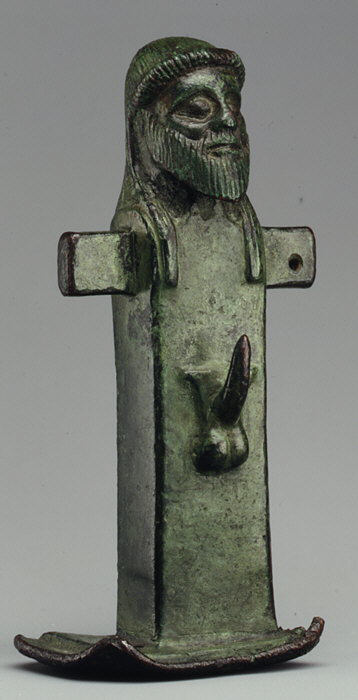
Arcardian Greek Bronze herm, circa 490 B.C., Metropolitan Museum of Art [public domain]
A couple of years ago, when I still considered myself a Lokean, John Beckett published a blog post detailing some channeled messages from Loki and his interpretations. I’d never heard of Mr. Beckett, but the post got a lot of traction in my corner of the internet. It wasn’t the first time I’d heard a channeled cautionary message about an upcoming difficult time. It wasn’t even the first time I’d run into Loki in a mood for a dance. But the article made me uncomfortable enough that I’ve thought about it for two years.
In it, the Seeress who channeled Loki says:
Loki says it’s about to be an unsafe time to be a Pagan: build masks and safety zones. Masks made up of the pieces of ourselves and pieces from those who love us, a mask made of truth and of what we want to show the world. So that it takes the hit when people shout Witch and throw things, and it won’t break – or it might break (so you don’t break) and then you can rebuild it.
I’m not in the business of arguing with gods. At least, not without good reason and a firsthand understanding of what they said. Channeling is by nature a slippery medium, as much emotional impact and physical presence as linguistic content. There’s no transcription of this message, no direct content from the god himself. I can’t, won’t, and don’t want to argue with Loki on this. I won’t even point out that it’s his brother, not Loki, that’s canonically big on masks.
I’ve got no such qualms about arguing against interpretations. The people that I saw reposting the article, expounding on it in their Facebook posts and their own columns, took this message as a push, if not a clarion call, to get ready to go “back into the broom closet.” In his interpretation, Beckett names several threats and acts of violence against Pagans and concludes that “Our Gods do not want martyrs … And sometimes that means wearing a mask and waiting to fight until the odds are in our favor.”
I wrote my own take on masks shortly after. It boils down to this: nobody is, at any point in time, all of themselves. In every conversation, every relationship, I have to make a decision about which parts of myself to show. Sometimes those choices are driven by comfort and whim. Sometimes they are practical, tactical choices about safety. But there is a big difference between choosing which true, honest version of myself to be and pretending to be someone else. There’s a world between choosing my mask and hiding.
It is also an accident of nature that I get to choose at all. In a country where anyone can be targeted and illegally deported because someone thinks they look Latinx, it is nothing but luck that protects me. I am lucky that I can wear a mask. I am lucky that I can choose to take it off.
As the American government reaffirms its commitment to white, straight, cis, Christianity, and I am confronted with news articles and blog posts and laws affirming that I should not exist, I do not think I am being told to hide. I think I am being challenged to find a way to hold myself enough apart that the constant flow of bad news does not break me. I think I am being encouraged to ground myself in my real communities, places where I can be fully myself. I think it is time to be seen – and to know that in my visibility I am allied with everyone who cannot hide.
We are – we have to be – in this together. Mask or no, none of us is safe.
Editor’s note: A previous version of this story included an image of an 18th century painting of an enslaved child having an ear pierced. At the request of the author that image has been replaced.
The Wild Hunt is not responsible for links to external content.
To join a conversation on this post:
Visit our The Wild Hunt subreddit! Point your favorite browser to https://www.reddit.com/r/The_Wild_Hunt_News/, then click “JOIN”. Make sure to click the bell, too, to be notified of new articles posted to our subreddit.