
WASHINGTON – At the Museum of the Bible in Washington, D.C., the Presidential Commission on Religious Liberty hosted an event that blended hymns, personal testimonies, and political messaging, culminating in a lengthy address from former President Donald J. Trump.
The symbolism of Trump’s visit to the Museum of the Bible was not lost. It coincides with a review initiated by White House officials of Smithsonian museums. The review aims to align with Trump’s directive to “celebrate American exceptionalism, remove divisive or partisan narratives, and restore confidence in our shared cultural institutions.” The Museum of the Bible was founded and largely funded by the Green family, who own the Hobby Lobby craft store chain. Trump referred to Steve and Jackie Green in his remarks as “rich as hell…It always helps. “

Museum of the bible logo [public domain
The gathering opened with musical interludes—How Great Thou Art, Leonard Cohen’s Hallelujah, and Amazing Grace. Commission members spoke about the global struggle for religious freedom. One recalled a papal conclave, noting that cardinals from countries facing persecution had told him, “You in the United States serve as a beacon for the rest of us.”
U.S. Attorney General Pam Bondi, formerly Florida’s Attorney General, introduced Trump, praising him as “the greatest defender of the First Amendment” and citing efforts under his administration to defend Christians and Jews.
Trump’s speech framed Christianity as central to American identity. “When faith gets weaker, our country seems to get weaker. When faith gets stronger, good things happen,” he said.
Trump also took the opportunity to vilify some political opponents. “The need for this commission has never been more clear than it was last week when the ineffectual senator from Virginia, man named Tim Kaine, stated that the notion our rights come from our creator is quote extremely troubling to him,” Trump said. “Troubling. Isn’t that terrible though how he would say something like that and advocated really by totalitarian regime? And this is what they say. But as everyone in this room understands, it is tyrants who are denying our rights and the rights that come from God. And it’s this Declaration of Independence that proclaims we’re endowed by our creator with the right to life, liberty, and the pursuit of happiness.”
The president also added that, “Democrats don’t want to give it up. I watched a congressman fighting like crazy this weekend for men having the right to play in women’s sports and they don’t understand,” he said.
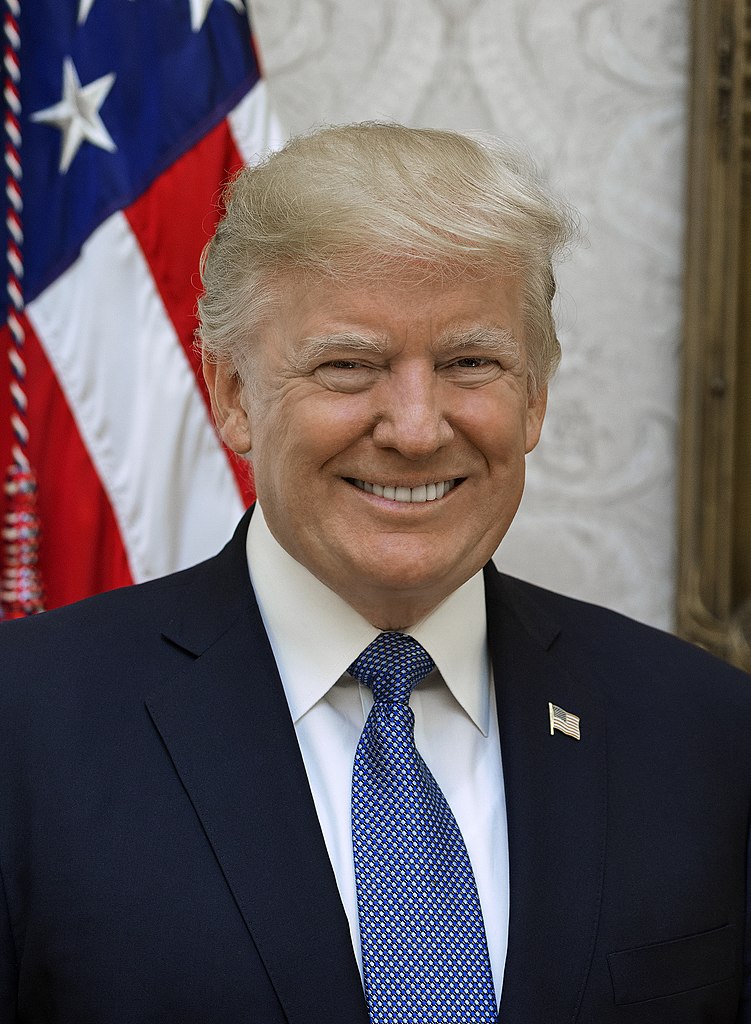
Official portrait of President Donald J. Trump, Friday, October 6, 2017. (Official White House photo by Shealah Craighead)
Trump connected recent violence to immigration, calling policy failures an “unforced error.” Referring to a fatal stabbing of a Ukrainian refugee in Charlotte, he said, “We’re all people of religion but there are evil people and we have to confront that.” He expressed condolences to the victim’s family and argued that such attacks underscored the need for stronger protections.
Two young people shared experiences of conflicts between faith and public schools. Hannah Allen of Texas described being stopped from praying for an injured classmate.
A 12-year-old student from California said his school forced him in fifth grade to read My Shadow Is Pink, a book about gender identity, to a younger child. The book’s message—that gender could be chosen based on feelings—conflicted with his religious beliefs. Though he feared punishment, he said his family spoke up, after which the school treated them poorly and he and his brother were bullied. “Despite the experience, I continue to trust in God,” the student said, adding that children should not be compelled to act against their convictions in school.
Trump used these stories to announce new federal guidance protecting prayer in schools and reiterated his stance that “there are only two genders: male and female.”
The former president linked religious liberty to broader political goals: ending what he called “transgender ideology,” expanding school choice, investigating universities for bias, and tightening law-and-order policies.
He also previewed national celebrations for the 250th anniversary of U.S. independence in 2026, which he dubbed informally as the “Super Centennial.” Trump invited faith groups to play a leading role, saying, “America’s great faith communities [will] pray for our nation and for our people and for peace in the world.”
While framed as a defense of religious liberty, the event repeatedly cast the United States as a Christian nation. For minority religions, including Pagan communities, such rhetoric raises concerns about Christian Nationalism—the merging of national identity with one dominant religious tradition.
When Trump declared, “We have to bring back religion in America. Bring it back stronger than ever before,” the implication was not religious diversity but the primacy of Christianity in public life.
Commission member Scott Turner concluded with a call for a national prayer campaign, “America Prays,” envisioning one million people gathering weekly to pray for the nation. “Prayer brings restoration… it ignites an indescribable power of hope,” he said, before leading the audience in rededicating the country as “one nation under God.”
As the USA approaches its 250th birthday, Trump promised to make this “the golden age of America.” The repeated framing of America as fundamentally Christian, the sidelining of secular or pluralistic traditions, and the assertion that only certain faith perspectives should shape public schools and public policy may leave minority religions uneasy, and it remains uncertain whether the vision described by the Commission includes non-Christian traditions at all.
The Wild Hunt is not responsible for links to external content.
To join a conversation on this post:
Visit our The Wild Hunt subreddit! Point your favorite browser to https://www.reddit.com/r/The_Wild_Hunt_News/, then click “JOIN”. Make sure to click the bell, too, to be notified of new articles posted to our subreddit.