Archives For The Wicker Man

There are lots of articles and essays of interest to modern Pagans out there, sometimes more than I can write about in-depth in any given week. So The Wild Hunt must unleash the hounds in order to round them all up.

Daniel LaPlante. Photo: The Boston Herald.

Daniel LaPlante. Photo: The Boston Herald.

  • A new documentary, The Art of Disappearing, tells the story of Haitian Voodoo priest Amon Fremon, who visited the People’s Republic of Poland in 1980. Quote: “What I did learn from the brief research I did on him, is that he believed that he was a descendant of Polish soldiers who were abandoned in Haiti, after the Haitian Revolution. They intermarried with Haitians, and may have established themselves at a settlement in Casales. And although they probably practiced Catholicism in the early days, some would later become practioners of Voodoo.” Sounds interesting!
  • The definition of who’s an Indian in the United States is causing some heartache (and fiscal strain) as the implementation of the Affordable Care Act rolls out. Quote: “The definition of “Indian” in the section of the law that deals with the insurance exemption appears to be the same as the one in 25 USC § 450b. That means only members of federally recognized tribes and shareholders in Alaska Native regional or village corporations are considered “Indian.” But that definition is narrower than the one found in the Indian Health Care Improvement Act, which was made permanent by the ACA. For example, California Indians with allotments have long been considered eligible for IHS care.” A hearing is scheduled to address these concerns.
  • Seattle pastor Mark Driscoll is becoming this generation’s Pat Robertson. Quote: “He’s been heavily criticized by Christian voices across the spectrum, and according to reports, several attendees at the Catalyst Conference in Dallaswalked out during his talk. He’s even being marginalized by some Reformed Christians (i.e. Calvinists) who precipitated his rise to prominence. “I’m not a Mark Driscoll kind of Calvinist,” some have remarked to me.” There’s good money in being a divisive lightning rod if you can withstand the weather.
  • StudioCanal has initiated a worldwide search for long-missing footage from the 1973 cult-classic film “The Wicker Man.” Quote: “Director Robin Hardy has endorsed a worldwide appeal launched by StudioCanal to locate original film materials relating to cult horror classic The Wicker Man. This year marks the 40th anniversary of the film about a policeman (Edward Woodward) sent to a remote island village in search of a missing girl, whom the townsfolk claim never existed. It also stars Christopher Lee. StudioCanal intends to mark the occasion by releasing the ‘most complete version of the film possible’.” There’s a special Facebook page created for the hunt. There have been a number of attempts to get at the “original” directors cut, with an “extended” version released in 2001 (and later packed in a deluxe box set). I’d love to see a high-quality restored director’s cut. 
  • “Evil spiritual entities” is not a real diagnosis. There’s no evidence base. 
  • Druid leader King Arthur Pendragon (no, not that Arthur Pendragon) is protesting plans to display human remains at the Stonehenge visitors center in England. Quote: “This is out of step with the feelings of many of the people and groups I represent, who would rather the ancient dead were reburied and left to rest in peace and, where appropriate, samples kept for research and copies put on display [...]  We shall not take this development lightly and will oppose any such intention by English Heritage at Stonehenge. I cannot rule out non-violent direct action against the proposals.” As I’ve noted before on this site, there is no consensus among British Pagans on this issue, with many, most notably Pagans for Archeology, opposed to the reburial of ancient human remains. Read more about King Arthur, here.

That’s it for now! Feel free to discuss any of these links in the comments, some of these I may expand into longer posts as needed.

One of my favorite films is the 1973 cult-classic “The Wicker Man.” Set in a remote Scottish island, it pits a priggish Christian police officer against a population that has rejected Christianity in favor of a revived Paganism. As the policeman slowly unravels the mystery of a missing girl, he’s drawn ever tighter into a conspiracy that will seal his fate. While the slow-burning plot is serviceable, it’s really the atmospherics, songs, and attention to detail that make the film transcendent (by the way, if you aren’t watching the restored extended version of the film, you are truly missing out). Many modern Pagans have embraced “The Wicker Man” over the years for transmitting an idyllic vision of Pagan culture that portrayed the inhabitants as happy, cheerful, and well-adjusted. As Lord Summerisle says during the film: “We don’t commit murder hereWe’re a deeply religious people.” Indeed, in the minds of the inhabitants, Sgt. Howie’s dreadful fate isn’t murder at all, but the ramifications of choices he unwittingly made during the film.

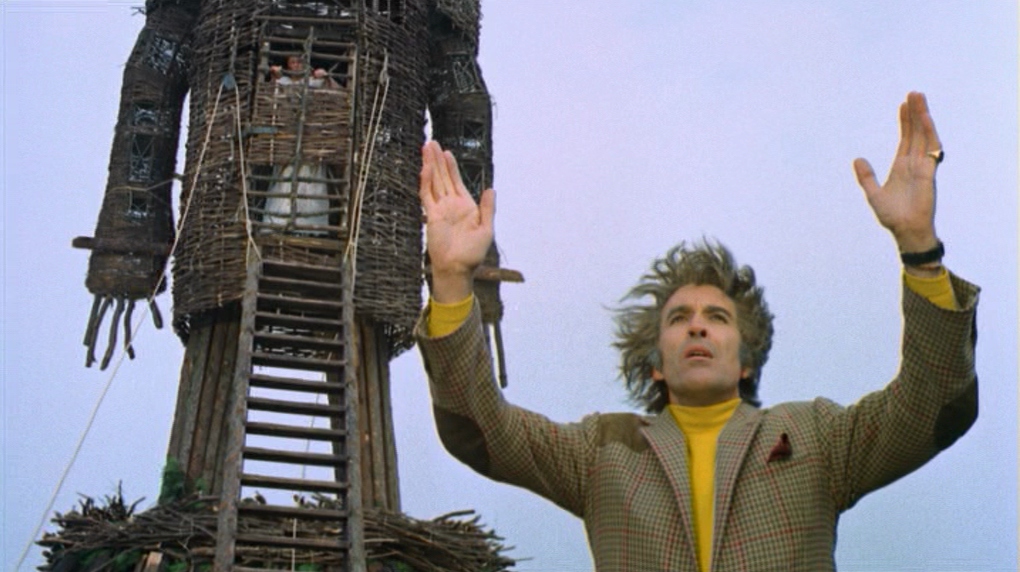
Still from 1973's "The Wicker Man".

Still from 1973's "The Wicker Man".

Like many cult films, there had been talk for years about a sequel, or a remake. The remake happened in 2006, a disaster of a film starring an inane and overacting Nicolas Cage. The film managed to remove nuance and any sympathetic characters from its treatment, and is largely seen as an unintentional comedy today (despite that, Cage is talking sequel). Then came word that a follow-up to the 1973 film, written and directed by Robin Hardy, who also directed the original, was in the works. Originally titled “Cowboys For Christ,” the new film would be a spiritual “companion” to the original film, not a direct sequel.  In production for years, and beset by money problems early on, the film, renamed “The Wicker Tree,” finally hit the festival circuit in 2011. It got mixed reviews at Fantasia 2011 and FrightFest 2011, with Total Film complaining that the new film had a “near-absence of momentum or intrigue.”

Now, at the beginning of 2012, “The Wicker Tree” is finally seeing a limited theatrical release. Andy Webster at The New York Times gives it a sympathetic review, but notes that it can’t live up to the “raw, earthy and mythic power” of the original film.

“In “The Wicker Tree,” two born-again Texans, Beth (the fresh-faced if one-dimensional newcomer Brittania Nicol) and Steve (Henry Garrett, slightly better), bring drawls, a cowboy hat and door-to-door evangelizing to rural Scotland (played unconvincingly by genteel Oxford), only to be drawn into a similar conspiracy, led by the nuclear-power magnate Lachlan Morrison (Graham McTavish, vainly trying to match the presence of the original’s Christopher Lee, who makes a cameo here).

Again, the town’s natives are a randy lot, with Honeysuckle Weeks playing the Britt Ekland temptress role and providing abundant nudity. But the decadence is more restrained; the gore, as before, is minimal. Inside references — animal carcasses, a costume horse-head, a sun pendant — drop in amid innovations, like an amusing crow’s-eye perspective. But finding sympathy for the leads isn’t as easy as it was for the forceful if self-righteous Woodward. Still, “The Wicker Tree” does manage to leave you with a haunted, agreeable unease.”

But will Pagans enjoy this new version? Pagan author and philosopher Brendan Myers has seen it, and gives it a thoughtful, somewhat positive, review.

“In a way, the film is about the inexorability of fate: Lord Summerisle himself says as much in a cameo appearance. So the plot of the film is an unfolding of Beth and Steve’s fate. We as audience members know what is going to happen: all the mystery and surprise is in how it happens. In that sense the film is a bit like a prequel. [...] I must also say, there were some moments at the end I genuinely didn’t expect. Beth and Steve met their fate as we knew they would, but the shock you feel when director Robin Hardy’s thesis is revealed – the thesis that great evil can come when people’s beliefs in the rightness of their actions is strong enough – came from an unexpected direction. This too helped make up for the weaknesses of the film: the unstable union of comedy and tragedy, the wooden-ness (dare I say wicker-ness?) of some of the characters. I’d give the film three out of five stars, although somehow I feel as if I should be giving it more. There’s still lots of depth and richness to be explored in the world of the Wicker Man, and lots more terrors to be seen as well. Robin Hardy, if you’re reading this, I hereby volunteer to write the script for the third film.”

Most mainstream reviewers are pointing out that this new film simply can’t live up to the original film, and that Hardy’s sensibilities as a director are a touch out of step with modern mores. I predict the consensus will be that “The Wicker Tree” is a noble failure that tries and ultimately fails to capture the magic of “The Wicker Man.” Better, by far, than the remake, but still a flawed attempt to “update” the basic story for a modern audience. Still, I’m interested to see what the wider Pagan response to this new film will be, and I look forward to judging the picture for myself.

I think that “The Wicker Man” caught hold of something at just the right time, British psychedelic folk and folk-rock bands were still riding high, occult practices and modern Paganism were becoming something more than an oddity, and this film seemed like a tuning fork that vibrated to the tensions and possibilities of that era. It became a touchstone for those who recognized that tension within their own lives, the desire to create a new world, to live in a new context, to break from the “straight” Christian world. The intrusion of Howie, and his undoing, can be read as a parable for the irreconcilable differences between the mainstream and the counterculture, the end of a “fool” who thinks this society should play by his rules. In a way, it is much like “The Exorcist,” which also played on tensions between cultures, but for different reasons, and to different ends.

I’m generally not a fan of remakes, and I think attempts to bottle the magic of “The Wicker Man,” no matter how faithful or well-pedigreed, will run into problems. Put simply, we live in different times, and the nature of tensions between Christianity and competing faiths and philosophies are different.  I think an excellent film can be made about those tensions, but I fear “The Wicker Tree” will not be that film.

For those wanting to see the extended version of “The Wicker Man”, you can still get it used for a reasonable price.

This week has seen an unusually high number of high-profile deaths, from Apple co-founder Steve Jobs to civil rights icon Rev. Fred Shuttlesworth, but perhaps lost among the many (deserved) tributes and remembrances are two other figures who have had an indirect but palpable influence on modern Pagan culture: Bert Jansch and Diane Cilento. Jansch, who died on Wednesday from lung cancer was a hugely influential guitarist and founding member of the British folk-rock band Pentangle. Pentangle, along with Fairport Convention, The Incredible String Band, and Nick Drake were part of a movement that re-contextualized and reinvigorated folk music and tradition in the late 1960s and early 1970s. They also, as historian Rob Young notes, had striking parallels with the emerging British Witchcraft traditions, and ended up providing an inspirational soundtrack for the nascent movement.

“In terms of their status in popular understanding, British Pagan Witchcraft and folk music are strikingly similar. Both are believed, even by many of the people who practice them, to afford a link to the distant medieval past or pre-Christian antiquity, but many of their identifying features are actually relatively modern inventions.”

Bert Jansch

Bert Jansch

During his career Jansch recorded at least 25 albums and toured consistently, inspiring Jimmy Page of Led Zeppelin and Johnny Marr of The Smiths with his unique guitar style. Towards the end of his career he collaborated with contemporary artists like Hope Sandoval (of Mazzy Star), Beth Orton and Devendra Banhart, inspiring a new generation of psych-folk and “freak” folk performers. Still, to many of us, he’ll be remembered as part of that band with the pentagram logo, which, along with the mythological and folkloric themes in their music, was more than enough to consider them one of “our” bands in the Pagan movement’s early stirrings. For his deep contributions to music, and for all those he inspired, Bert Jansch will live on for generations to come.

Another death that will have reverberations among many modern Pagans is the passing of actress Diane Cilento, famous to many as the first wife of Sean Connery, but beloved to us as “Miss Rose” in the 1973 cult-classic film “The Wicker Man”.

Cilento would go on to marry “Wicker Man” writer Anthony Shaffer, and was a spiritual seeker who eventually studied Sufism.

Diane Cilento

Diane Cilento

“It doesn’t really matter what basically the religion is, it’s all the same thing. It’s all oneness. And I don’t think you can divorce or segregate or pigeonhole life in that way much. It is just life, and poetry’s part of that.”

Cilento was also the mother of Jason Connery, who played the second Robin Hood in the Pagan-drenched English series “Robin of Sherwood.” Her role in creating a “microcosm of what sacred and profane life in a village might be like if Christianity had never been imported to the Isles” will forever endear her to generations of modern Pagans. May her spirit be united with the oneness she sought in life.

Just a few quick news notes for you on this Thursday.

COG Local Council Protests Go Daddy: The Dogwood Local Council of Covenant of the Goddess (COG), a regional body that serves Witches and Wiccans living in Georgia and Alabama, have sent out an announcement that they have stopped using the Internet domain service Go Daddy and are joining an ongoing protest that stems from company CEO Bob Parsons shooting and killing an elephant in Zimbabwe.

“We understand that Parsons’ acts were within the legal limits of Zimbabwe’s laws. And he may believe that he is doing good. However, the ends do not always justify the means. After careful consideration, we, as Witches and members of humanity, have decided to protest these killings,” states Hawk, First Officer of Dogwood Local Council and High Priestess of GryphonSong Clan [...] “While we do not want to see humans starving as a result of these roving elephants, we cannot condone the progressive annihilation of a species simply because they are in our way. And the African Elephant is still on the WWF endangered species list.”

Parsons has repeatedly defended his actions as humanitarian in nature, criticizing his critics as unwilling “to step up and do anything,” saying they are “all talk and no walk.” Vanity Fair notes that Parsons seemingly failed to realize that the “heroism of rich white men shooting elephants” has long ago fell out of fashion. As for Dogwood’s protest, it remains to be seen if the rest of COG, or other Pagan organizations, will follow suit.

The Wicker Tree Will Be Coming to America: Fangoria reports that “The Wicker Tree”, the forthcoming companion film to the classic 1973 Pagan-themed horror film “The Wicker Man,” has been picked up by Anchor Bay Entertainment for distribution, and that the film will be screened at this year’s Cannes Film Festival.

“Fango has learned that writer/director Robin Hardy’s THE WICKER TREE—the British helmer’s semi-sequel to his 1973 classic THE WICKER MAN—has been picked up for distribution in North America and the UK, as early as this fall. The film’s international sales agent, High Point Media Group, will screen THE WICKER TREE at the upcoming Cannes Film Festival on May 14 and 16. Anchor Bay Entertainment will release THE WICKER TREE, described as a “companion piece” to the original film and based on Hardy’s 2006 novel COWBOYS FOR CHRIST (the initial title for the follow-up movie, previously attempted and scuttled a few years ago), which takes place 40 years after the events of the previous film.”

So we could be seeing this film in theaters this fall! Maybe just in time for Samhain? We’ll keep you posted. You can read all of my “Wicker Tree” coverage, here.

New Orleans Voodoo and Hoodoo Gets a Magazine: New Orleans Voodoo Examiner Denise Alvarado brings our attention to a new quarterly magazine entitled Hoodoo and Conjure Quarterly.

“Recognizing the resurgence of folk magic and the growing community of hoodoos, rootworkers, and spiritualists, Planet Voodoo has created a new, high quality journal that meets the needs of today’s conjurers and curious. Hoodoo & Conjure Quarterly (HCQ) journal is the first publication of its kind that focuses on New Orleans Voodoo and hoodoo and related African derived traditions. It shares historical and contemporary information about aspects of the conjure arts, including magico-religious practices, spiritual traditions, folk magic, southern hoodoo, and religions with their roots in the African Diaspora and indigenous herbalism. Each issue of Hoodoo & Conjure Quarterly brings you original and traditional formulas, spells, tutorials, root doctor, spiritual mother, and conjure artist profiles, information about New Orleans Voodoo and more!”

The periodical was created by Alvarado and her business partner Sharon Marino. The first issue came out in March, is in full color, and is 100+ pages long. If you want order a copy, please visit Planet Voodoo.

Just a few quick news notes for you this Saturday.

Subcultural Red Light Districts: The aptly-named city of Banning, California is looking to adopt changes to its zoning codes, targeting certain kinds of businesses.

“Under the proposed development standards, tattoo and body-piercing parlors, hookah and smoking lounges and businesses that specialize in fortunetelling or occult arts would be kept away from schools and parks, residential neighborhoods and businesses that sell alcohol and adult merchandise. Their hours of operation would be limited. Someone who wants to open this type of business in Banning would have to obtain a conditional use permit from the city. Such permits cost $4,779 and have to be approved by the Planning Commission.”

They are, in essence, working to make sure no-one opens a tattoo parlor, occult shop, or smoking parlor in any place where people might congregate. They can’t even open near an “adult” book shop! This is how you ban certain kinds of businesses without actually banning them, make the barriers so high few can surmount them. It remains to be seen if singling out such businesses like this is legal, or will hold up to litigation. The city council is scheduled to take up the matter on Jan. 25, 2011.

Teaching Vodou: The Lexington Herald-Leader interviews history professor Jeremy Popkin about his class “Haiti in the Modern World”, which includes a section on the religion of Vodou. According to Popkin, the class was a way for the campus to discuss and explore Haiti after it came to international attention during the January earthquake that devastated Port-au-Prince. The paper also interviews Vodou scholar Leslie Brice about the oft-misunderstood faith.

There is a movement to create a centralized way to share information about voodoo. There is now a federation of voodoo practitioners in Haiti. But efforts to alter what for hundreds of years has been a religion passed down as an oral tradition have encountered resistance, said independent voodoo scholar Leslie Brice, who spoke at UK earlier this fall. Some of the resistance is because people fear the religion will be mocked by those who don’t really understand it, Brice said. Voodoo is often portrayed in popular culture, especially movies, as a singularly dark force, said Brice, who is studying to be a voodoo priestess. But, she said, it really is a religion centered on healing. When slaves were first brought to Haiti they came with “nothing except for what was in their minds and hearts,” she said. The religious traditions they brought with them were crucial to their survival, she said.

In a culture that often depicts Vodou as a detriment to Haiti’s future, and often only reports on it when something horrific happens, classes like these are vitally needed to educate people as to Vodou’s true nature and legacy. Classes like these, along with an emerging “Vodou voice”, may be essential to preserving this faith at a time when Haiti is in serious crisis.

Saving the Wicker Man Library: The Whithorn Library, the front of which was featured in 1973 cult classic film The Wicker Man, is in danger of being closed down due to government austerity measures. Jan Cole, and other campaigners, are trying to rally support to stop the historic library from being shut down.

The "Wicker Man" Library

“The library is part of the famous Wickerman Trail which popular with tourist fans as well as, surprisingly, stag parties who have been known to turn up in fancy dress. Occasionally fans will be seen to re-enact the film, or take a rubbing of the plaque outside.”

A sit-in protest was held last week, and there already seems to be some response from local government. Hopefully this site will be spared, not only because it was in a cult film that many of us love, but because libraries are wonderful things that should be honored and protected! You can keep track of the campaign at their official Facebook group.

That’s all I have for now, have a great day!

News outlets are reporting that Polish/British actress Ingrid Pitt died yesterday after collapsing a few days prior. Pitt became famous for playing villainous (usually vampiric)  sexually charged characters in a number of 1970s “Hammer Horror” films. She also had a small but important role in the 1973 cult classic film “The Wicker Man”.

Ingridd Pitt

Ingrid Pitt in The Wicker Man

Robin Hardy, the director of The Wicker Man, said he had “very good memories” of Pitt. He said: “She was a very attractive person in every sense. She was a perfectly good actress but a very decent person as well, not that those two things don’t often go together.”The UK Press Association

Pagan film critic Peg Aloi says that “this beautiful and classy actress brought decades of joy and fascination to legions of horror fans, and she will be dearly missed.” A sentiment I can only echo.

For more on Ms. Pitt, please check out her official web site.

It’s no secret that we here at The Wild Hunt are big fans of the 1973 cult film The Wicker Man, and are very much looking forward to writer/director Robin Hardy’s recently completed “spiritual sequel” The Wicker Tree; so I was pleased to hear that Hardy screened a 12-minute teaser of the film this Sunday at the Abertoir Horror Festival in Aberystwyth.

Robin Hardy will show a 12-minute promo of The Wicker Tree at the Abertoir Horror Festival in Aberystwyth on Sunday 14 November. The new film features a cameo by Christopher Lee who starred as Lord Summerisle in the original Wicker Man … “I am happy with this film because it is in the same genre as The Wicker Man, although it is not a sequel. There are lots of songs, sex, comedy and something terrible happens when you least expect it.”

Two interesting tidbits from the BBC piece is that Hardy was motived by the (unintentionally, awfully) comedic Nicolas Cage-starring 2006 remake to return to working on a follow-up to The Wicker Man (“That film took the original plot and threw away the rest of what made the original film work.”), and that he’s already at work on the third film in the “Wicker trilogy”.

“Mr Hardy has just finished writing a script for what he describes as ‘the third film in the Wicker trilogy’, The Wrath of the Gods, which he intends to start filming next year.”

The Wicker Tree is due to be released in 2011, but will it draw crowds? The Guardian thinks the original is one of the best horror films of all time, and it still receives generous critical praise, not to mention the ever-renewing cult fanbase, so there should be enough excitement for the film to give it a decent chance at wider success. If so, here’s hoping the 88-year-old Hardy is spry enough to finish the third film! We will, naturally, keep you updated on release dates and other related news items. Now to see if the Daily Mail will rage at the BBC for being too Pagan friendly because it covered this film.

Top Story: As I’ve covered here before, the Supreme Court of British Columbia in Canada is about to hear a case that will decide if the practice of polygamy should be considered a criminal act (as it currently is). There’s been an affidavit filed in support of decriminalizing multiple-marriage from a local Wiccan priest, and the family behind the case is a polyamorous triad. The defense is taking a “Muslims and Mormons” angle, arguing that the evils of polygamy outweigh the free expression of the families involved. Now, The Canadian Polyamory Advocacy Association (CPAA) is requesting that the government reveal if they think polyamory falls under their definition polygamy.

“The CPAA brought forward the motion Chief Justice Robert Bauman will consider on Sept 8. It was heard as part of a court reference to examine the constitutional validity of Section 293 of the Criminal Code of Canada. Section 293 bans polygamy. The CPAA wants to know if polyamorists will be caught under Section 293 should it be determined that the section is constitutional. CPAA lawyer John Ince told Bauman the attorneys general for Canada and BC have not delineated what their thinking is on the polyamorists. That, he said, makes it hard for him to prepare a case.”

Ince points out that polyamory isn’t the same as polygamy, as it isn’t patriarchal, isn’t intergenerationally normalized, and isn’t restricted by gender pairing or sexual orientation. The looming case has provoked some to wonder if polyamory is the “new gay”, making legal rights for poly families the next big social campaign after gay marriage. The biggest hurdle will be convincing the public that there’s a difference between the abusive compelled polygamous marriages often found in Fundamentalist Mormon off-shoots and polyamory. As I’ve been saying since 2006, our communities, which openly welcomes and celebrates so many polyamorous relationships (30% of poly families identify as Pagan according to one survey), needs to be ready for when this issue becomes the next culture-war battle.

“…this is an issue that will continue to gain steam as time goes by. Eventually polyamory will reach a “tipping point” and garner widespread national attention. Are our leaders and organizations ready for questions regarding polyamory? Eventually hostile questions will come, and they will cite this Salon.com article, and we shouldn’t be found wanting for a clear, empathetic, and inclusive answer.”

I’d say this court case is the “tipping point” I was talking about in 2007. Even if the courts rule that polygamy should remain criminal this won’t be the end of the issue. We see here the beginnings of a movement that will argue that polyamory shouldn’t fall under the same legal restrictions of polygamy, and we might even see a ruling where the criminal code is upheld but that clarifications of the definitions essentially decriminalize the practice of polyamory. Once decriminalization is achieved, legal recognition is the logical next step. You can also be sure that a victory in Canada will embolden activists in the United States and other countries. By 2012 expect “poly rights” to be in the popular vernacular if not in the court rooms.

One Way to Handle Regulation: In Romania, where mystical attacks are taken very seriously by some politicians, a proposed law that would hold psychics liable for bad predictions has been dropped due to fears of a curse.

“The politicians who had drafted the new law claim it is because they feared they would be cursed if they passed the plans. Alin Popoviciu and Cristi Dugulescu of the ruling Democratic Liberal Party drafted a law where witches and fortune tellers would have to produce receipts, and would also be held liable for wrong predictions. Maria Campina, a well-known Romanian witch, said that it was difficult to tax thousands of fortune tellers and witches partly because of the erratic sums of money they received.”

Despite the success of Romanian witches in the political process, I don’t think threats of magical retaliation would go over as well here in America. We’ll just have to stick to using lawyers, who are far more scary a threat in our culture.

The Wicker Tree is Done: Film company British Lion has announced that post-production for The Wicker Man‘s “spiritual sequel” The Wicker Tree is now complete.

“British Lion has completed post-production on Robin Hardy’s TheWicker Man follow-up, The Wicker Tree. Hardy has reunited with British Lion CEO Peter Snell, who produced the 1973 cult horror story, for the contemporary tale about two Texan Christians who travel to the Scottish fiefdom of Tressock to spread the gospel … “The Wicker Tree is a chilling contemporary take on the genre,” Snell said. “We have a very strong cast, wonderful locations and like The Wicker Man, music plays a pivotal role in the story-telling.”

No word yet on a release date, but at least we know it’s completed. So keep your eyes open for further announcements.

PNC-Minnesota Gets Noticed: One of the goals of the Pagan Newswire Collective is to better inform mainstream media outlets concerning news happening within the modern Pagan community, so I was very happy to see the MinnPost’s The Daily Glean referencing a PNC-Minnesota story.

“A Celtic temple has opened in Northeast Minneapolis, as reported by the Pagan Newswire Collective — the small structure is the first of its kind in North America, dedicated to the Old Belief Society, which derives its beliefs from old Celtic practices. We point this out, firstly because we find it interesting, and secondly to point out just how wide we at the Glean cast our newsgathering net. Come on, who else is reading the Pagan Newswire Collective? Eric Eskola? Hardly.”

Congratulations to the Minnesota bureau! This is only the beginning, our network of bureaus continues to grow, and soon our main site will launch which will highlight and expand on the great local stories our bureaus are working on.

That’s all I have for now, have a great day!

Just want to quickly share some The Wicker Man, and its spiritual companion The Wicker Tree, news with you today. Starting with a newly updated and revised book on the 1973 cult-classic film by Scottish journalist Allan Brown. “Inside the “Wicker Man”: How Not to Make a Cult Classic”, originally released in 2000, gives an inside look at the many hurdles the film faced, and how it became a cult hit despite these setbacks.

“Inside The Wicker Man is a treat for all cinemagoers, exhaustively researched and achieving a near-perfect balance between history, trivia and serious analysis. Allan Brown describes the filming and distribution of the cult masterpiece as a ‘textbook example of ‘How Things Should Never Be Done’. The omens were bad from the start, and proceeded to get much, much worse, with fake blossom on trees to simulate spring, actors chomping on ice-cubes to prevent their breath showing on film, and verbal and physical confrontations involving both cast and crew. The studio hated it and hardly bothered to distribute it, but today it finds favour with critics and fans alike, as a serious – if flawed – piece of cinema.”

The revised and expanded edition also talks about the plans for the film’s “spiritual sequel” The Wicker Tree, which has just released a teaser trailer at its web site.

There’s also a collection of photos and videos available on the film’s media page. Sadly, we still don’t have a release date for the film, but hopefully the teaser means we don’t have to wait too much longer. It remains to be seen if The Wicker Tree will be able to withstand the weight of expectation, especially after the unintentionally comic and misguided 2006 remake of the original Wicker Man. Regardless of how well the “sequel” does, the original continues to be a hugely popular phenomenon, inspiring countless tributes and new contexts.

The Wickerman Festival in Scotland, while inspired by the cult-classic film, has very little to do with Paganism. It’s a sort of mini-Glastonbury, a family-friendly outing with a few nods to its inspiration (they burn a wicker man every year). However, it seems that organizers are having problems with the perceived ”pagan” elements, despite their best secular intentions.

“…yesterday as more than 15,000 converged on an inclement south west of Scotland for the final day of The Wickerman – one of the foremost alternative music festivals – it emerged organisers have been unable to shake off concerns about its pagan roots. Two marriages made use of a controversial marrying stone on the site yesterday despite calls for it to be removed, leading to criticism that it is endorsing paganism … The highlight of the 2010 Wickerman at midnight last night was the symbolic burning of a 25ft high wicker effigy. Elements of the churchgoing community of the parish of Auchencairn and Rerrick are concerned about the triangular-shaped wedding stone placed at the base of the effigy. It is seen as a pagan alter made from granite with a hole at the top for the couples to link hands. Rev Alistair MacKichan, former minister in the parish, said his concerns were about the stone becoming a centre for pagan rituals. “The Wickerman is actually a lovely family festival,” he said. “But if you start to establish a pagan ceremonial site, so it becomes a permanent fixture, then inevitably those involved with paganism will feel they have a locus around the year and those who have been married there will have other rites of passage there.” The 60-year-old festival founder, director and farm owner, Jamie Gilroy, insists “there are no religious reasons” behind the festival.”

These concerns seem to ignore the fact that most of the weddings conducted at the “marrying stone” are humanist in nature, and aren’t Pagan in any religious sense of the term. But in way, the concerned Christians are on to something. You can’t simply invoke a film so deeply rooted in a (perceived) Pagan experience without also invoking a bit of real-live Paganism along with it. Further, the growth of a “family” festival that features marriages, merriment, and rituals outside of the purview of the local churches must make them very nervous indeed. After all, if you go to Wickerman for your rites of passage, explicitly Pagan or not, the end result is still a growingly irrelevant religious institution outside the festival structure.

I think organizers and critics alike will find that even if they remove the “marrying stone”, it won’t stop marriages on site. The natural human inclination towards collective joy can’t be repressed, or diverted, for very long. Eventually, it will find a way to express itself within, or without, the structures of the culture they live in. If the churchgoing community near the festival want to do something about all the “paganism” on display, they could either throw their own festival, or integrate into the one already near them.