

Editor’s note: This column contains references to rape and sexual assault. There are also spoilers for the ending of Obsession.
There is a moment early in Curry Baker’s Obsession when Bear stands in a metaphysical shop, a box no larger than a tube of toothpaste in his hand. White card, fire-engine red ink, a cartoon boy and a cartoon girl beaming from a spray of stars, a wand caught mid-snap with CRACK! printed beside it. AMAZE YOUR FRIENDS! runs along one end, and the only fine print on the face is a boast dressed as a limit: You only get ONE WISH. It has the visual grammar of a whoopee cushion, a joke-shop card trick, a snap-pop you throw at the sidewalk on the Fourth of July. Turn it over and there are warnings. That, more than anything else on the box, is worth lingering over.
Single use only. One wish per person in a lifetime. Wishes are irreversible; consider long-term effects. No time manipulation, no resurrection, no immortality. The manufacturer is not responsible for misinterpretations. There is a customer service number. All of it is the prose of a return policy, and none of it is the prose of anyone who will still be standing there when the wish comes due.
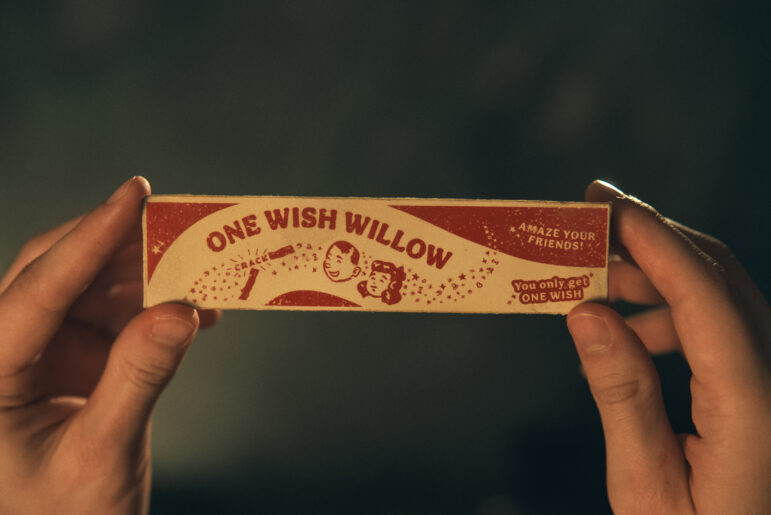
The One Wish Willow from Obsession (2025) [Focus Features]
The film’s amber light lends the box the patina of something recovered from an attic, though the object itself is factory fresh. The price? $6.99. Bear buys it the way you buy gum at a register. Ninety minutes, a dead young woman and two more bodies to count later, the Final Girl cries while the credits roll on a film audiences have spent all summer describing as a story about the dangers of witchcraft.
Nothing in it, however, has anything to do with sorcery: it requires no practitioner, no teacher, no tradition, not a single hour of study. What Bear does? That’s shopping.
What the genre has been saying for over 30 years
The critical reception of Obsession has settled into a pattern so familiar that it barely registers as interpretation: Christian review sites have embraced the film as vindication, reaching for Deuteronomy almost instinctively, while secular critics have praised its moral seriousness about spellwork as though the idea that magic might warrant serious moral consideration were itself a revelation. Both readings, for all their apparent differences, rest on the same old assumption: the belief that danger inheres in the practice itself, that the peril lies in the craft rather than in the hand that wields it. The border between licit religion and illicit magic was drawn by people with a stake in where it fell, redrawn whenever the stakes shifted, and has never once stayed put.
Set aside that familiar premise, and the history of the genre tells a rather different story. For more than 30 years, films routinely dismissed as teen horror have been examining, with remarkable consistency, what happens when magic is used to trespass upon another person’s will.
Long before The Craft, horror had already been asking what happens when magic is used to impose one person’s desire upon another’s will. We could trace that lineage much further back, of course, but an argument has to begin somewhere, and 1996 gives us a particularly useful place to start. (Hellraiser, hello?) The Craft laid the groundwork that year — three decades later, it remains the film to beat. Sarah’s spell on Chris does exactly what a compulsion is supposed to do: it creates infatuation with nothing underneath it and corrects not even one of his cruelties. What Chris receives is not a new desire but the appetite he already possessed, amplified and given a target. It takes him to her window, and then to her throat. A film sold to teenagers on the strength of its soundtrack understood that a spell aimed at another person’s will eventually comes back through the caster’s own door.
Buffy the Vampire Slayer returned to the question in three distinct ways. In “Bewitched, Bothered and Bewildered,” Xander commissions a love spell out of wounded pride and finds an entire town’s appetite turned back upon him, the comedy curdling into genuine menace by the third act.
Giles names what Obsession stages almost 30 years later: “Do you have any idea how serious this is? People under a love spell, Xander, are deadly. They lose all capacity for reason.” Deadly. Not cute. Deadly. Like Chris before and Nikki later. Three decades of the lesson, still on the shelf.
In another episode, “Something Blue,” Willow’s grief slips into her ordinary speech until every idle sentence binds, offering an elegant image of what happens when a practitioner works while bleeding. In the sixth season, Willow reaches for Lethe’s bramble to erase an argument from Tara’s memory.
Here the show made its sharpest move: the magic works.
It works perfectly. Tara wakes affectionate and untroubled, the fight erased, the evening salvaged. The relationship ends anyway, because Tara eventually learns what was done to her and understands what it means that the woman she loves treated her consent as an obstacle to be routed around. The violation happened in private, with tenderness, at the hands of someone who apologizes afterward. Violated all the same.
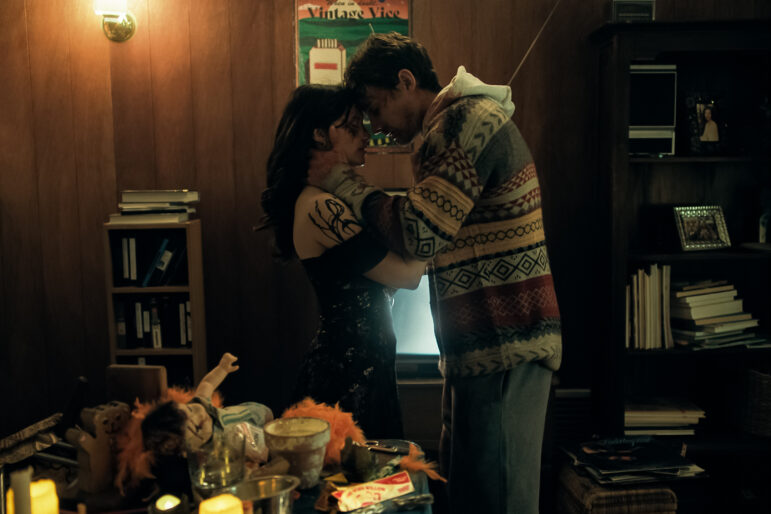
Nikki (Inde Navarrette) and Bear (Michael Johnston) from Obsession (2025) [Focus Features]
Beneath Obsession, however, lies the older machinery the movie actually runs on, which belongs not to the spellbook but to the wish-fable: the monkey’s paw, the djinn of Wishmaster, the desire granted with such precision that the precision itself becomes the punishment. Barker has said that the seed of the film was a monkey’s-paw sketch on The Simpsons, and that the obsessive relationship came first in the writing, with the wish arriving afterward as the mechanism that could carry it.
Scholarship on erotic compulsion describes agoge as a working that draws a person into a relationship rather than opening the possibility of one. Contemporary practitioners increasingly treat love magic as cursed work, not out of squeamishness but for a structural reason: to perform it is to manufacture a victim. The principle appears in a hundred beginner’s books, stated more plainly than anything in this film.
Who pays?
Sarah pays for her spell; Willow pays for hers across two seasons, a friendship, and a partner who eventually walks out the door. In Obsession, by contrast, the account is settled almost entirely by Nikki, who bears the transformation, the unraveling, the violence, and every frame of body horror the film has to offer, while Bear moves through the story in a register the camera repeatedly frames as anguish. The production even went so far as to shoot additional material clarifying why he does not undo the wish the moment he understands what it is doing, adding a scene that emphasizes how desperately he wants it to work.
The film is generous to him. A harder reckoning is available within the same material, and it does not require reading against the grain.
Bear never has to plan Nikki’s dismantling. The horror requires only that he watch her being emptied out and, hour after hour, continue accepting what he asked for because what he asked for is arriving. Every hour in which he does not end it becomes another hour in which he chooses being “loved” over her continued existence as herself. The quotation marks are not ornamental. What he receives is a performance of devotion generated to his specification, and he knows its provenance from start to finish. That knowledge is the one advantage he possesses over her from the first minute to the last.
The film is unambiguous about what that acceptance entails. Nikki’s desire for him was installed; it is not hers, it was never hers, and could not have been hers, because the mechanism of the wish consists precisely in overwriting the woman who might have said yes or no. So, sex obtained that way is rape. It is rape the first time and every time after, and the fact that the instrument is a novelty item from a gift shop rather than a substance in a glass alters nothing about the structure of the act. Horror has a long habit of allowing supernatural framing to blur this distinction. The word exists, and it fits.
The film’s own mechanics push the point further still. Everything that happens proceeds from Bear’s wish, made in his own name, with his one allotment, over a woman who was never consulted. That is the engine from beginning to end. But the One Wish Willow grants one wish per person in a lifetime, and Nikki’s is spent too, only not by Nikki. The woman who breaks that second branch is the construct, the thing assembled from Bear’s wanting and wearing Nikki’s face (well, whole body, actually), and it spends her one chance while the person whose lifetime it belonged to is nowhere in the room. The real Nikki is therefore not merely remade by somebody else’s wish. Through that remaking, she is stripped of her own wish as well, in her own body, without ever surfacing long enough to know that it happened. His wish cost her everything, and then it cost her the only thing she had left to spend.
Which is why the passive reading of Nikki fails, and it fails on the film’s own evidence. Nikki fights. She surfaces again and again through a construct built to keep her submerged, and every return costs her something even as the machinery of the wish continues to operate. She resists a wish designed to make resistance impossible, from inside her own overwritten body, with no ally, no information, and no instrument except her own refusal to be dissolved. Horror has a name for the person who does that and remains standing at the end of it, and Nikki has earned it more strenuously than most who wear it: Final Girl.
Then the film ends, and the arithmetic continues beyond the credits, which is where the generosity toward Bear becomes hardest to accept.
Bear takes himself out of the equation and, while that exit has been read in some quarters as sacrifice, even as a form of atonement, it is neither. It is the cheapest door in the house. He leaves before the reckoning, before the questions, before a single consequence can be addressed to him by name, and the reading that finds nobility there is the same that has been letting him off the hook since the second act.
Three people are dead. Nikki is the one left standing in the room with them, inhabiting a body that has been used, altered, and driven to acts that were never hers to choose, carrying the entire history of what happened in a form no official account is likely to recognize. The film cuts away before anyone official arrives, but the aftermath is not difficult to imagine, and it belongs to her alone. There will be a version of events she has to reconstruct aloud for people whose first instinct may be to disbelieve it: a story involving a $6.99 novelty from a gift shop and a wish a man made about her without ever speaking to her about it. Every material fact points toward her. The only person who might have corroborated her account has arranged not to be available. The Final Girl survives into that solitude, carrying the bill for a purchase she never made and no receipt anybody will honor.
The merch table opened before the credits
The easiest conclusion to draw from Obsession is that magic itself is dangerous, a reading as tempting as it is deeply at odds with the distinction the film’s own mechanics allow us to make, and conveniently useful to people who have never wished this community well.
Paganism offers no single theory of magic. It is not a single tradition, and the category itself remains contested both in scholarship and among practitioners. Yet several contemporary currents hold to a principle remarkably close to the one this film illustrates quite possibly without intending to: the magical instrument contains no morality of its own. Ethics reside in the intention that directs it, in the manner of its use, and in what follows. This does not make the instrument harmless; if anything, it places a heavier burden on the person who takes it in hand. In the film, the object supplies the mechanism; Bear supplies the wish.
The film offers its own evidence for this in an exchange that passes quickly enough to be overlooked: having learned the one-wish-per-lifetime rule, Bear asks the man behind the counter to make the wish on his behalf. The answer is no, for the simplest possible reason: the man has already used his. He spent his one wish some time ago and is still standing there, running a shop, restocking shelves, unhaunted, undeformed, entirely intact.
That exchange functions as a control case dropped into the middle of a horror film. Someone used the One Wish Willow, received what they asked for, and went on with their life. From what we can see? No punishment imposed. No price exacted. No interest accrued.
What separates that man from Bear is most probably the content of the wish.
The One Wish Willow’s function is to collapse the distance between wanting something and possessing it, and in an unaltered world that distance is precisely where other people live. Nikki can say no. She can prefer Ian. She can want neither of them, or want someone or something else entirely, or simply remain a person entitled to determine the course of her own life. Resistance is what another person’s autonomy feels like from the outside. The One Wish Willow removes it, and in doing so reveals what a man will do when nothing remains that can prevent him from having what he wants. We can infer that the shopkeeper’s wish, whatever it was, could be fulfilled without dismantling another person. Bear’s could not. His required a woman to be overwritten before it could be granted.
The horror of Obsession begins at the moment we learn what the man making the wish is prepared to call love.
There is another detail in that exchange worth lingering over. The man behind the counter understands the object better than anyone else in the film. He knows its limits, knows that its power cannot be transferred, knows precisely what he is selling—yet he displays no dread of it. Knowledge of the instrument turns out to be the safest position anyone in this story occupies, which is more or less what magical education has insisted upon for as long as there have been people willing to teach it: know what you are handling before you put it to work.
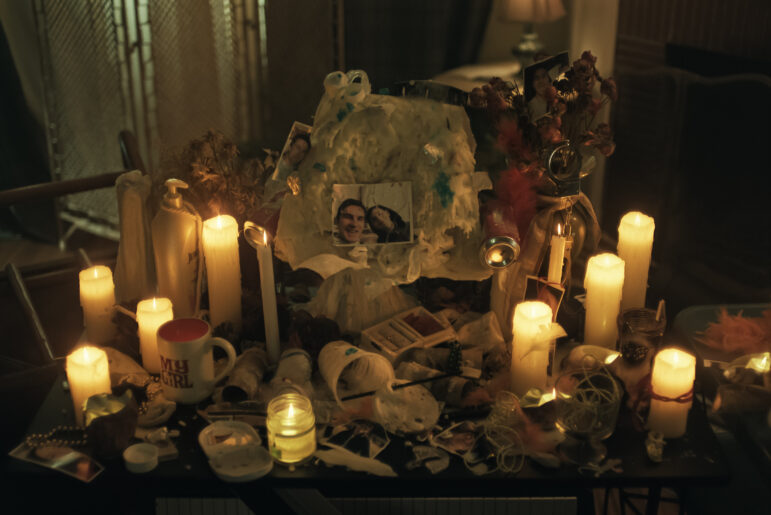
An obsessive shrine in Obsession (2025) [Focus Features]
The One Wish Willow arrives complete. There is no teacher, no coven, no year and a day, no elder with the authority to say no, no interval at all between wanting something and possessing it. In living traditions, that interval is precisely where much of the work takes place: the waiting, the study, the discipline, the person across the table who has seen this go wrong before and will still be there when it does. Remove that friction, and what remains is a horror engine. That removal is Barker’s real discovery, and perhaps the film’s most interesting formal conceit.
The joke, meanwhile, has walked off the screen and into the world. The One Wish Willow can be bought. The film’s own site sells official replicas, packaged with terms and conditions composed in earnest by a fictional manufacturer that declines responsibility for misinterpreted wishes. Etsy is thick with 3D prints, cosplay pieces, shirts. And the version that matters most is on Shein, where it costs pocket money and ships anywhere, landing in the hands of young viewers who saw the film and wanted the object itself, including those who may never have the money for a class, a festival ticket, or the twenty-dollar book that might explain why compelling another person is a grave act.
Inside the film: it is a novelty, please do not break it. Outside the film: it is a collectible, please buy it.
The disclaimer became advertising copy, and the market has made the wish cheaper and easier to reach than any teaching about the wish.
What Sally Owens knew
Practical Magic returns to theaters on September 11, and the comparison is worth having ready, because Sally Owens is Bear inverted at every joint.
Frightened as a girl by the family curse and by the possibility of loss, Sally constructs a spell designed to fail. She catalogs qualities no man could possibly possess all at once, hoping to spare herself both the vulnerability of falling in love and the grief of being left behind. Her magic turns on her own desire rather than upon another person’s will, which is the entire ethical distance the genre has to offer, distilled into a single childhood ritual. And she learns it at a kitchen table, from women who will still be in that house when the consequences arrive.
But the crucial difference comes later, and it is the one Obsession has no equivalent for. Sally tells him. When Gary turns out to match her childhood list, line for improbable line, she confesses the working to the man standing inside its consequences. She speaks the thing aloud, gives him the knowledge, and leaves him free to walk away from it. He answers in kind: he had been wishing for her, too, describing her to himself for years without knowing her name, and he tells her so. Two people who had each reached toward something they could not yet have, disclosing what they had done to one another, and only then choosing.
Bear never tells Nikki anything. He watches her come apart while holding the secret of why, and that secret is the only thing keeping the arrangement intact.
That is the whole of it: one tradition produces a spell that can be confessed to a person still there to hear it, still free to refuse it. The other produces a stick in a box and a customer service number. Only one of those is a craft; the other is a purchase, and the difference is no decoration. It is the only part of this that we can actually offer the people who left those theaters scared to death.
The Wild Hunt is not responsible for links to external content.
To join a conversation on this post:
Visit our The Wild Hunt subreddit! Point your favorite browser to https://www.reddit.com/r/The_Wild_Hunt_News/, then click “JOIN”. Make sure to click the bell, too, to be notified of new articles posted to our subreddit.