
NASHVILLE, Tenn. — A Jewish couple who say they were denied the opportunity to foster a child because of their religion are asking a Tennessee court to rule that the state’s funding of religiously affiliated foster-care agencies violates protections for religious freedom and equal treatment. The case could have broad implications for foster parents of minority religions.
Elizabeth and Gabriel Rutan-Ram of Knox County are represented by Americans United for Separation of Church and State, DLA Piper LLP, and the Kramer Law Center. At an Aug. 27 hearing in Rutan-Ram v. Tennessee Department of Children’s Services, their attorneys asked the Davidson County Chancery Court for summary judgment.
The dispute began after Holston United Methodist Home for Children, a state-funded Christian child-placement agency, declined to provide the Rutan-Rams with foster-parent training and a required home study because they did not share the agency’s Christian beliefs.
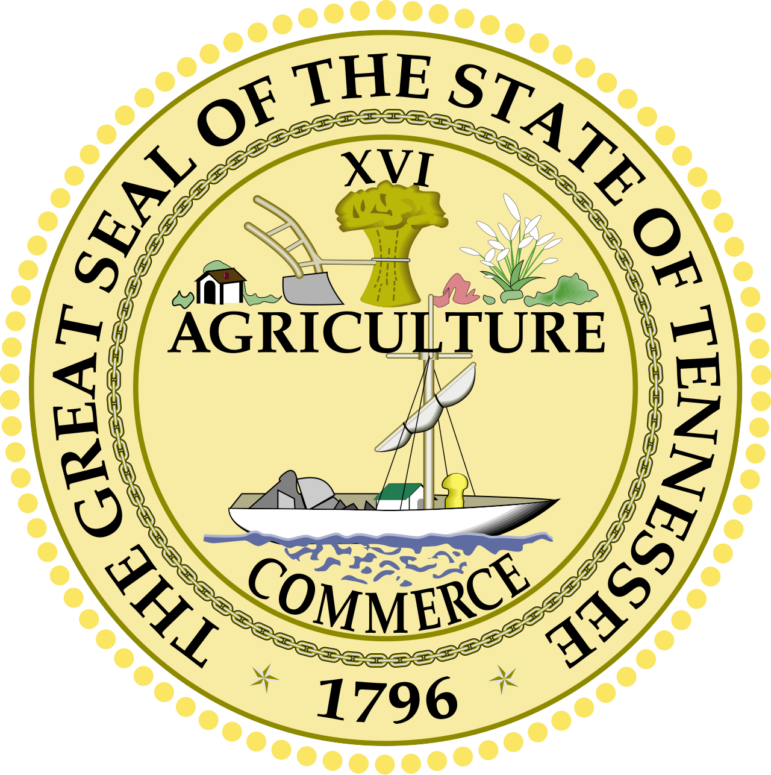
Seal of Tennessee [Public Domain]
The case challenges a Tennessee law permitting state-funded foster-care agencies to decline services when doing so would conflict with the agencies’ religious convictions. The Rutan-Rams contend that the arrangement allows agencies performing government-funded services to impose a religious test on prospective foster and adoptive parents.
“We are asking the court to help end this four-year long legal nightmare that upended our lives and prevented us from adopting a child in need,” Liz and Gabe Rutan-Ram said. “Our tax dollars should not be financing a system that actively discriminates against anyone who can’t pass a religious test and delays vulnerable children from finding loving homes. State-sanctioned religious discrimination should have no place in Tennessee.”
Americans United President and CEO Rachel Laser said the dispute illustrates the consequences for religious minorities when government-funded organizations are permitted to make services contingent upon religious belief.
“Liz and Gabe Rutan-Ram continue to suffer unacceptable discrimination solely because they are Jewish,” Laser said. “This loving couple wanted to help a child in need, only to be told they wouldn’t be served by a taxpayer-funded agency because of their religion.”
“We urge the court to affirm that religious freedom is not a license to discriminate and that what happened to Liz and Gabe violates the Tennessee Constitution’s promise of religious freedom and equal protection under the law.”
The dispute comes amid other church-state controversies in Tennessee.
Civil-liberties organizations, including Americans United for Separation of Church and State (AU), the ACLU of Tennessee, and the Freedom From Religion Foundation (FFRF), are also investigating plans by five Tennessee school districts to display the Ten Commandments under a recently enacted state law. The organizations maintain that decisions about religious instruction belong to families and faith communities rather than government, while supporters of the law argue that the Ten Commandments have historical significance.
The organizations have requested public records related to plans approved by five school districts:
- Blount County Schools — approved Aug. 4
- Rutherford County Schools — approved Aug. 20
- Washington County Schools — approved Aug. 4
- White County Schools — approved Aug. 13
- Wilson County Schools — approved July 23
Public Chapter 924, which took effect July 1, permits Tennessee public and charter schools to display the Ten Commandments alongside the first sentence of the second paragraph of the preamble to the Declaration of Independence and the preamble to the U.S. Constitution. The legislation requires the documents to be displayed together and prominently, with text of at least 26-point type that students can easily see and read.
Blount County’s Board of Education voted unanimously to place the Ten Commandments in all 21 district schools, although it removed language that would have called for disciplinary action against schools failing to display them. Rutherford County approved a design for displays in all 53 schools, estimated to cost $12,400, with $7,000 already raised at the time of the vote.
White County approved displays containing the Declaration of Independence, Constitution, Bill of Rights, and Ten Commandments. Its policy also calls for administrators to commemorate the installations during the 2026-27 school year in a “respectful manner,” with participation by students as administrators consider appropriate. Wilson County approved displays subject to requirements concerning their location and presentation.
AU, the ACLU of Tennessee, and FFRF have requested records from all five districts, including emails, board documents, and proposed display designs.
“Forcing biblical scripture on public-school children violates families’ religious freedom,” the organizations said in a joint statement. “Families and faith communities, not the government, get to decide what role religious doctrine and belief play in their lives.”
The groups said they are investigating each district implementing the law and urged affected families to contact them. Washington County Superintendent Jerry Boyd responded that the district acted under authority granted by the Tennessee General Assembly and would seek legal counsel as appropriate while proceeding with implementation.
The foster-care lawsuit and the school-display controversy are separate legal matters, but both raise questions about the boundaries of religious freedom and government involvement with religion in Tennessee, as well as the broader implications of those boundaries for minority faiths.
The Wild Hunt is not responsible for links to external content.
To join a conversation on this post:
Visit our The Wild Hunt subreddit! Point your favorite browser to https://www.reddit.com/r/The_Wild_Hunt_News/, then click “JOIN”. Make sure to click the bell, too, to be notified of new articles posted to our subreddit.