

We are humans, and nothing human is foreign to us. In the era of power designated by artificial intelligence, our nation forgets at times that we not only started as an experiment, but like all experiments we evolve. The American experience as a nation called the United States of America is at a precipice: we need to embrace a path of remembrance of our history, our honor, and our heritage.
There are many types of Americans. Each of us must choose where we stand, especially at this semiquincentennial.
Our nation first declared its independence on July 2, 1776 with the Lee Resolution, when the Declaration of Independence was presented; its final approval was on July 4, 1776.
Two hundred and fifty years later, our nation struggles through an emotional morass that hovers like a low-hanging weather system with each economic, environmental, and political event that makes the news. For those who were alive during 1976 bicentennial, the feel, the mood, and the execution of American’s birthday in 2026 is grim.
Americans are known to be perpetual optimists with a “can-do” attitude. The film industry has been one of our strongest national exports, beginning with The Great Train Robbery (1903), an early entry into a world where American cultural power grew in strength from the exportation of American media including the film industry.
Our heroes do not give up. In our films and in our lives, we fight. We keep fighting. We are stubborn believers that there is always a way to make it through the darkness of the night. Think of any classic action adventure film when all hope is lost, until the main heroes save the day. In this country, our presidents, and more specifically, those who served in Congress as US Senators have done much to keep the fight going.
This is not just for the motion picture screen. Art reflects life.
Our parents, and for some, grandparents or even great-grandparents brought this spirit of survival and an awareness of how to take historical and societal imperfections to the civil rights movement. I think of my own relatives who rebelled as students, participating in sit-ins at Read’s Drug Store in the 1950s and other local establishments in the 1960s, the predecessors to later, widespread sit-ins in the Deep South, culminating in the first March on Washington for Jobs and Freedom in August, 1963.
How would they respond to recent Supreme Court decisions invalidating the various aspects of the Voting Rights Act? In 2026, barely a full 60 years since the passage of the first Voting Rights Act of 1965, continued lawsuits have led to Supreme Court rulings that gutted the promises and the hard-fought protections publicly stated in writing in the Fifteenth Amendment (1870), but rarely enjoined in practice in the Jim Crow South.
It took nearly 100 years to fulfill the promise of freedom stated in the ratified Thirteenth (abolishment of slavery, 1865); Fourteenth (rights of citizenship and equal protection under the law, 1868); and Fifteenth (prohibition of denial or abridgment of an individual’s right to vote, 1870) Amendments. Commonly known as the Civil War or Reconstruction Amendments, these three amendments directly addressed the issue of race in our nation as we approached the centennial of our nation in 1876.
Slightly more than 150 years later, we still have the very weapons that our parents, grandparents, and great-grandparents used before the passage of the Voting Rights Act of 1965: patience, persistence, purposefulness, and perseverance.
It is easy to obscure the true meaning and long-term impact of denying a portion of the population the right to participate fully in a democratic society. African-Americans were just under 11% of the total population in 1965 just before the law was signed and passed in August, 1965. Below is a chart showing how the Black population dropped from over 20% at the time our country was founded to just over ten percent in the decades after 1930 when our country was in the Great Depression.
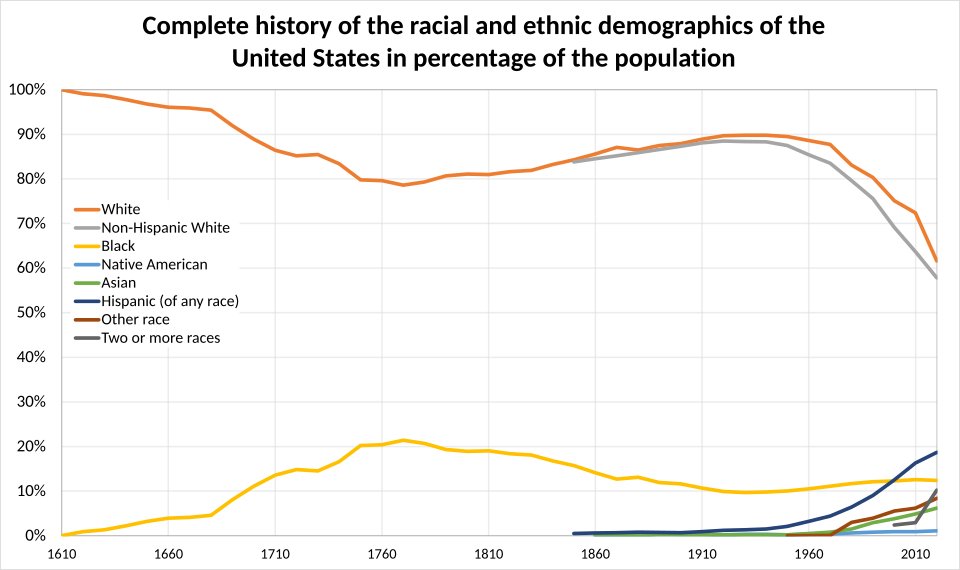
Racial and Ethnic Demographics 1610-2010 Tweedle, CC BY-SA 4.0 <https://creativecommons.org/licenses/by-sa/4.0>, via Wikimedia Commons
Why is this important? When 20%, or even 10%, of the population are not able to participate in elections in our democracy, formally known as a Federal Democratic Republic or a Presidential Republic, then the goals of life, liberty, and the pursuit of happiness are not possible in the country as a whole. The split of haves and have nots occurs is race, and by extension, culture. The lack of having a vote silences the voice and of the minority population, affecting the overall country.
The Voting Rights Act of 1965 sought to achieve through law what was not evident in the real-life experiences for those who lived in the wrong part of the country, and for those who publicly were accepted and privately considered as less than the majority population.
A decade before we celebrated the Bicentennial, we faced the brutal ugly truth of who we were as a nation and attempted to rectify it: the administration of President Lyndon Baines Johnson (commonly known as LBJ), a brash former Texan Senator, vice-president to John Fitzgerald Kennedy, whose domestic achievements reached spectacular heights even as the Vietnam war proved his undermining and cause to not seek re-election in 1968.
The Twenty-Fifth Amendment, introduced in 1965 and ratified in 1967 was a direct result of Johnson’s accession to the presidency upon the assassination of John F. Kennedy without a successor to replace his role as vice-president.
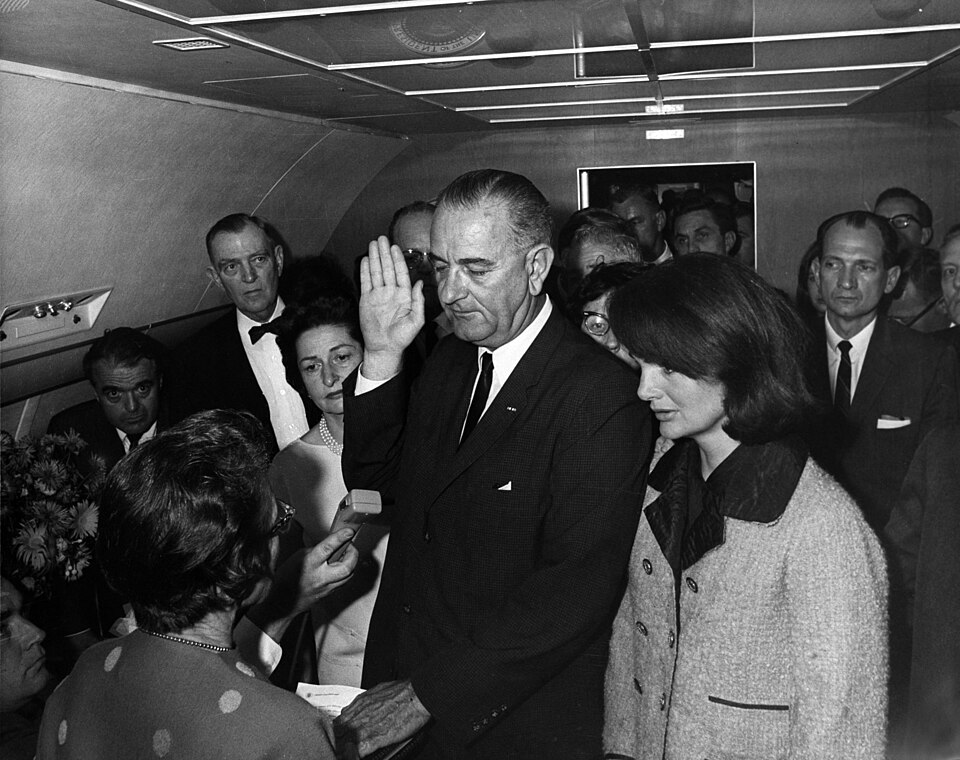
Lyndon Baines Johnson taking the oath of office after the assassination of President John Fitzgerald Kennedy. List of others in photo: Left to right: Mac Kilduff (holding dictating machine), Judge Sarah T. Hughes, Jack Valenti, Congressman Albert Thomas, Marie Fehmer (behind Thomas), First Lady Lady Bird Johnson, Dallas Police Chief Jesse Curry, President Lyndon B. Johnson, Evelyn Lincoln (eyeglasses only visible above LBJ’s shoulder), Congressman Homer Thornberry (in shadow, partially obscured by LBJ), Roy Kellerman (partially obscured by Thornberry), Lem Johns (partially obscured by Mrs. Kennedy), former First Lady Jacqueline Kennedy, Pamela Turnure (behind Brooks), Congressman Jack Brooks, Bill Moyers (mostly obscured by Brooks), White House correspondent Sid Davis (behind Brooks, looking down) Cecil W. Stoughton, Public domain, via Wikimedia Commons
Current generations presume that measures to address potential physical or mental health defects, including solutions if a president died in office or became incapacitated have always been present. During the past sixty-five years, five presidents served in the U.S, Senate prior to assuming the presidency. All have had a profound impact on the United States populace: Kennedy, Johnson, Nixon, Obama, and Biden. Each one has introduced legislation that has benefited the country domestically.
In this country, our presidents, and more specifically, those who served in Congress as US Senators have done much to maintain the legacy of what makes the United States of America strong.
Of the five, I argue that Johnson, the only one of the five past presidents who is least familiar to current generations, did the most. During his presidency, many of the rights that current citizens take for granted were formed. As the title of Pulitzer Prize winning journalist, Philip Geyelin’s review published on President Johnson’s last day in office, noted, “He wanted nothing more than to succeed.”
A part of Geyelin’s essay notes the following:
‘There is division in the American house now. … I would ask all Americans, whatever their personal interest or concern, to guard against divisiveness, and all of its ugly consequences,’ Johnson said during remarks on his decision not to seek reelection.
Sound familiar?
Johnson as a dealmaker gambled and won with many domestic achievements in the areas of housing, civil rights, voting rights, and health because he thought first of the American people, and he implemented what Kennedy could not due to his assassination:
He wanted nothing more than to succeed — and he did, in many, many ways. But he wanted support for the war and money for a bigger antipoverty effort and safety in the streets and housing for the poor and education for all our children and medical care for all the elderly and love and respect of all the people, and it wouldn’t stretch. He wanted to get it all at once and Roosevelt was right: nobody can.
Kennedy wanted to build a “New Frontier” as promised in his speech at the 1960 Democratic National Convention, but he died before the fight was done. Johnson knew how to use his past connections as a former US Senator as leverage to honor Kennedy’s civil rights legacy, but to expand it in what his goal to create attempt to fulfill what he gave as a commencement speech on May 22, 1964 called the “Great Society“.
If you were born in or after 1964 or know of someone who has benefited from government programs meant to eliminate poverty and racial injustice, remember to thank a brash Texan who wasn’t always pretty in his actions, but he got the job done.
Johnson did a great deal to help make the promises of the Declaration of Independence and the U.S. Constitution a full reality for those who were left out due to socio-economic factors and racial factors. The goal was to shape society to be welcoming to all.
Remember that promise on the Statue of Liberty? The one we learn about in school as the beacon of hope for those who come to the United States seeking freedom and a better life?
Johnson’s Great Society did that. Do you care for the environment, public transportation, providing food assistance to the poor? How about caring for the elderly, how our children are educated, gun control, the Freedom of Information Act, permitting bilingual education, updating Social Security, and yes, the Voting Rights Act?
If you are thinking some of these sound familiar from the earlier administrations of Presidents Franklin Delano Roosevelt and Harry S Truman, you would be correct, as Johnson’s proposed legislation has its base in what Roosevelt and Truman attempted to enact including Executive Order 9981 which led to the racial re-integration of the armed forces during the Korean War (1950-1953).
Hope blossomed with a number of freedoms during and in the decade following Johnson’s tenure (November 22, 1963 – January 20, 1969) that are worth listing because it is too easy to forget.
Johnson gave us for better or worse the following: in 1963: Clean Air Act; in 1964, the year after Kennedy’s assassination, the Civil Rights Act, Urban Mass Transportation Act with follow up in 1970 and 1974), the Economic Opportunity Act, The Wilderness Act, and the Food Stamp Act with follow up in 1977 and 2008.
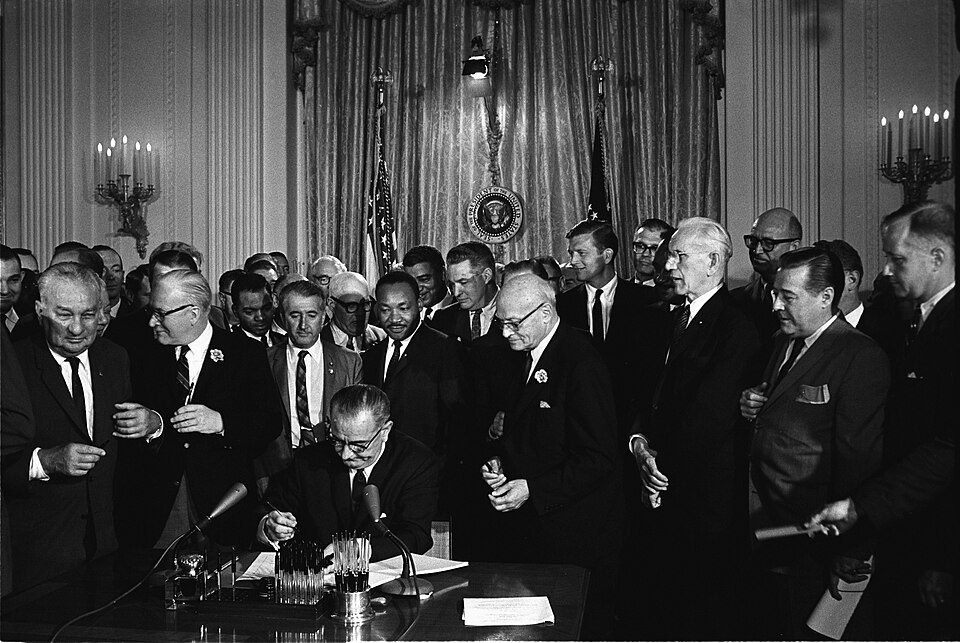
Lyndon Baines Johnson signing Civil Rights Act on July 2, 1964. President Lyndon B. Johnson signs the 1964 Civil Rights Act as Martin Luther King, Jr., and others, look on. Cecil Stoughton, White House Press Office (WHPO), Public domain, via Wikimedia Commons
In 1965, Johnson flexed his political muscle by pushing into seven legislative acts into law the Voting Rights Act, with amendments (1970, 1975, 1982, 1992, 2006); the Housing and Urban Development Act, the Higher Education Act, the Older Americans Act, the Coinage Act, the Social Security Act, which created the twin programs for the elderly (Medicare) and the poor (Medicaid),and the Immigration and Nationality Act.
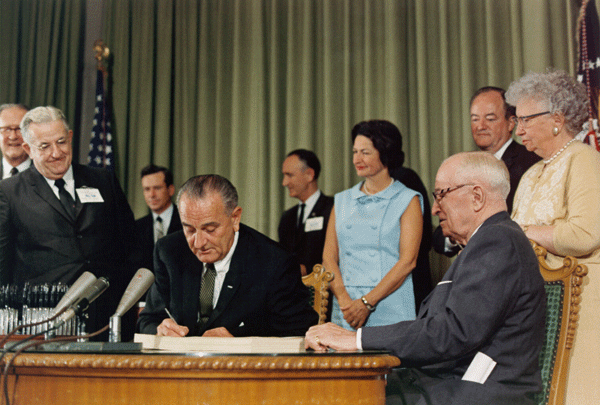
President Johnson signing of the Medicare Bill July 30, 1965 at the Harry S. Truman Presidential Library in honor of Truman who first proposed type of universal health care on November 19, 1945. National Archives and Records Administration, Public domain, via Wikimedia Commons
Having burned through 13 bills in two years, plus another three in 1963, Johnson only did two major bills in 1966, but they were huge: the Animal Welfare Act and the very important Freedom of Information Act, which is heavily used to this day.
Likewise in 1967, at the near height of Vietnam, Johnson only got two blockbuster bills through: the Age Discrimination in Employment Act, and for every parent, nature lover, and music aficionado, the Public Broadcasting Act, which created the Corporation for Public Broadcasting.
Sadly, the Rescissions Act of 2025 took away the Congressional funding, thereby leading to the corporation’s dissolution in 2026. While not the only clear example of erasure, it is one of the more prominent ones that has affected a wide variety of individuals. After all, who did not like Sesame Street, Mr. Rogers’ Neighborhood, Molly of Denali, Big Bird, Barney the Dinosaur, or have children who did? There are entire generations of parents who relied upon PBS to educate and socialize their young children with deep gratitude.
Johnson’s final gifts to American society while in office included the Civil Rights Act of 1968 and its amendments (1968, 1974, 1988, and 2017); the need to make buildings accessible for the disabled with the Architectural Barriers Act, an understanding that our population needed support and therefore, equity for Bilingual Education, and the need for regulation with the Gun Control Act.
Although it was not an official act, if you ever have needed emergency services and picked up the phone to dial 9-1-1, you can thank the plans started in 1968 to put what we take for granted in place.
As we celebrate our semiquincentennial, we enjoy the right to interracial marriage (1967); the right of women to secure credit in their own right (1974), Title IX (1972); additional updates in protection against employment discrimination (1972) with amendments for age discrimination (1974 and 1978).
Johnson’s efforts to shape the nation in a positive manner through legislation reminds us of the positive results from an effective, competent, and ethical leadership which allows our nation to prosper. We are taught in school to love and revere our country in its wisdom and despite its flaws.
We are an experiment, however, which means there are times when things don’t go well. Our current president seeks to retract many of these gains with the assistance of a complicit conservative Supreme Court with a six to three majority in the twenty-first century.
While in office, President Johnson had the assistance of the liberal Chief Justice Earl Warren and the Warren court (1953-1969). It is doubtful that were Johnson attempting to make such changes in the 1970s or in the past 20 years that any Supreme Court challenges would have been successful as the various courts have become progressively more conservative: Chief Justice Warren Berger of the Berger court (1969-1986); Berger’s successor, William Rehnquist and the Rehnquist court (1986-2005); and Rehnquist’s successor, John Roberts, the Chief Justice of the current conservative Roberts court (2005 to present).
Johnson’s actions 60 years ago celebrated the continuation of our nation as conglomerate – a mutt of varied lineage. Unless you were indigenous whose people lived in North America when the various colonies were settled, your people and your ancestors were immigrants who brought with them their individual preferences, prejudices, and religious beliefs.
Johnson’s actions in courage and valor during the 1960s helped our expanded nation take flight as a complete union of fifty states with the admission to the union of Alaska and Hawaii, both in 1959 under President Dwight David Eisenhower.
Johnson exemplified a willingness to put country first, the courage to lead the nation through turbulent era of Civil Rights. His understanding of Congressional politics combined with his exceptional emotional awareness directed his success in pushing through his vision of a Great Society.
Over time each President of the United States has had varying amounts of the following qualities: an understanding that the office requires honesty and the ability to be above reproach and corruption – in short, a person of integrity; a person who has charisma to deal with the variety of peoples who comprise the vast personage present within the United States – in short, someone who knows when and how to work political circles in Congress and with the Supreme Court; someone who has the stamina in body, mind, and spirit to lead for no president has left office without a substantial amount of aging – in short, this is one of the most stressful jobs on the planet; someone who understood true statesmanship with the ability to relate both on an intellectual and an emotional level with other politicians and the American populace.
The most important quality is to be able and willing to put country above party and above financial or personal gain.
To a certain extent, each president from our 47 has exhibited some range of these qualities. Johnson was far from perfect although in comparison with the current occupant of the White House, his actions and mores seem almost saint-like. Our nation’s expectations of presidential power, its limits, and its moral boundaries are far different in 2026 than they were in the 1960s or in 1863 or when our nation was founded in 1776.
Sadly, as nation we must pause to remember or we’ll continue a slide down the path of erasure led by the very government that is the glue to hold our democracy together.
We owe a debt to our ancestors, including the founders of our country. Erasure happens when we forget our origins. At key points in our nation’s history, our country survives thanks to the actions of brave Americans who remind us our truth, our values, and the role of honor. This is why the role of President of the United States requires individuals who choose to put country above self, and valor above selfishness.
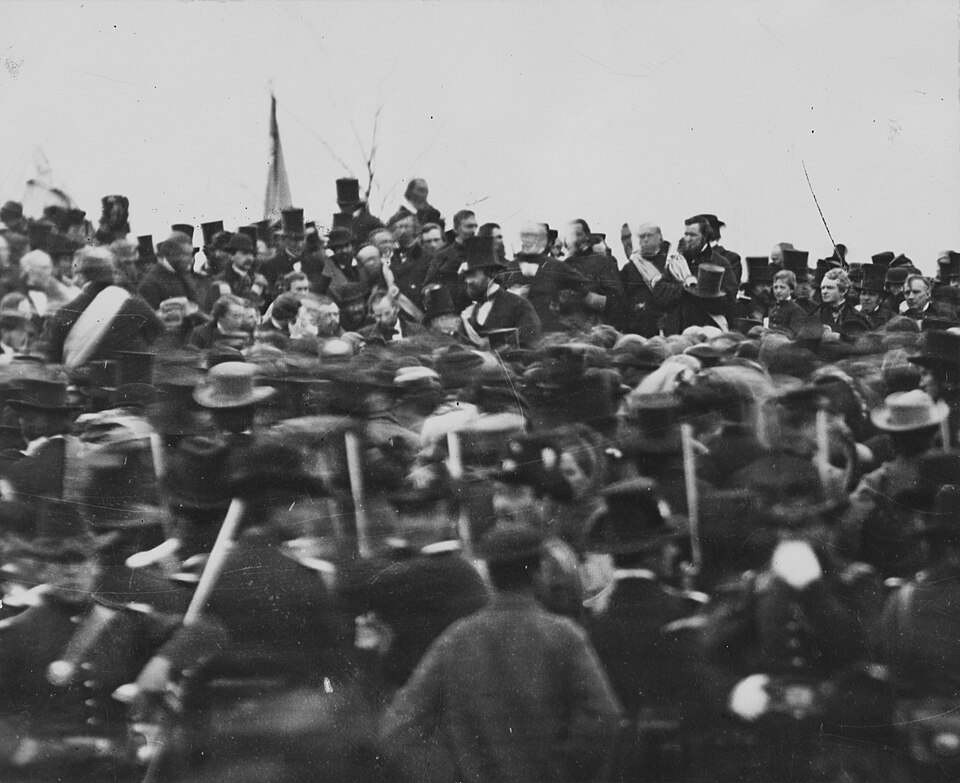
Lincoln at Gettysburg, November 19, 1863 Photographer attributions vary from unidentified (William Frassanito) to Mathew Brady (NARA) and David Bachrach (1845-1921) (Center for Civil War Photography)., Public domain, via Wikimedia Commons
Thirteen years before the centennial of our great nation, President Abraham Lincoln was the last speaker at the Consecration of the National Cemetery at Gettysburg on November 19, 1863. Lincoln’s remarks remain poignant and relevant to this day. The final sentence of the Bliss version of the Gettysburg Address resonates with the goal of honor, values, and what matters for the still fledgeling United States of America:
It is rather for us to be here dedicated to the great task remaining before us—that from these honored dead we take increased devotion to that cause for which they gave the last full measure of devotion—that we here highly resolve that these dead shall not have died in vain—that this nation, under God, shall have a new birth of freedom—and that government of the people, by the people, for the people, shall not perish from the earth.
A sample shows Lincoln’s clear and beautiful writing:
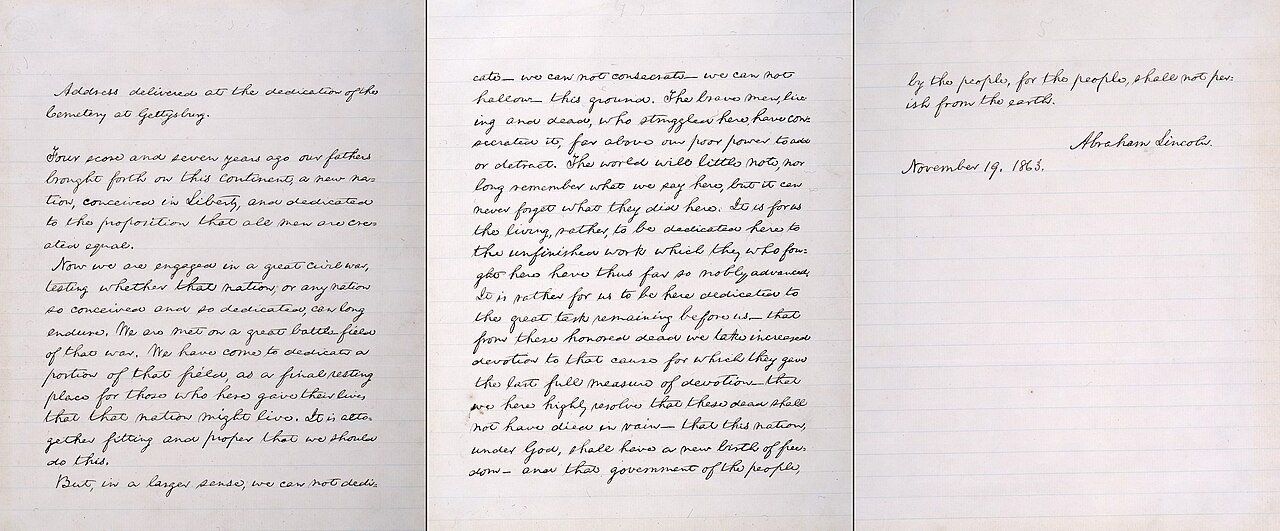
Bliss Copy of the Gettysburg Address White House, Public domain, via Wikimedia Commons
As we approached the bicentennial, younger generations learned American history through a series with catchy tunes called Schoolhouse Rock! series. How many recall the Preamble and the Constitution (1787), not by reading it, but singing it? Add to that other important principles, such as how a bill becomes a law.
The text of the Preamble reminds all of us of what the United States of America truly represents:
We the people, in order to form a more perfect union
Establish justice
Ensure domestic tranquility
Provide for the common defense
Promote the general welfare and
Secure the blessings of liberty to ourselves and our posterity
Do ordain and establish this Constitution for the United States of America.
These seven lines represent promises that our country continues to work towards fulfilling. We join in community as a nation. We enjoin a robust judicial system to resolve disputes in fairness. We attempt to live in harmony with our neighbors, which includes maintaining civil rights in order to provide domestic tranquility. We supported our military as a common defense. We promote free and fair elections with the aspect of one ballot per person where all citizens are equal. Finally, as Americans we are entitled to protection of freedoms both at the time of the writing of the Constitution and in the present day for ourselves and our descendants.
Of all the statements of the Preamble, this is the most precious and valuable aspect of our constitution: our freedoms.
To this end, the blessings of liberty includes ensuring that any legal precedents made by the Judicial Branch would hold and shape liberties which apply to any and all within the United States.
As a democratic experiment, the United States is still a work in progress. The last line of the Declaration of Independence in 1776 remains a goal for every American:
And for the support of this Declaration, with a firm reliance on the protection of divine Providence, we mutually pledge to each other our Lives, our Fortunes and our sacred Honor.
While each of us is not a founding father, we pledge as citizens or those who reside in the United States pledge to work to maintain our democracy, our integrity, and our principles as Americans. By accepting ourselves as part of this country, we pledged ourself its growth and success, even if we were not running for political office.
When we view our most cherished emblem: the Statue of Liberty in New York harbor we are reminded of our goal in supporting the democracy where we live. Officially known as “Liberty Enlightening the World”, its presence reminds us that our nation is built on the embrace of liberty and the freedoms it promises.
These seven lines are seven promises that we cling to as a nation, especially at this time of erasure.
With the seventh, we put our will and our plans into effect as the start of a new nation.
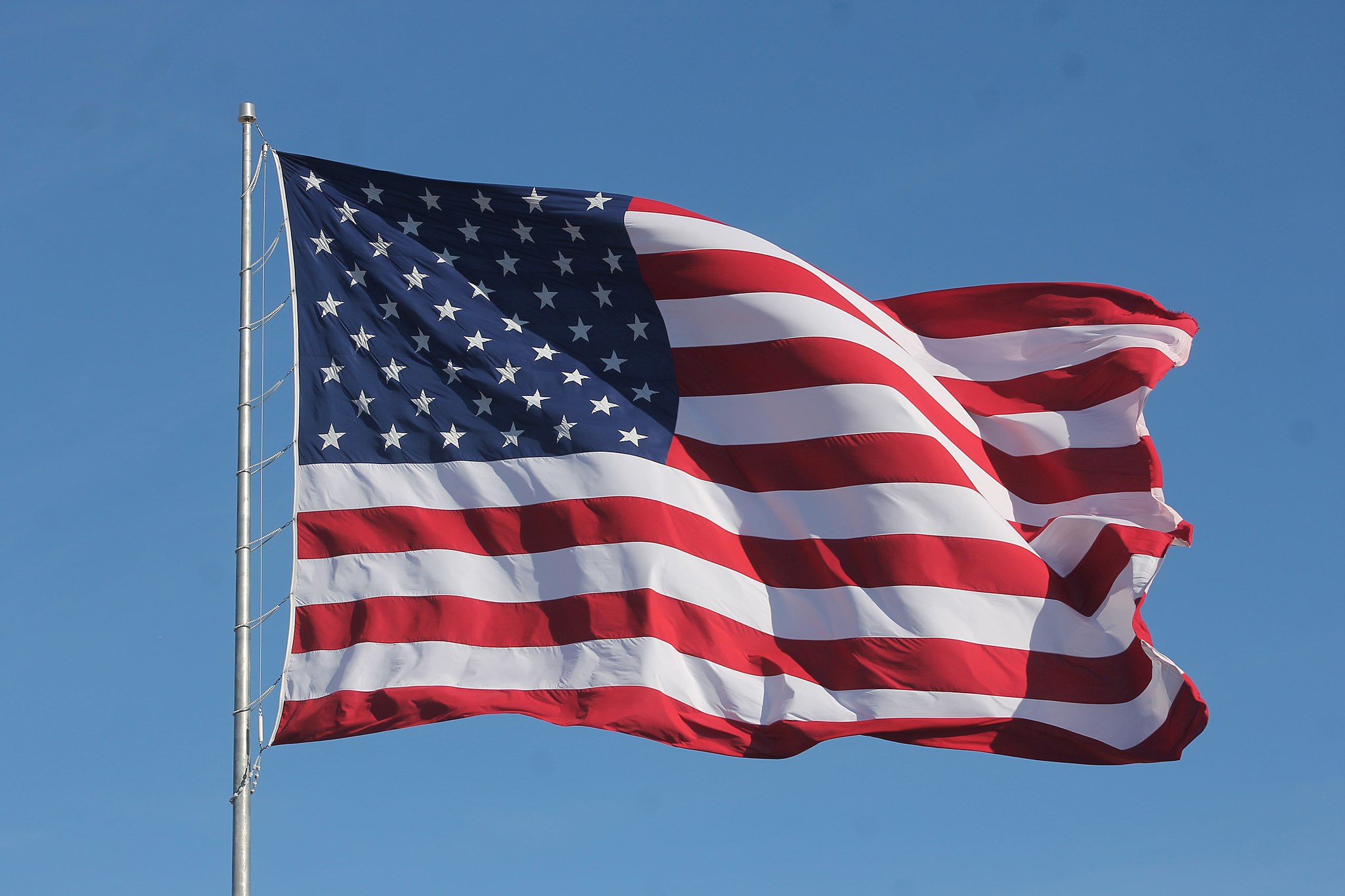
So in 2026, we continue striving to regain the ethical backbone that formed the foundation of this country. Without it, we destroy our nation through erasure of what truly matters to all Americans. On this day, our successful separation from our old path as colonies and our embrace of reality as a new nation. The message of the Declaration of Independence, the Bill of Rights, the U.S. Constitution, and the work of various presidents is clear: even as we celebrate with family, friends, and fireworks, we must continue to fight because justice never takes a holiday.
We are Americans – we are optimistic and we never give up.
Happy Fourth!
The Wild Hunt is not responsible for links to external content.
To join a conversation on this post:
Visit our The Wild Hunt subreddit! Point your favorite browser to https://www.reddit.com/r/The_Wild_Hunt_News/, then click “JOIN”. Make sure to click the bell, too, to be notified of new articles posted to our subreddit.