

Today’s offering is a letter submitted on behalf of several Heathen organizations.
In 2025, leaders from The Asatru Community, The Fellowship of Fire and Ice, Heathens Against Hate, The Troth, and Urglaawe International began talking seriously about what an organized coalition of Asatru, Heathen, and Norse Pagan groups could do for people around the world.
The question before us was not only how to coordinate our messaging. It was how to coordinate programs, resources, clergy support, educational tools, and public witness for the shared benefit of Heathenry itself.
There were reasons this had never been done before, even though so many had suggested it. There were years of mistrust to address. There were old attacks, old wounds, bad blood, and real harms to name. This was not easy work.
And it is not always easy to maintain. We do not all agree on every message. We do not all sign the same statements. We argue. We debate. Sometimes we act jointly. Sometimes we act separately. Even so we do this work openly, as people who understand that Heathenry’s future will not be built by pretending our differences do not exist.
This alliance is built on mutual interest, mutual respect, and an ironclad commitment to a universally accessible Heathenry which is open to everyone who is called to it.
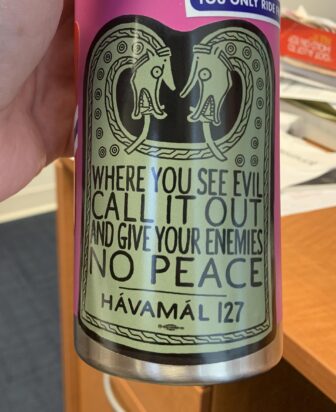
Hávamál 127 sticker from Hearth Kvlt [E. Scott]
Heathenry is a family of living religions rooted in relationship: with the gods, with the spirits of the world around us, with our ancestors, with our communities, and with our fellow human beings. It asks us to seek wisdom, to speak truthfully and kindly, and to do healing deeds. It calls us into reverence for life, spiritual and physical alike. It also asks us to endure hardship, engage in sacrifice, and to take risks when such actions are needed to ensure these values are upheld. This reverence is a sacred responsibility, and because of this, we utterly reject the false doctrine of Folkish belief.
Folkism teaches that the soul itself is encoded with race. It teaches that belonging is bestowed by blood alone. It transforms racism into theology and exclusion into piety. It tells people that divine relationship is only conferred through whiteness, as though the gods were small and petty enough to be contained by the categories of modern racial politics.
We reject that.
We reject it because it is morally wrong. We reject it because it is spiritually false. We reject it because it has harmed real people in our communities. We reject it because it diminishes the holy powers and turns them into little more than racial mascots. And we reject it because the evidence that the gods call whom they will is already before us.
They have called people from the Philippines, Kenya, Costa Rica, Brazil, Thailand, South Africa, the United States, Europe, and far beyond. They have called people from all extractions and backgrounds all around the world. Wherever the names and the fame of our gods has spread, there we have found people who want to enter into a relationship with them. Northern Europe may be the cradle in which these traditions first took recognizable historical form, but Heathenry has grown beyond that cradle.
It now walks the whole of the Earth.
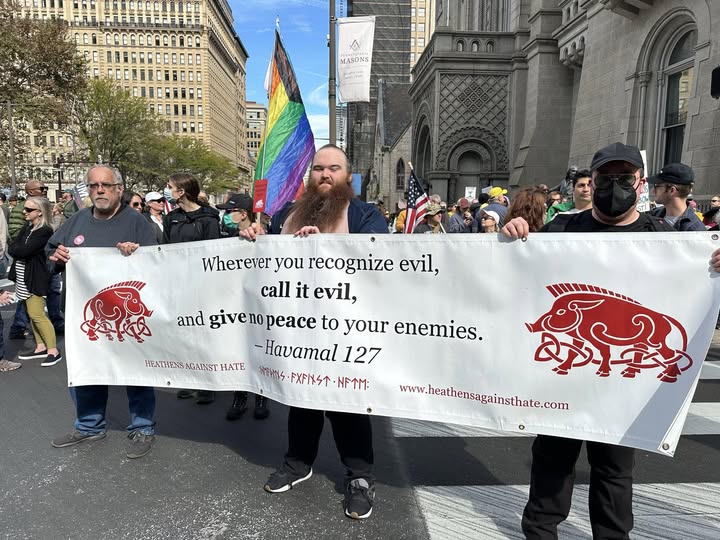
Heathens Against Hate in Philadelphia [Image Via public HAH Facebook]
Folkish belief is not a harmless difference of opinion. It cannot merely be dismissed as “whatever floats your boat.” It is chosen, taught, defended, organized, and enacted. It does not remain abstract. It shapes who is welcomed, who is watched, who is warned away, who is denied leadership, who is told they do not belong, and who learns to remain silent for fear of what might happen if they speak.
Many of us remember the years when people tried to build Heathen spaces broad enough to include the Folkish alongside everyone else. We remember what community those compromises produced.
We remember biting our tongues. We remember the fear of confrontation. We remember people from marginalized communities being pulled aside and told not to return. We remember the excuses made for racist speech, racist symbols, and racist organizing. We remember communities that asked the harmed to be patient with those harming them.
Even as our communities were forced to make way for the Folkish, the Folkish actively refused to reciprocate. Whatever space they could take, they filled. They advocated for allying with white supremacist groups, supported silencing Heathens for worshiping gods they did not approve of, and stood in lockstep with Christian Nationalists when it came to opposing women’s rights, LGBTQIA+ rights, or the equal protections of Black, Indigenous, Latino, and other people of color.
Their vision of compromise was nothing less than our total submission. The Folkish were free to do as they pleased and everyone else was free to do what the Folkish allowed.
In this sense, Declaration 127 was not merely a condemnation of behavior or words we didn’t like. It was our liberation. It said that Heathens should no longer have to organize around the comfort of racists. It said that we would no longer shrink our communities to avoid offending the bigoted. We didn’t need them to forge our way in this world.
From now on: we will do this our way.
Declaration 127 was never only about what we reject. It was, and remains, a statement where we began to finally talk about who we are.
We are Heathens, Asatruar, and Norse Pagans who believe the gods are powerful enough, wise enough, and generous enough to call people from every people and every nation. We believe that those who answer that call can live in right relationship with the gods, the spirits, the ancestors, the land, and one another. We believe our communities are stronger when they are built on reverence, courage, hospitality, accountability, and truth.
We will not abandon our friends, our clergy, our children, our elders, our LGBTQIA+ kin, our BIPOC kin, our disabled kin, our incarcerated kin, our military kin, our immigrant kin, or anyone who seeks the gods in earnestness.
We will not go back. We will not move from this point. And we will not be made into the problem for taking a stand where the gods demand we stand.
This matters now because Pagan communities are facing real pressures in public life. Religious minorities are still fighting for visibility, dignity, and equal treatment in institutions that often do not understand us. When Pagan, Heathen, Wiccan, Druid, and other minority religious designations disappear from official systems, it is not an abstraction. It affects chaplaincy, accommodation, data, recognition, and the ability of people to be seen accurately by the institutions that govern their lives.
We also know who the Folkish have long sought to be in coalition with. In 2016, when the rest of Heathenry was coming together to reject bigotry, Stephen McNallen, the founder of the Asatru Folk Assembly, instead turned to the ascendant Christian Nationalist movement:
“All I ask is, first: respect my religion, and I’ll respect yours. And second: work with us for the attainment of our common goal: the awakening of our people. We’ve heard the slogan, ‘No more brother wars’ for decades now, and we need to expand that to include ‘No more religious brother wars.’ Our struggle is about the existence and the destiny of our people, not about religion.”
This was despite the clearly stated preference of Christian white supremacists for a Christian Nationalist state which bans all non-Christian forms of spirituality, the dismissal of religious practice by atheistic white supremacists, and the general disdain held for the Folkish by many other white supremacist groups.
“Respect my religion,” they beg.
Well, certainly those of us with any clue have been thoroughly disabused of any illusion that such respect was ever going to be in the cards. Heathens were never going to be given a seat at their table. We were always on their menu.
And yet these are the hands the Folkish would gladly shake over ours?
It is clear that given the choice, the Folkish would sooner serve us all up to the devouring Nidhogg of White Nationalism rather than reject racism and join with us. It is clear who they think their friends are, even when those so-called friends gleefully fantasize to see them once again converted by the sword.
This is why a real coalition matters, real interfaith work matters, and why we have worked so hard together to make a coalition of inclusive Heathenry happen.
It is not enough to issue statements. We need durable institutions. We need consistent clergy training. We need conflict resolution systems that protect the vulnerable. We need educational resources that are accessible to all. We need meaningful interfaith relationships. We need vigorous public advocacy. We need communities that can receive newcomers without exploiting them. We need organizations strong enough to survive disagreement without collapsing into suspicion, gossip, or factional war.
Solidarity is not sameness. It does not require every organization to speak with one voice on every issue. But it does require enough trust, honesty, and shared purpose that we can work together where the work is necessary.
We began this coalition because the future of Heathenry will be built by us, not by them. It will be built by those of us willing to do the harder work: healing old harms, telling the hard truths, making amends where needed, building durable institutions worthy of trust, and opening the doors to all whom the Gods call.
If those who have embraced Folkism renounce racism, make amends for the harm they have caused, and return to right relationship with their fellow human beings, then restoration is possible. Heathenry contains room for reconciliation, repair, and changed hearts.
But without rejection of racism, there can be no repair. Without repair, there can be no reconciliation. Without reconciliation, there can be no frith.
And so there shall be no frith with folkism.
- Alix du Rhin, The Troth
- Benjamin Kowalsky-Grahek, The Troth
- Garrett White, Heathens Against Hate
- Miche Nickolaisen, Heathens Against Hate
- Robert L. Schreiwer, der Urglaawe
- Ryan Smith, The Fellowship of Fire and Ice
- Stacey Lynne Stewart, der Urglaawe
- Suzannah Eggleston, The Asatru Community
The Wild Hunt is not responsible for links to external content.
To join a conversation on this post:
Visit our The Wild Hunt subreddit! Point your favorite browser to https://www.reddit.com/r/The_Wild_Hunt_News/, then click “JOIN”. Make sure to click the bell, too, to be notified of new articles posted to our subreddit.