
Veneralia
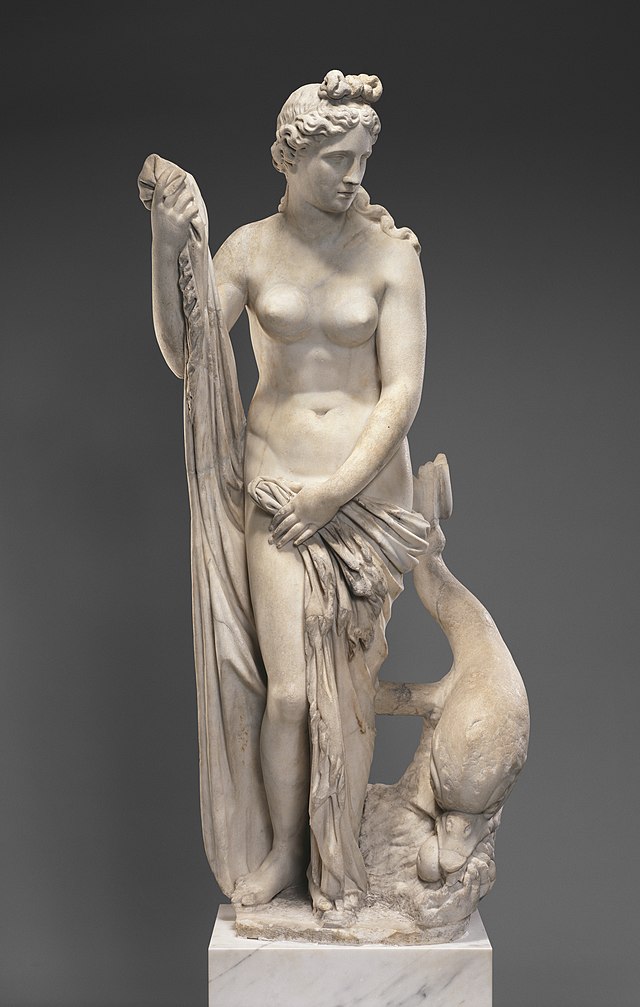
Mazarin Venus Courtesy: J. Paul Getty Museum
The Veneralia, celebrated annually on April 1 in ancient Rome, was a festival dedicated to the intertwined powers of love, beauty, and fortune through the goddesses Venus Verticordia (“Venus the Changer of Hearts”) and Fortuna Virilis (“Manly Fortune”). The festival continues to be celebrated by many modern Pagans and polytheists today.
While Venus stood at the center of the observance as the embodiment of desire, attraction, and emotional transformation, Fortuna’s presence reflected the unpredictable role of luck in relationships and social life. Together, they represented both the emotional and circumstantial forces that shape human connection.
The title Venus Verticordia emphasizes the goddess’s moral and transformative dimension. She was not only a figure of sensual love but also a guide who could “turn hearts” away from vice and toward fidelity and virtue. Women in particular sought her favor, asking for harmony in their relationships, increased attractiveness, and emotional renewal. Fortuna Virilis complemented this by being invoked for favorable perception, especially the hope that men might look kindly upon women, overlooking perceived flaws. This pairing reveals a nuanced Roman understanding of relationships as a balance between inner character and outward fortune.
Rituals associated with the Veneralia were both public and personal. Statues of Venus were ceremonially washed and adorned with garlands of roses and myrtle, symbols of love and beauty. Offerings of incense, flowers, and sometimes food were made, and women visited the baths as part of purification rites. The day also carried a social, interpretive function: it was a time for reconciliation, when estranged lovers or spouses might seek to repair bonds, aligning personal renewal with divine blessing.
In contemporary Pagan practice, the Veneralia continues to resonate as a celebration of love in its many forms. Modern observances often adapt ancient elements, incorporating ritual baths, devotional offerings, and creative expression such as poetry or art. Practitioners may focus on self-love, emotional healing, and the renewal of relationships, reflecting Venus’s enduring role as both muse and mediator. Through these evolving practices, the spirit of the Veneralia persists as a moment of reflection, beauty, and heartfelt transformation.


A skull in shadows [Kabe32, Pixabay
ATAPUERCA, Spain — A newly analyzed fossil from northern Spain is offering an unprecedented glimpse into the earliest known human presence in Western Europe. Researchers working at the Sima del Elefante cave site in the Atapuerca Mountains have identified fragments of a skull—nicknamed “Pink”—dating to between 1.1 and 1.4 million years ago, making it the oldest known human face in the region.
The fossil, catalogued as ATE7-1, consists of part of the upper jaw (maxilla) and cheekbone (zygomatic bone) from the left side of an adult individual. Despite its fragmentary nature, the specimen provides critical anatomical information. According to the study published in Nature, the find allows scientists to reconstruct aspects of early facial morphology and better understand how the first humans in Europe may have looked.
The Atapuerca site has long been central to the study of early Europeans, particularly through discoveries linked to Homo antecessor, a species believed to have inhabited the region roughly 800,000 to 1.2 million years ago. However, the newly identified fossil appears to represent an even earlier population. Researchers suggest that “Pink” shows affinities with Homo erectus—the first hominin known to migrate out of Africa—leading them to classify it as Homo affinis erectus, or a form closely related to H. erectus.
This distinction is significant. It suggests that Western Europe may have been populated by multiple waves of early humans, rather than a single lineage. The morphology of the fossil—less derived than H. antecessor but more advanced than earlier African ancestors—hints at a transitional population that could help bridge gaps in the evolutionary timeline.
The discovery also comes amid a broader wave of breakthroughs in paleoanthropology. Just months earlier, researchers extracted the oldest known DNA from modern humans at a site in Ranis, Germany, further reshaping understanding of early human dispersal across Europe.
Together, these findings reinforce the idea that Europe’s human history is deeper and more complex than once thought. The face of “Pink,” though incomplete, offers a rare and tangible connection to some of the continent’s earliest inhabitants—individuals whose journeys ultimately shaped the course of human evolution.
New Project by Heathen Poet
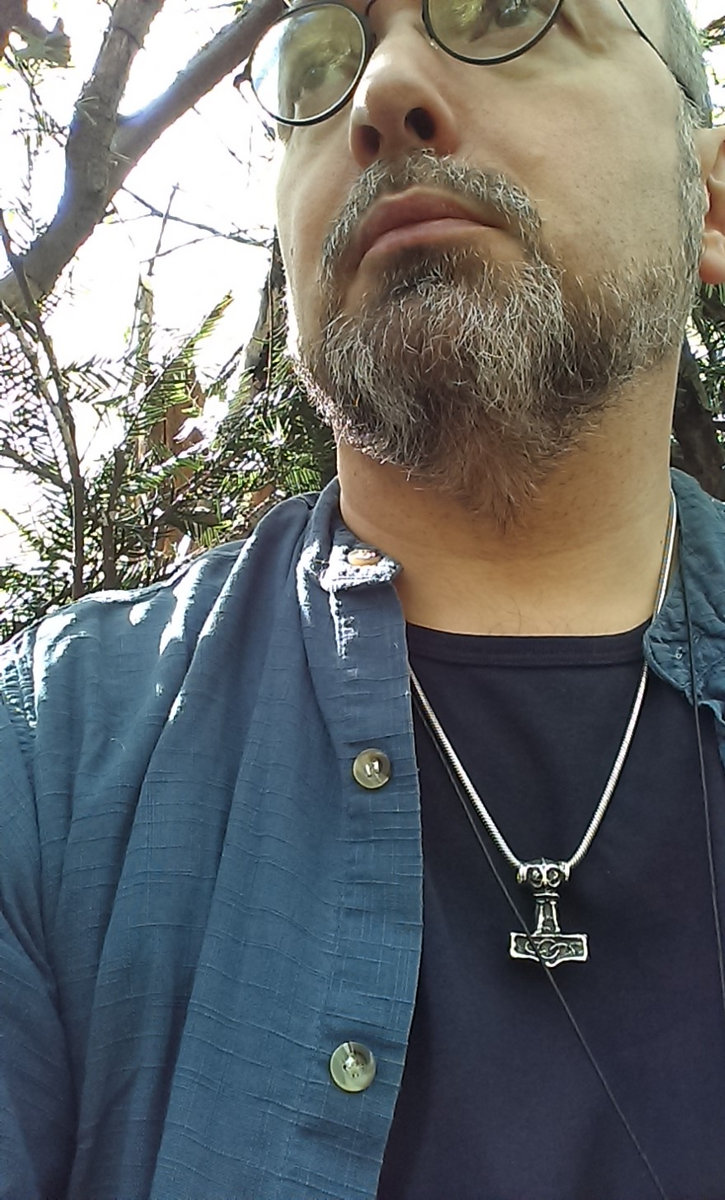 Math Jones, a longtime British Heathen poet, recently announced the conclusion of his latest project: a reworking and recording of the Gylfaginning section of Snorri’s Edda. Found in various forms through a handful of medieval manuscripts, Gylfaginning is the section of Snorri’s Edda that transmits the most mythological narratives out of the entire work.
However, unlike the largely versified sections of Skáldsaparmál and Háttatál, Gylfaginning was written in prose and thus departs from the traditional form most mythological lore would have been preserved in pre-Christian Scandinavia. Jones, who has been dabbling with ancient Germanic alliterative poetry for a few decades now, decided to remedy this by reworking available English translations of Gylfaginning into alliterative verse inspired by skaldic and eddic poetry.
The result, although somewhat destabilizing at first for those familiar with the original prose, is enlivened by Jones’ dynamic diction, his mastery of rhythms, as well as clever stylistic choices such as rendering most Old Icelandic names as common modern English-language substantives. Released on February 18, the whole album is available for streaming and downloading via bandcamp. Jones aims to eventually follow up this work with a poetic reworking of this time, the prose sections of Skáldsaparmál. Info available via Bandcamp.
SPIRAL MOON MEDIA GROUP LAUNCHES CREATOR ALLIANCE AND CREATOR NETWORK TO EMPOWER PAGAN VOICES IN A FAIR, SOVEREIGN DIGITAL ECOSYSTEM
Thank you! Thank you! Thank you!
If you’ve been thinking about supporting The Wild Hunt, now is the time.
👉 This is how you can help:
Tax-Deductible Donation
PayPal
Patreon
As always, our deepest gratitude to everyone who has brought us this far.
Events and Announcements
Do you have news to share with our community?
Announcements? Festivals? Elevations? Events?
We’ll share it with the community in the
TWH Events Calendar featured on the Front Page.
(Yes, it’s free, we just need your information.)
Let us know at pcn@wildhunt.org
More Events at our new Events Calendar
Tarot of the Week by Star Bustamonte
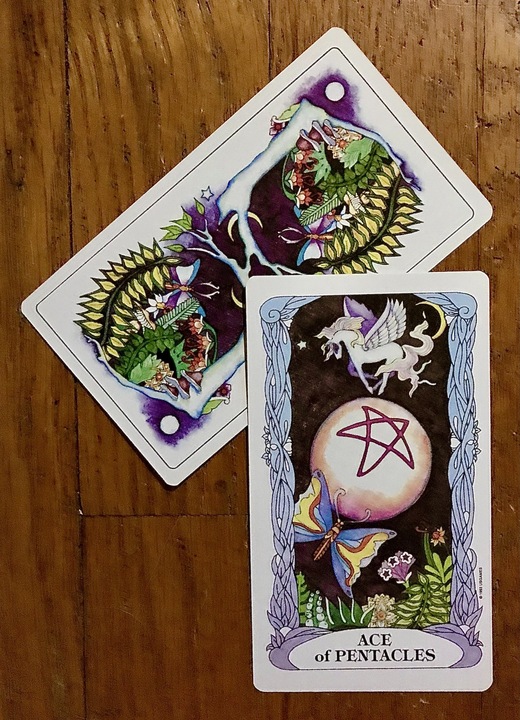
Deck: Tarot of a Moon Garden, paintings by Karen Marie Sweikhardt, instructions by Laura E. Clarson, published by U.S. Games Systems, Inc.
Card: Ace of Pentacles
This week, there is likely to be a continued focus on finances, and wealth—both material and spiritual. There is the potential for new opportunities in increasing financial sources, particularly when it comes to picking up side jobs or projects that are liable to provide a good return for the effort expended. Spiritually, openings for expanding not only how spiritual practices are conducted but also exploring new ways to magically apply what is being learned.
Conversely, all that glitters is not gold. And even if it is actually gold, it does not guarantee that obtaining it will result in happiness. There is also the likelihood of indecision resulting in missed opportunities, but deals that seem to be too good to be true should probably be avoided. Due diligence should be performed before signing on to any new deals, no matter how great they might seem at first.
👉 Don’t forget: supporting The Wild Hunt helps sustain independent Pagan journalism.
Tax-Deductible Donation
PayPal
Patreon
As always, our deepest gratitude to everyone who has brought us this far.
Let the envious burst!
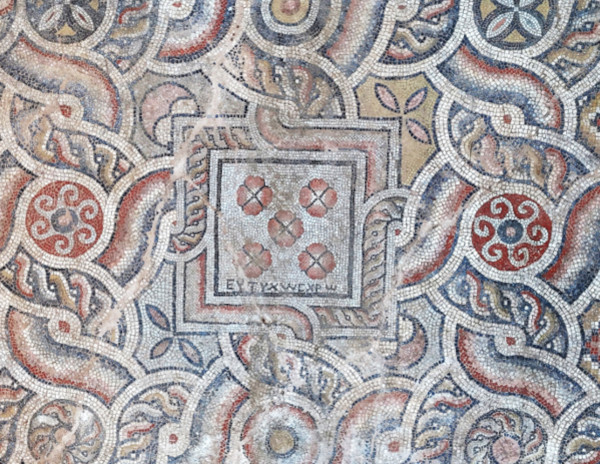
In Seydra, the Greek inscription reading “Use it with joy! is a mosaic welcoming visitors to the building . [ Photo courtesy of the General Directorate of Cultural Heritage and Museums
Archaeologists working in the ancient city of Syedra have uncovered a remarkably well-preserved mosaic that is shedding new light on daily life, symbolism, and belief in the late Roman period. The mosaic, discovered within a bath complex, features vivid geometric patterns alongside inscriptions and symbolic imagery that suggest both decorative and protective functions.
At the center of the find is a striking panel bearing Greek inscriptions, including the phrase “Let the envious burst!”, a well-known apotropaic expression intended to ward off envy and the “evil eye.” Accompanying this is another message, often translated as “Use it with joy!”, which offers a welcoming and celebratory sentiment to those entering the space. Together, these phrases reflect a dual purpose: protecting visitors from ill will while encouraging enjoyment of the communal setting.
Rather than a simple moral warning, the inscriptions point to a widespread ancient concern with envy and social visibility. In bathhouses—spaces where people gathered, relaxed, and were seen by others—such messages would have carried particular resonance. The combination of protective and inviting language suggests an environment that was both socially vibrant and spiritually guarded, where beauty, leisure, and unseen forces were understood to coexist.
Scholars note that inscriptions like these served as both decoration and embedded ritual intent, integrating belief into everyday public architecture. The mosaic’s placement suggests it may have functioned as a subtle safeguard, reinforcing shared cultural anxieties about reputation, status, and interpersonal dynamics while also framing the space as one of pleasure and well-being.
The mosaic’s craftsmanship is notable for its precision and durability. Composed of thousands of small tesserae, the design has retained much of its original color and structure despite centuries of burial. Its geometric motifs align with broader trends in late Roman decorative art, where symbolic meaning was increasingly woven into architectural design.
Researchers emphasize that findings like this contribute to a deeper understanding of how ancient communities communicated values and identity through shared spaces. The Syedra mosaic stands not only as a work of art but also as a message preserved across time—one that continues to speak to the human concern with behavior, reputation, and social harmony.
The Wild Hunt is not responsible for links to external content.
To join a conversation on this post:
Visit our The Wild Hunt subreddit! Point your favorite browser to https://www.reddit.com/r/The_Wild_Hunt_News/, then click “JOIN”. Make sure to click the bell, too, to be notified of new articles posted to our subreddit.