

Author’s note: More than likely, some spoilers ahead.
Our collective memory of Homer is a strange thing. Ask someone who knows a bit about Greek myth, but hasn’t read the Iliad, what it’s about, and they will tell you of Achilles, the great hero who is invulnerable but for a single spot on his ankle. And ask the same person of Odysseus, and after they tell you of his long journey home, full of grotesque monsters and seaborne peril, they may remember that it was Odysseus who devises the Trojan Horse, the ploy which allows the Greeks to sack the holy city of Troy and end their decade of war. Homer’s story of Achilles ends before the hero’s death, and his tale of Odysseus barely mentions the horse, but no matter; all these centuries later, these are the stories we think we know, the stories we expect to hear.
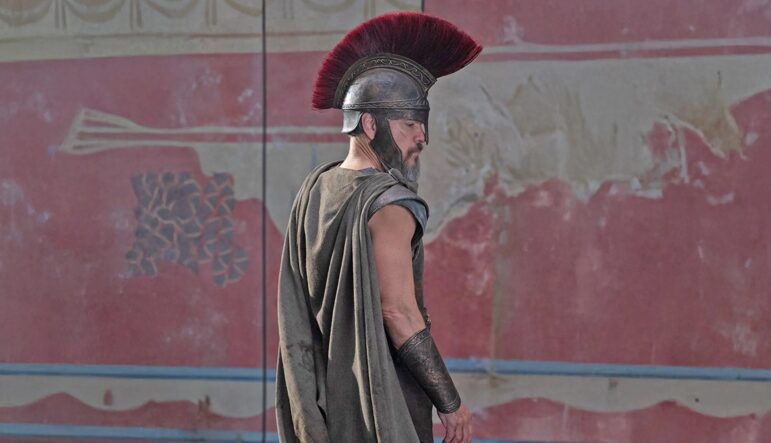
Matt Damon as Odysseus in Christopher Nolan’s THE ODYSSEY (2026) [Universal]
Christopher Nolan’s new adaptation of The Odyssey seems, at first, like a faithful disappointment. The opening of the film, like the opening of the poem, focuses not on Odysseus (Matt Damon), but his son, Telemachus (Tom Holland), and his attempts to assert his nascent manhood against the dozens of suitors who have taken up residence in his father’s hall in the 20 years since he left for Troy. The suitors are purportedly there to woo Odysseus’s wife Penelope (Anne Hathaway), but it’s clear that most of them don’t care about actually winning her hand — they just enjoy the excuse to laze about and consume her food and wine. Only their leader, Antinous (Robert Pattison) seems to actually desire the queen, but though he puts on a good show of genuine desire for her as a person, even he really only desires the wealth and prestige that would come with entering her bed.
I can see a good script coming together around the political intrigues of Ithaca in Odysseus’s absence, but frankly the opening scenes of this film are not that script. The dialogue has an odd incongruence, as the characters broadly speak in an elevated, theatrical tone, but also call Odysseus “Daddy,” with all the hypermodern psychosexual implications that carries. It feels like a blessing when Telemachus gets out of Ithaca, en route to Sparta, where he (and we in the audience) hope to learn more about his father.
When we meet Odysseus, old and bedraggled, he is living on a deserted beach with Calypso (Charlize Theron), absent-mindedly collecting driftwood and bolting down lotus petals that numb away his memory of how he came there. Diaz’s Calypso is mysterious but benevolent, a caretaker content to let Odysseus figure out in his own time what has happened to him and what he is to do next. This is a considerable change from Homer, where Odysseus, there a captive of a goddess who does not wish to let him go, knows full well what has happened to him and weeps for the home he has lost.
Odysseus’s most famous characterization is that of the wily schemer, a hero who, while strong and tough, is best known for his cunning. Homer’s first description of him, πολύτροπος, has been variously translated, from “wound with wisdom” (Chapman, 1615) to “sagacious” (Bryant, 1871), to “versatile” (Ress, 1960), to, famously, “complicated” (Wilson, 2017). (My favorite will always be Robert Fagles’s “the man of twists and turns,” from the 1996 translation that was my first encounter with the Odyssey.) Damon’s Odysseus, however, only rarely displays this sense of duplicity or underhandedness. Instead, his prevailing trait is that he is haunted by what he has seen and done, especially by the deaths he has caused or failed to prevent. Indeed, he seems to think those two categories are much the same.
My feelings about the film pivoted on a question Odysseus asks of Calypso: why don’t I want to go home? In Homer, there’s no question, at least not on the surface: Homer’s hero, as mentioned, spends every day for the years he is Calypso’s captive crying at the memory of Ithaca and Penelope, and happily rejects immortal comfort with the nymph to return. But even in Homer, the question, while unspoken, is there: if home means so much to you, then why does your every turn take you farther from it? Nolan says it aloud, much as Tennyson and Cavafy did:
Keep Ithaka always in your mind.
Arriving there is what you’re destined for.
But don’t hurry the journey at all.
Better if it lasts for years,
so you’re old by the time you reach the island,
wealthy with all you’ve gained on the way,
not expecting Ithaka to make you rich.
There’s nothing Odysseus wants more than to return home, and also nothing he wants more than to avoid that homecoming; that tension is at the heart of Nolan’s film, and fuels its dreadful, inevitable climax.
Author’s note: Really, this is where there’s spoilers.
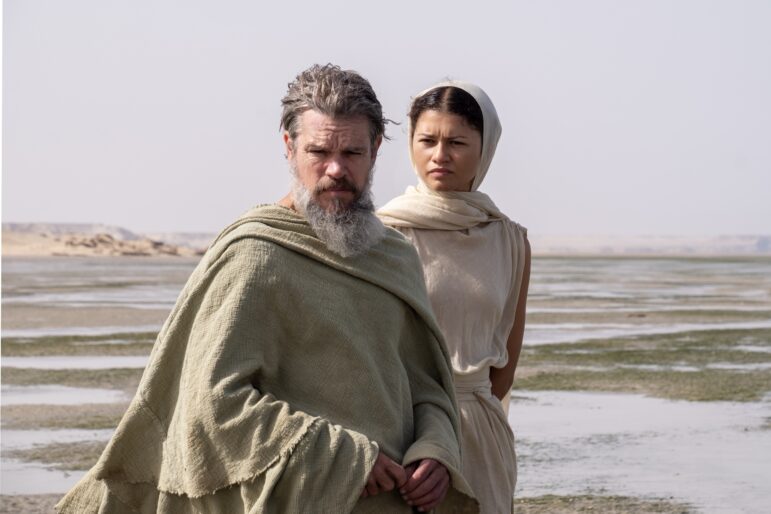
Matt Damon as Odysseus and Zendaya as Athena in Christopher Nolan’s THE ODYSSEY (2026) [Universal]
“What if one night, in a strange city,” Odysseus asks of himself late in the film, “he saw something that made him think his home was no more?”
For Nolan’s Odysseus, the answer is that he feels he has destroyed his home, has destroyed everybody’s home, by enabling the Greeks to destroy the Trojans. It’s not simply that the Greeks prevailed in war; it’s that they created a gift, the horse, and invited the Trojans to bring that gift into their city – indeed, to the sacred ground of the temple of Athena. And having offered that gift, the Greeks betray its intent, slaughtering the Trojan guards and opening the gates to allow their armies to storm and sack the city, a nightmare of blood and fire. The Greeks have broken the code of xenia, referred to constantly in the film as “Zeus’s Law,” and in doing so, they have broken all of civilization.
Before any viewer thinks this is a wholly modern intrusion about the heroic narrative, it’s worth noting how Homer describes Odysseus’s reaction to a song of the Trojan Horse while at the court of Alcinous, shortly after escaping Calypso:
But the heart of Odysseus was melted and tears wet his cheeks beneath his eyelids. And as a woman wails and flings herself about her dear husband, who has fallen in front of his city and his people, seeking toward off from his city and his children the pitiless day; and as she beholds him dying and gasping for breath, she clings to him and shrieks aloud, while the foe behind her smite her back and shoulders with their spears, and lead her away to captivity to bear toil and woe, while with most pitiful grief her cheeks are wasted: even so did Odysseus let fall pitiful tears from beneath his brows.
The idea that Odysseus has what we might today call post-traumatic stress disorder following his actions in Troy is not something original to Nolan.
Like many modern adaptations of Greek epics, the gods are mentioned but quite absent in Nolan’s Odyssey. While Homer often shows us the gods directly intervening in the lives of heroes, here, Odysseus’s crew “becomes convinced” that he has angered Poseidon, who has driven them off course, and they are told that the sun god (here named as Apollo) drives his cattle on the isle of Thrinacia, but the gods do not themselves appear. It is left ambiguous whether or not Odysseus and his crew’s suffering truly comes at the hands of the gods, or if that is just a superstitious explanation for the calamities that befall them.
(Which is not to say that Nolan’s film disclaims magic or the supernatural altogether — the monstrous Cyclops, the hulking Laestrygonians, and the witch Circe are all quite real, perhaps more real than in Homer, since in Homer we only have Odysseus’s descriptions to go on while here the camera depicts them as inarguable. Nor is there much question about whether Odysseus’s men are really swallowed by Scylla, or if they actually visit the dead in Hades — indeed, one of Odysseus’s dead retainers (Elliot Page) provides a crucial and very material object that figures into the story’s conclusion. It’s only the gods who are left to the imagination.)
The only great god we meet in person is Athena (Zendaya), a figure only Odysseus sees, a young woman dressed in white who mainly appears to shake her head at him in disappointment. At first I found this annoying, a diminishment of Athena’s role as Odysseus and Telemachus’s patron and co-conspirator in the poem. But Zendaya is the subject of the film’s most searing shot, the fulcrum around which everything else turns. It’s rare that a director and a performer can create a moment that reveals every mediocre moment prior as something deliberate and brilliant, but Nolan and Zendaya have accomplished it here.
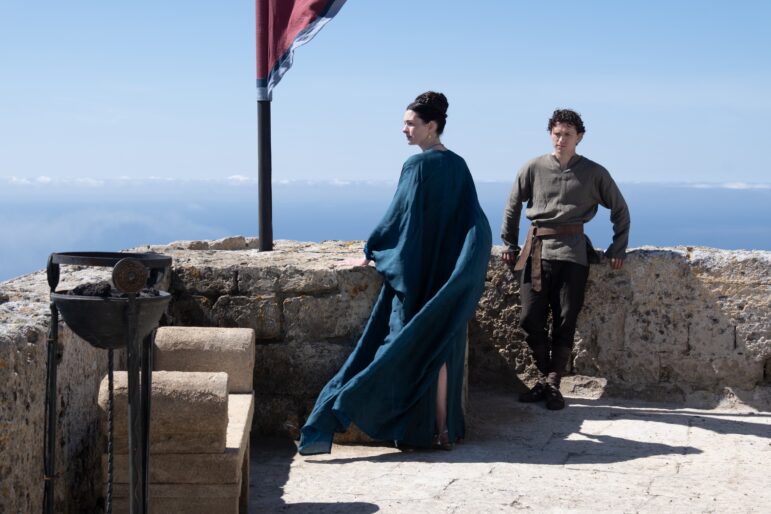
Anne Hathaway as Penelope and Tom Holland as Telemachus in Christopher Nolan’s THE ODYSSEY (2026) [Universal]
The film’s finale ends up as a recapitulation of the horrors at Troy. Just as the sack of the city begins with murder at the temple of Athena, so does Odysseus’s bloody return to Ithaca begin at Athena’s temple at Pylos. Odysseus’s revenge on the suitors is less a triumphant return of the rightful king and more a final dissolution of the concept of homecoming. Notably, despite the film offering many justifications for Odysseus’s revenge — the suitors break Zeus’s law constantly by mistreating beggars, conspiring against the prince, even literally kicking old dogs — Odysseus sends himself into exile in the aftermath, both as punishment for his deeds and as reward. This Odysseus never actually returns home from the war.
Certainly I feel tempted to read all this as allegory. It feels as though the world has turned nativist and duplicitous, that we are breaking Zeus’s law of xenia every day, and perhaps this will lead to the end of our civilization, too. Our everlasting wars abroad have returned home and brought with them grief and death and the sense that nothing will ever again be as it was.
It’s not a perfect metaphor: Nolan treats the Greeks who went to Troy as liars who broke the law of the gods, but those who remained home at Ithaca are treated as cowards and oathbreakers, so it’s not clear whether it’s better to go off to war or to stay home and avoid it. And the “end of civilization” would appear to come not by civil war among the Greeks but by invasion from the Sea Peoples – a reference to the Bronze Age Collapse that occurred between the mythical time of the Trojan War and the time of the Odyssey’s composition (around the 8th century B.C.E.) The Sea Peoples are a historical entity, yes, but also, in this film, they are foreign barbarians, come to snuff out the light of civilization — as with much of Nolan’s work, there’s plenty of space for a reactionary reading of this film too.
The breadth of interpretation speaks to the accomplishment of the film. I spent the first hour or so impressed by the visuals — it is definitely worth the effort to see this in IMAX – but frustrated by the characterization and the script. My advice is to have patience. Nolan’s Odyssey diverges from Homer’s in a way that reminds me of another of my favorite Pagan films of the last decade, David Lowery’s The Green Knight (2021): an adaptation that understands that stories change in the retelling, picking up new meanings and importance to new audiences.
The longer I sit with this film, the more I look forward to seeing it again.
The Wild Hunt is not responsible for links to external content.
To join a conversation on this post:
Visit our The Wild Hunt subreddit! Point your favorite browser to https://www.reddit.com/r/The_Wild_Hunt_News/, then click “JOIN”. Make sure to click the bell, too, to be notified of new articles posted to our subreddit.