

Uncovering the Past
GONIO, Georgia — Archaeologists working at the Roman fort of Apsaros on Georgia’s Black Sea coast have uncovered the first direct epigraphic evidence that the cult of Jupiter Dolichenus was practiced at the strategically important military outpost nearly 2,000 years ago.
The discovery, published in Zeitschrift für Papyrologie und Epigraphik by researchers from the University of Warsaw’s Centre for Research on Ancient Civilizations (CAŚ UW) and the Adjara Cultural Heritage Protection Agency, centers on a small gold votive plaque unearthed during the 2024 season of the Polish-Georgian Archaeological Expedition.
Shaped like a stylized leaf and crafted using the repoussé technique, in which a design is hammered from the reverse side of a thin sheet of metal, the plaque bears a Greek inscription recording that a man named Thrasymedes dedicated the offering to the “Dolichenian God,” a reference to Jupiter Dolichenus.
Originating in Doliche (modern-day Dülük, Türkiye), the deity fused the Roman Jupiter with ancient Semitic and Hittite-Hurrian weather gods. Jupiter Dolichenus became especially popular among Roman soldiers and was widely venerated along the empire’s military frontiers during the second and third centuries CE.
Usually depicted standing on a bull while carrying a thunderbolt and double axe, Jupiter Dolichenus became the focus of one of the Roman Empire’s most popular mystery cults during the second and third centuries CE. The find represents the first inscription from Apsaros directly linking the Roman garrison to the worship of the deity.
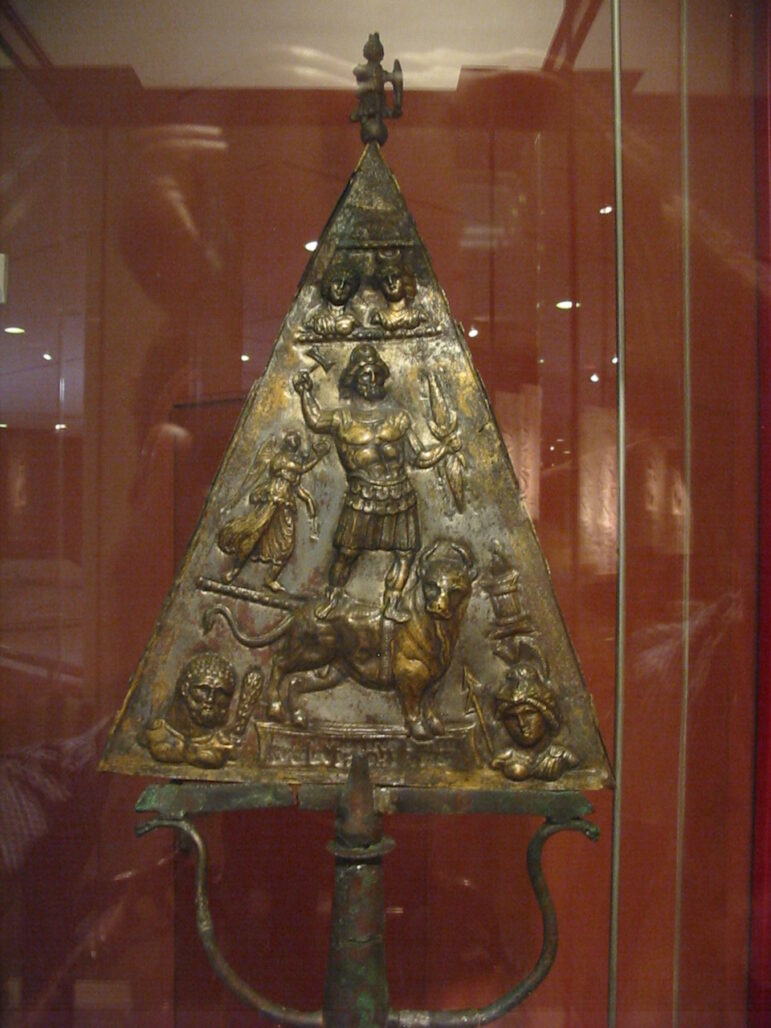
Jupiter Dolichenus bronze plaque from Lussonium (Dunakömlőd), Hungary. Hungarian National Museum, Budapest. [Public domain
The cult was especially popular among Roman soldiers, officers, and merchants. As military units moved throughout the empire, they carried the worship of Jupiter Dolichenus far beyond its origins in Commagene. Temples and altars dedicated to the deity have been unearthed in Rome, Germany, Romania, Hungary, and even along the empire’s northern frontier at Hadrian’s Wall. Although dedications have been found across much of the Roman world, evidence from the eastern Black Sea region has remained comparatively scarce.
Researchers say the Apsaros plaque is significant not simply because it is made of gold but because it provides the first direct written evidence that the cult had reached one of Rome’s eastern frontier forts.
The inscription also gives the discovery a rare human dimension. Thrasymedes was an uncommon name during the Roman period, and little is known about the donor’s identity. His place of origin, military rank, and role within the fort remain unknown. Nevertheless, the inscription preserves the name of an individual whose costly offering reflects personal devotion and suggests the presence of people with Greek cultural backgrounds within the fort’s diverse military population.
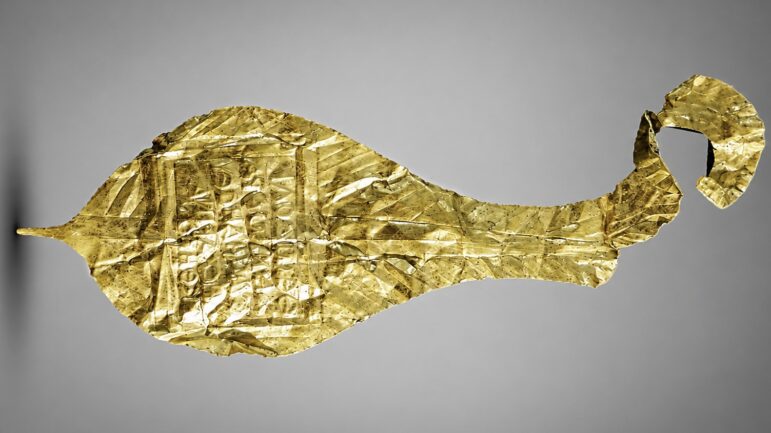
The gold plaque via the Polish Centre of Mediterranean Archaeology, University of Warsaw
The possibility that Jupiter Dolichenus was worshipped in a dedicated sanctuary at Apsaros has also gained new support. Near the plaque’s discovery site, archaeologists recovered a bronze figurine depicting an eagle perched upon a bull, imagery closely associated with the deity. While no temple or shrine has yet been conclusively identified, the combination of finds suggests that a designated place of worship may once have existed within the fort.
Known today as Gonio, Apsaros occupies a commanding position near the mouth of the Chorokhi River, approximately 15 kilometers (9 miles) south of Batumi. Established during the first century CE, the fort guarded an important route linking the Black Sea coast with the interior of the Caucasus.
The site is well known from the writings of Roman authors, including Arrian, who visited Apsaros during the second century and reported that five military cohorts were stationed there. He described inspecting the soldiers, fortifications, armaments, and supplies, providing one of the most detailed contemporary accounts of the garrison. Despite the fort’s historical prominence, inscriptions from the site have been exceptionally rare, making the new discovery particularly valuable.
Beyond documenting the presence of a military cult, the plaque also illustrates the cultural diversity of Rome’s eastern frontier. Apsaros stood at the crossroads of Roman, local Caucasian, and eastern Mediterranean traditions, and the inscription highlights the movement of religious ideas alongside soldiers, merchants, and administrators across the empire.
The find is extraordinary not only for what it reveals about Roman religion, but also for the individual voice it restores. Two millennia after Thrasymedes commissioned his offering, his brief dedication provides the first direct evidence that worship of Jupiter Dolichenus reached one of the empire’s most important military garrisons on the eastern Black Sea.
The Wild Hunt is not responsible for links to external content.
To join a conversation on this post:
Visit our The Wild Hunt subreddit! Point your favorite browser to https://www.reddit.com/r/The_Wild_Hunt_News/, then click “JOIN”. Make sure to click the bell, too, to be notified of new articles posted to our subreddit.